
Exchange 4B
Overview
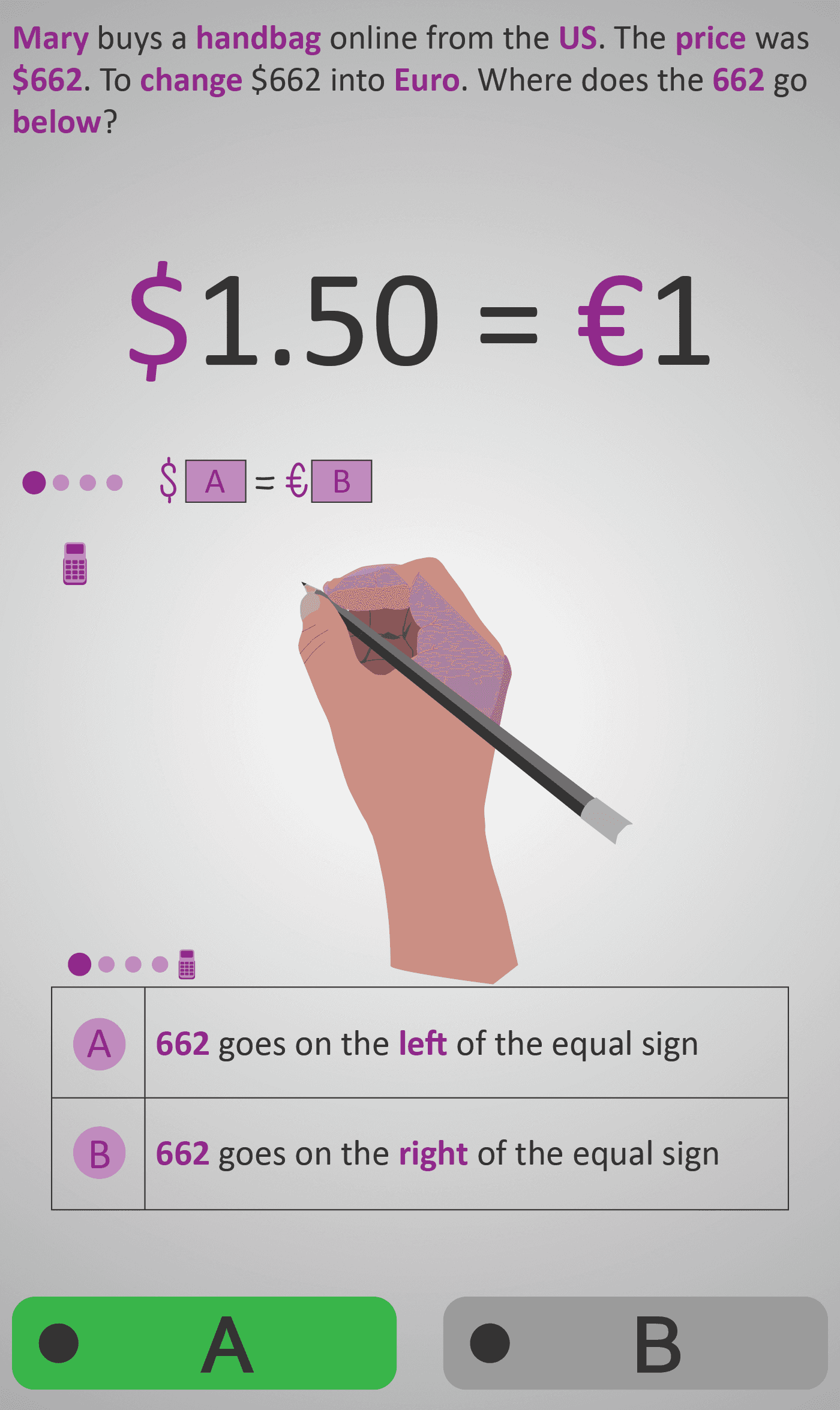
In this Phlow, learners convert $662 → € ? using the exchange rate $1.50 = €1. The sequence begins by placing the known value ($662) in the correct position, then exploring the key conceptual decision — should we multiply or divide?
By reasoning that €1 equals fewer dollars, learners deduce that converting from Dollars back to Euro requires dividing by 1.50: $662 ÷ 1.50 = €441.33.
Each screen isolates one micro-step — identifying the currency direction, choosing the operation, confirming the divisor, then performing the calculation. This approach deepens conceptual understanding of inverse proportional relationships while reinforcing calculator fluency.
Worked Example
- Exchange rate: $1.50 = €1
- To convert $662 → € ?
- Divide $662 by 1.50 → €441.33
- Interpretation: You’ll receive €441.33 for $662.
Sample Questions
- Convert $300 to Euro when $1.50 = €1
- Convert $1,200 to Euro when $1.20 = €1
- Why do we divide instead of multiply when converting from USD to EUR?
- How would you estimate whether your answer seems reasonable?
By the end, students can confidently determine when to divide or multiply in currency conversions and explain the mathematical reasoning behind each choice.
Prerequisite Knowledge Required
- Exchange 4A – Converting Euro → US Dollars (multiplication)
- Divide (Calculator) 4 – Using division for proportional scaling
- Multiply (Decimal) 4 – Fluency with decimals in financial contexts
Main Category
Arithmetic → Proportion & Applied Division
Estimated Completion Time
Approx. 8–12 seconds per question.
30 questions total → Total time: 4–6 minutes.
Cognitive Load / Step Size
Moderate. This Phlow mirrors Exchange 4A but reverses the operation. Moving from multiplication to division introduces a conceptual shift that demands reasoning, but each screen builds sequentially and clearly.
Language & Literacy Demand
Low to moderate. Short, consistent phrasing (“Do you multiply or divide by…?”) helps all learners. Key vocabulary — divide, multiply, exchange rate — is highlighted in purple to support visual memory.
Clarity & Design
- Equation layout reversed ($ = €) to reinforce concept of directionality.
- Purple highlighting for the active operation and divisor.
- Animated handwriting shows correct calculator entry.
- Clean, uncluttered visuals support focus on proportional reasoning.
Curriculum Alignment (ROI Junior Cycle Mathematics)
- Strand: Number
- Strand Units: Operations; Measures (Money)
- Learning Outcomes:
- Convert between currencies using multiplication and division.
- Recognise and apply inverse proportional relationships.
- Use calculator operations appropriately in real-world contexts.
- Explain reasoning behind operation choice in currency conversions.
Engagement & Motivation
High. The real-life context — such as buying online from the US — enhances engagement and ownership. Students gain practical numeracy skills they can use beyond the classroom.
Error Opportunities & Misconceptions
- Multiplying instead of dividing when converting back to Euro.
- Reversing the exchange rate (mixing €1 and $1.50).
- Misplacing the known value ($ amount) on the wrong side of the equation.
- Decimal input or rounding errors on the calculator.
Transferability / Real-World Anchoring
Very strong. Applies to travel, shopping, and budgeting in multiple currencies. Reinforces confidence in interpreting exchange rates and using proportional reasoning in financial contexts.
Conceptual vs Procedural Balance
Balanced, with conceptual emphasis. Students don’t just perform the operation but understand why division reverses the exchange direction. This builds flexible reasoning about ratios and inverses.
Learning Objectives Addressed
- Identify the correct operation (divide) for foreign currency → Euro conversion.
- Apply division accurately using a calculator.
- Represent currency relationships symbolically.
- Use reasoning to check the plausibility of results.
What Your Score Says About You
- Below 20: You may be unsure when to divide or multiply — revisit Exchange 4A.
- 21–29: You understand the logic but may mix up placement of values — practise sequence steps.
- 31–39: Strong understanding — refine your calculator precision and rounding.
- 40 / 40: Excellent — you’ve mastered both directions of currency conversion with full conceptual understanding.