
Factors 4A
Overview
In this Phlow, learners explore common factors of number pairs such as 6 and 8.
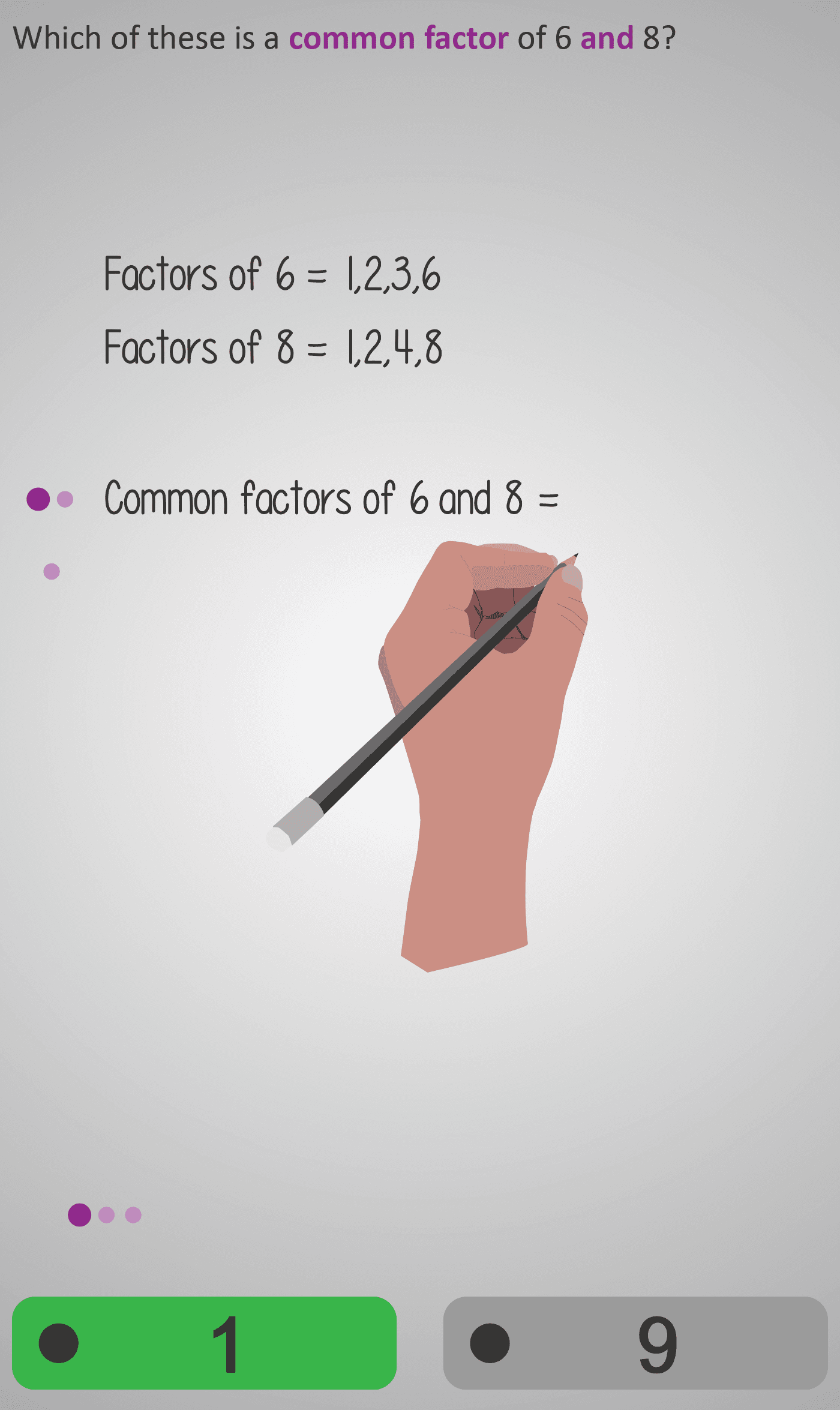
The first screens remind students how to list all factors of each number:
6 = 1, 2, 3, 6 and 8 = 1, 2, 4, 8.
They then identify which numbers appear in both lists — the common factors — and select the highest common factor (HCF). The step-by-step layout visually guides students to spot overlaps, reinforcing how shared divisibility works.
This process forms a foundation for higher-level skills like simplifying fractions, finding equivalent ratios, and algebraic factorisation. The handwriting animation supports reasoning by showing how to build and compare factor lists clearly.
Worked Example
- Find all factors of 6 → 1, 2, 3, 6
- Find all factors of 8 → 1, 2, 4, 8
- Identify common factors → 1 and 2
- Highest Common Factor (HCF) = 2
Sample Questions
- What are the common factors of 12 and 18?
- Which number is the HCF of 15 and 20?
- How can you check that 4 is a factor of 8?
- What’s the difference between a factor and a multiple?
By the end, students can list, compare, and interpret factor sets accurately, explaining why certain numbers divide evenly into others.
Prerequisite Knowledge Required
- Multiples 3 – Understanding repeated addition and multiplication patterns
- Division Facts 3 – Recognising which numbers divide evenly into others
- Prime Numbers 3 – Differentiating between prime and composite numbers
Main Category
Number → Factors & Multiples
Estimated Completion Time
Approx. 8–12 seconds per question.
30 questions total → Total time: 4–6 minutes.
Cognitive Load / Step Size
Low to moderate. Each step isolates one reasoning action: list factors → compare → identify HCF. This sequence supports clarity and deepens understanding of shared divisibility without cognitive overload.
Language & Literacy Demand
Low. Simple prompts and consistent wording (“Which of these is a common factor?”) make the activity accessible. Key terms — factors, common, highest common factor — are highlighted visually to reinforce meaning.
Clarity & Design
- Handwriting animation illustrates factor listing and overlap clearly.
- Black numbers and purple prompts separate data from instructions.
- Clean, consistent layout without distractions supports visual reasoning.
Curriculum Alignment (ROI Junior Cycle Mathematics)
- Strand: Number
- Strand Units: Operations; Number Theory
- Learning Outcomes:
- Identify all factors of a given number.
- Determine common factors between two numbers.
- Recognise and calculate the highest common factor (HCF).
- Apply factor knowledge in division and simplification tasks.
Engagement & Motivation
Moderate to high. Students enjoy the discovery element — uncovering shared factors feels like solving a puzzle. Immediate feedback reinforces achievement and curiosity in number relationships.
Error Opportunities & Misconceptions
- Confusing factors with multiples.
- Omitting 1 as a factor.
- Assuming all pairs have more than one common factor.
- Choosing the largest number overall instead of the largest shared factor.
Transferability / Real-World Anchoring
Moderate. While abstract, factor knowledge supports practical reasoning like simplifying fractions, dividing items evenly, or scaling recipes — all rooted in proportional thinking.
Conceptual vs Procedural Balance
Conceptually weighted. Students understand why numbers share factors before relying on recall, preparing them for later topics in ratios, algebra, and factorisation.
Learning Objectives Addressed
- List all factors of given numbers accurately.
- Identify shared (common) factors between two numbers.
- Determine and interpret the highest common factor (HCF).
- Understand relationships between factors, multiples, and divisibility.
What Your Score Says About You
- Below 20: You may be confusing factors with multiples — revisit earlier multiplication and division Phlows.
- 21–29: You understand how to list factors but may miss shared ones — review overlap identification.
- 31–39: You compare and identify factors accurately — solid reasoning.
- 40 / 40: Excellent — full mastery of factors and divisibility logic.