
Factors 4B
Overview
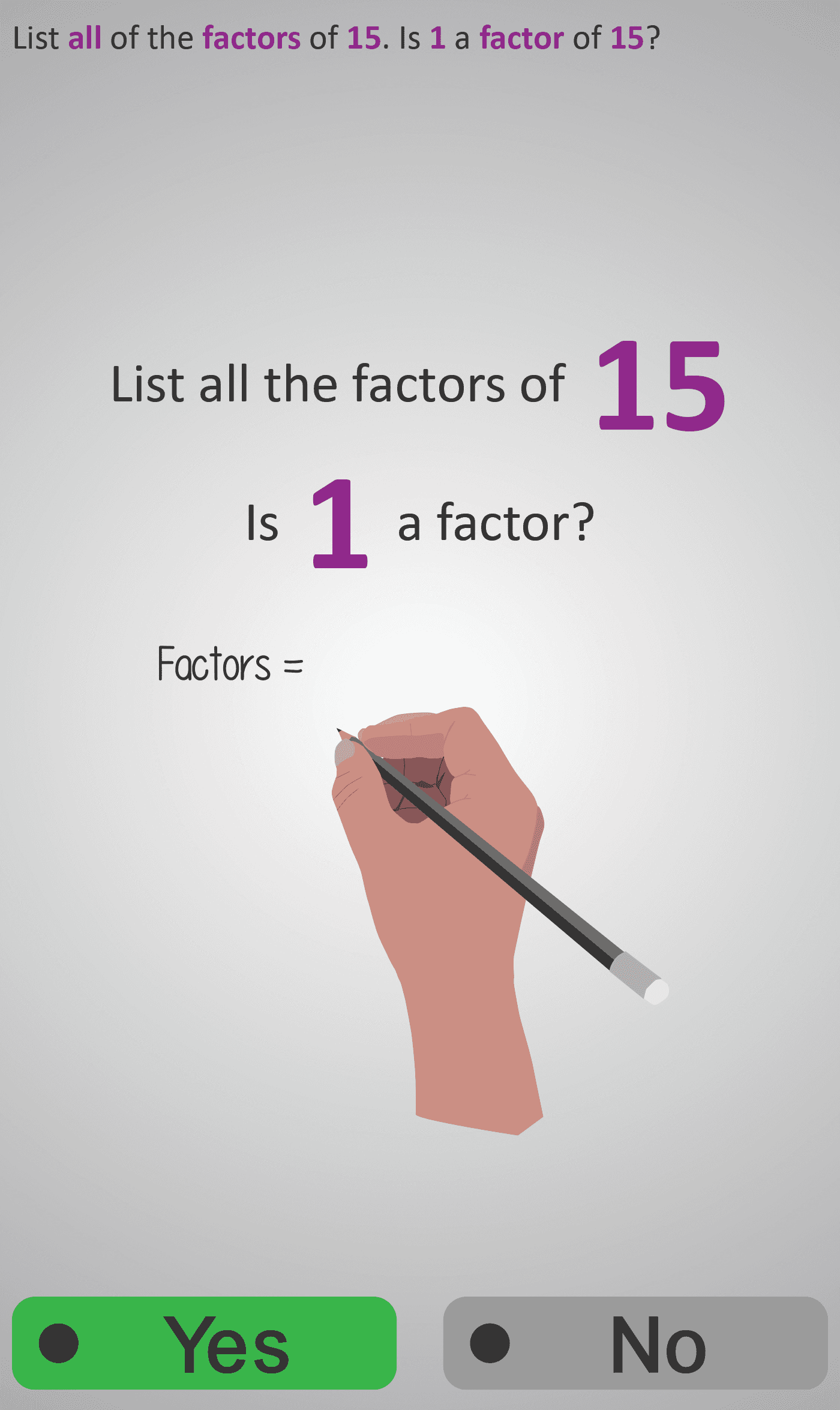
In this Phlow, learners construct a full list of factors for a number — for example, 15. Each step poses a question such as “Is 4 a factor of 15?” Students decide whether it divides exactly, reinforcing the concept that a factor divides a number with no remainder.
The sequence models a systematic reasoning process: start from 1, test each number in order, and continue until the complete list is found — 1, 3, 5, 15. This structured exploration builds procedural fluency while strengthening understanding of what factors truly represent.
Through repetition and immediate feedback, learners gain a reliable method for identifying factors of any number and for explaining why a number “fits” as a factor.
Worked Example
- Target number: 15
- Test divisibility in order: 1, 2, 3, 4, 5, …
- Numbers that divide evenly: 1, 3, 5, 15
- Factor list: 1, 3, 5, 15
Sample Questions
- Is 6 a factor of 18?
- List all factors of 12.
- How can you check if 4 is a factor of 20?
- What happens if a number doesn’t divide evenly?
By completing this Phlow, students develop both accuracy and reasoning when identifying factors — a foundation for later skills like finding the HCF or simplifying fractions.
Prerequisite Knowledge Required
- Division 3 – Understanding what it means to divide “exactly” with no remainder
- Multiplication Facts 3 – Recognising number pairs that multiply to form another number
- Even and Odd Numbers 3 – Knowing divisibility patterns for even vs. odd numbers
Main Category
Number → Factors & Multiples
Estimated Completion Time
Approx. 8–12 seconds per question.
30 questions total → Total time: 4–6 minutes.
Cognitive Load / Step Size
Low. Each screen isolates a single yes/no decision — “Is this a factor?” This simplicity reduces cognitive strain while reinforcing accuracy through repetition.
Language & Literacy Demand
Low. Short, consistent questions such as “Is 4 a factor of 15?” keep reading minimal. Purple highlights and clear numerical focus support accessibility for all learners.
Clarity & Design
- Uniform layout with large centred numbers and minimal text.
- Purple highlights guide focus to divisibility and correctness.
- Animated handwriting builds the factor list dynamically, reinforcing process and memory.
- Predictable rhythm and pacing support focus on mathematical reasoning.
Curriculum Alignment (ROI Junior Cycle Mathematics)
- Strand: Number
- Strand Unit: Number Theory
- Learning Outcomes:
- Identify all factors of a given number.
- Determine whether one number divides exactly into another.
- Recognise the link between multiplication and factors.
- Record complete factor sets systematically.
Engagement & Motivation
Moderate to high. The binary “Yes/No” questioning adds a game-like rhythm that keeps learners engaged. Students experience a growing sense of progress as they build complete lists one step at a time.
Error Opportunities & Misconceptions
- Assuming all smaller numbers are factors automatically.
- Forgetting to include the number itself as a factor.
- Confusing factors with multiples.
- Stopping before completing the full list.
Transferability / Real-World Anchoring
Moderate. Though abstract, factor identification connects to real scenarios like sharing evenly, packaging, and ratio creation. It builds essential foundations for more complex proportional reasoning in daily life.
Conceptual vs Procedural Balance
Procedurally weighted with conceptual reinforcement. Students master the systematic testing process while implicitly deepening understanding of divisibility.
Learning Objectives Addressed
- Define a factor as a number that divides evenly into another.
- Identify all factors of a number through systematic testing.
- Recognise factor pairs and their relationship to multiplication.
- Prepare for advanced topics like HCF, LCM, and prime factorisation.
What Your Score Says About You
- Below 20: You may be guessing — review what “divides evenly” means.
- 21–29: You’re improving — focus on checking all numbers systematically.
- 31–39: You understand factors well but can refine accuracy.
- 40 / 40: Excellent! You can confidently identify and justify all factors of a number.