
Fraction 4B
Overview
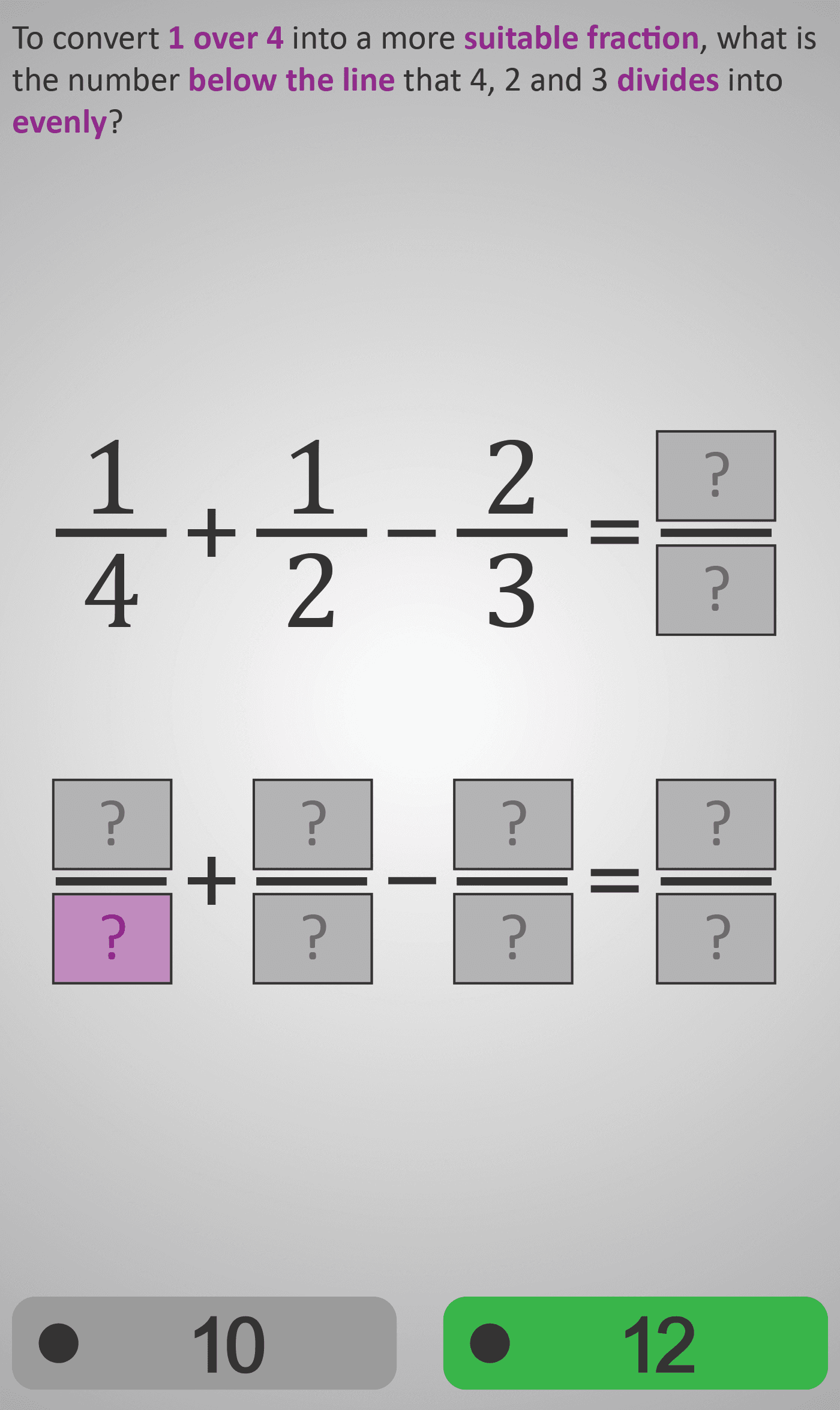
In this Phlow, learners extend their understanding of fraction operations by combining three fractions — ¼ + ½ − ⅔. The sequence guides them to find the lowest common denominator (12), then express each fraction in equivalent form: 3/12 + 6/12 − 8/12.
They learn to align numerators and denominators correctly, performing addition and subtraction across fractions while keeping the denominator constant. Each stage reinforces key reasoning steps — identifying suitable denominators, converting accurately, and sequencing operations carefully.
This structured progression develops procedural fluency and conceptual understanding of equivalent fractions, strengthening both calculation accuracy and logical reasoning when handling multi-fraction expressions.
Worked Example
- Find the least common denominator (LCD) of 4, 2, and 3 → 12.
- Convert each fraction:
- ¼ = 3/12
- ½ = 6/12
- ⅔ = 8/12
- Perform operations: 3/12 + 6/12 − 8/12 = 1/12.
Sample Questions
- What number is under the line when ½ is changed to twelfths?
- How many twelfths equal ¼?
- What is ¼ + ½ − ⅔?
- Why must all denominators be the same before adding or subtracting?
By completing this Phlow, students gain both the conceptual insight and step-by-step reliability needed to manipulate fractions efficiently — laying the groundwork for ratios, percentages, and algebraic fractions.
Prerequisite Knowledge Required
- Fraction 4A – Identifying parts of a whole and understanding numerator/denominator
- Factors 4A – Recognising factors and multiples to determine shared denominators
- LCM 4A – Finding the least common multiple of small numbers
- Addition 3B – Combining like terms accurately with place value awareness
Main Category
Number → Fractions & Proportion
Estimated Completion Time
Approx. 8–12 seconds per question.
30 questions total → Total time: 4–6 minutes.
Cognitive Load / Step Size
Moderate. The Phlow manages complexity by isolating each operation: 1️⃣ Identify denominators → 2️⃣ Convert → 3️⃣ Add/Subtract. The sequencing supports learning through smooth transitions and scaffolding.
Language & Literacy Demand
Moderate. Questions rely on short, repetitive structures (“What over 12 equals 1 over 2?”). Terms like over and under strengthen mathematical language comprehension while keeping focus on numbers and structure.
Clarity & Design
- Dual-layer layout shows both original and converted fractions clearly.
- Purple highlighting emphasises transformation and equivalence.
- Minimalist visuals focus attention on numeric relationships, not decoration.
- Handwriting-style animation reinforces logical flow of calculation.
Curriculum Alignment (ROI Junior Cycle Mathematics)
- Strand: Number
- Strand Unit: Fractions
- Learning Outcomes:
- Convert fractions to equivalent forms with common denominators.
- Add and subtract simple fractions with unlike denominators.
- Use least common multiples to align denominators correctly.
- Recognise that denominators remain constant when numerators are combined.
Engagement & Motivation
High. Students experience frequent, small wins — finding shared denominators, matching equivalent forms, and combining results. These successes sustain motivation and reinforce logical thinking.
Error Opportunities & Misconceptions
- Adding denominators instead of finding a common one.
- Failing to scale numerators when converting.
- Reversing numerator/denominator positions.
- Mismanaging signs when mixing addition and subtraction.
Transferability / Real-World Anchoring
Moderate. The reasoning extends naturally to proportional and measurement problems — such as combining quantities, scaling recipes, or comparing ratios — building algebraic readiness.
Conceptual vs Procedural Balance
Balanced, leaning procedural. While procedural skill is practised, conceptual insight is reinforced through equivalence and transformation visuals.
Learning Objectives Addressed
- Identify and apply least common multiples to align denominators.
- Convert fractions into equivalent forms correctly.
- Add and subtract fractions accurately with unlike denominators.
- Develop structured, sequential reasoning for multi-step fraction problems.
What Your Score Says About You
- Below 20: You may be unsure how denominators affect equivalence — revisit Fraction 4A.
- 21–29: You can find LCMs but may mix up numerator adjustments — focus on consistency.
- 31–39: You demonstrate solid procedural and conceptual understanding.
- 40 / 40: Excellent! You’ve mastered multi-fraction addition and subtraction — great work!