
Fraction 4D
Overview
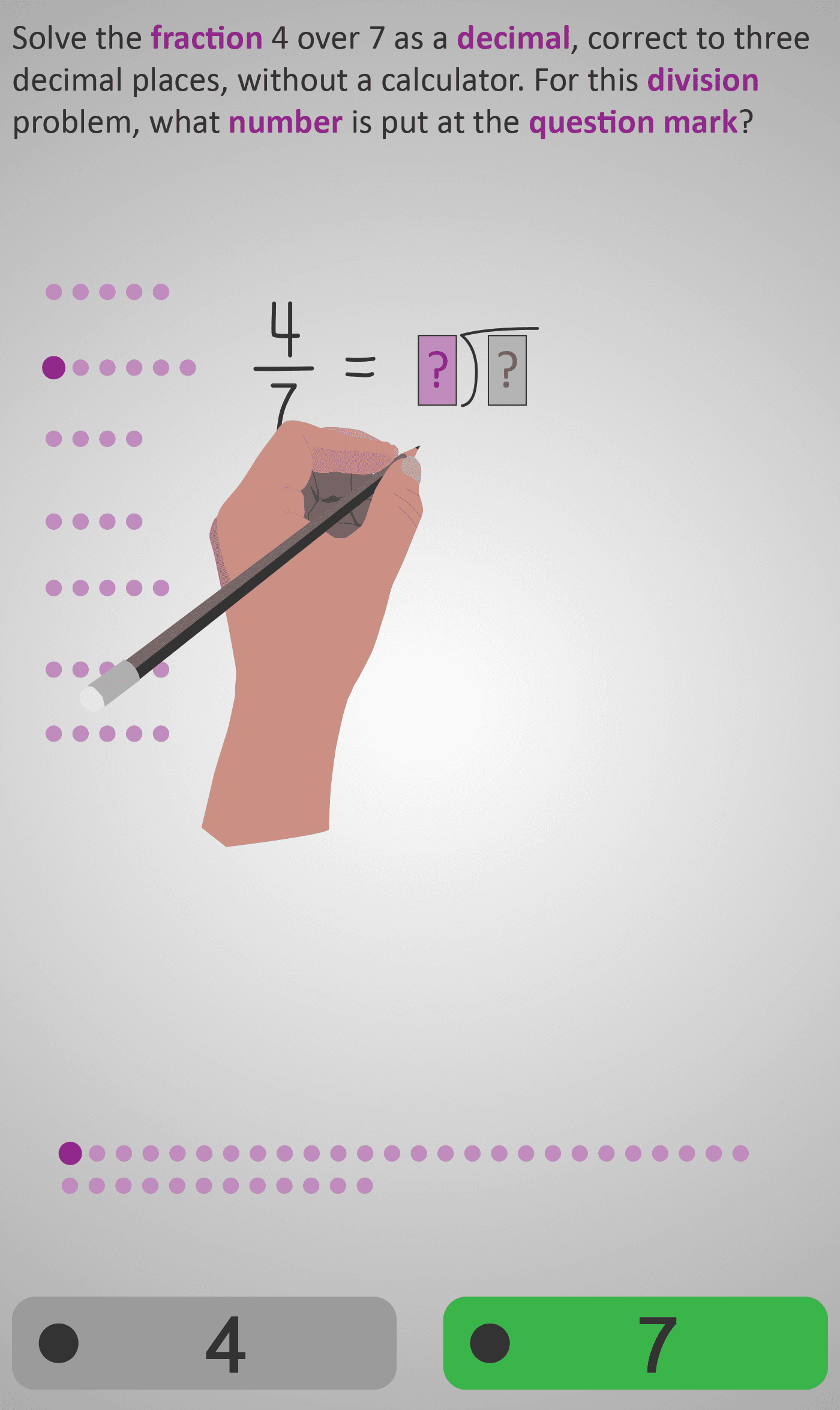
In this Phlow, learners convert a fraction such as 4/7 into its decimal equivalent through a step-by-step long division process. Each screen isolates a single micro-step to ensure clarity and accuracy.
- Set up the division — write 4 ÷ 7.
- Recognise that 7 doesn’t divide into 4, so place a 0 before the decimal point.
- Add a decimal point and bring down a 0 → forming 40 ÷ 7.
- Continue dividing, multiplying, and subtracting until three decimal places are shown (0.571...).
Every step is modelled visually — highlighting decimal placement, remainder management, and digit alignment through clear animations. Learners connect fraction notation with decimal representation, gaining a concrete sense of equivalence.
Worked Example
- Fraction: 4/7
- Division setup: 4 ÷ 7 = 0.
- Add a decimal → 40 ÷ 7 = 5 remainder 5.
- Bring down another 0 → 50 ÷ 7 = 7 remainder 1.
- Continue → 10 ÷ 7 = 1 remainder 3 → Decimal ≈ 0.571...
Sample Questions
- Convert 3/8 to a decimal.
- What is 5 ÷ 8 as a decimal?
- How do you know where to place the decimal point?
- Which digit repeats when converting 4/7?
By completing this Phlow, students develop both procedural fluency and conceptual insight into how division extends beyond whole numbers — a critical foundation for understanding percentages, ratios, and measurement conversions.
Prerequisite Knowledge Required
- Fraction 4C – Finding a fraction of a number using division and multiplication
- Division 4A / 4B – Performing multi-step long division
- Place Value 3C – Understanding the role of the decimal point
- Multiplication Tables (7×) – Recall of multiples to assist with division steps
Main Category
Number → Fractions and Decimals
Estimated Completion Time
Approx. 12–15 seconds per question.
40 questions total → Total time: 8–10 minutes.
Cognitive Load / Step Size
Moderate to high. Each step introduces new reasoning demands — decimal placement, remainders, and digit alignment — but the micro-step pacing and animation reduce intrinsic load, making complex division manageable.
Language & Literacy Demand
Moderate. Phrases like “number below the line,” “bring down a 0,” and “place the decimal” are used consistently. Mathematical logic drives the task more than text, making it accessible but cognitively rich.
Clarity & Design
- Animated pencil shows each calculation step.
- Purple highlights draw focus to decimal placement and active digits.
- Ample spacing in the long-division layout improves visual clarity.
- Every element is instructional — no decorative distractions.
Curriculum Alignment (ROI Junior Cycle Mathematics)
- Strand: Number
- Strand Unit: Fractions, Decimals, and Percentages
- Learning Outcomes:
- Convert fractions to decimals through division.
- Understand and correctly position decimal points.
- Extend division beyond whole numbers into decimals.
- Recognise recurring decimals and their fractional origins.
Engagement & Motivation
High. Learners “follow along” with the animated process, filling in missing digits to stay active. Immediate visual feedback makes each step satisfying and intuitive.
Error Opportunities & Misconceptions
- Forgetting to write 0 before the decimal point.
- Misaligning digits in long-division columns.
- Incorrect decimal placement in the quotient.
- Stopping prematurely when a remainder persists.
Transferability / Real-World Anchoring
Strong. Fraction-to-decimal understanding supports later topics such as percentages, measurement conversions, and interpreting data or financial information.
Conceptual vs Procedural Balance
Balanced. Though procedural in format, each action (“divide”, “multiply”, “subtract”, “bring down”) explicitly connects to conceptual understanding of the decimal system.
Learning Objectives Addressed
- Perform long division to convert fractions into decimals.
- Position decimal points accurately in multi-step division.
- Develop precision and confidence with recurring decimal results.
- Strengthen equivalence understanding between fractions and decimals.
What Your Score Says About You
- Below 20: You may be missing key long-division steps — review decimal placement carefully.
- 21–29: You understand the process but need steadier accuracy handling remainders.
- 31–39: Strong procedural understanding and precision.
- 40 / 40: Excellent mastery — confident, accurate, and fluent in decimal conversions!