
Fraction 4E
Overview
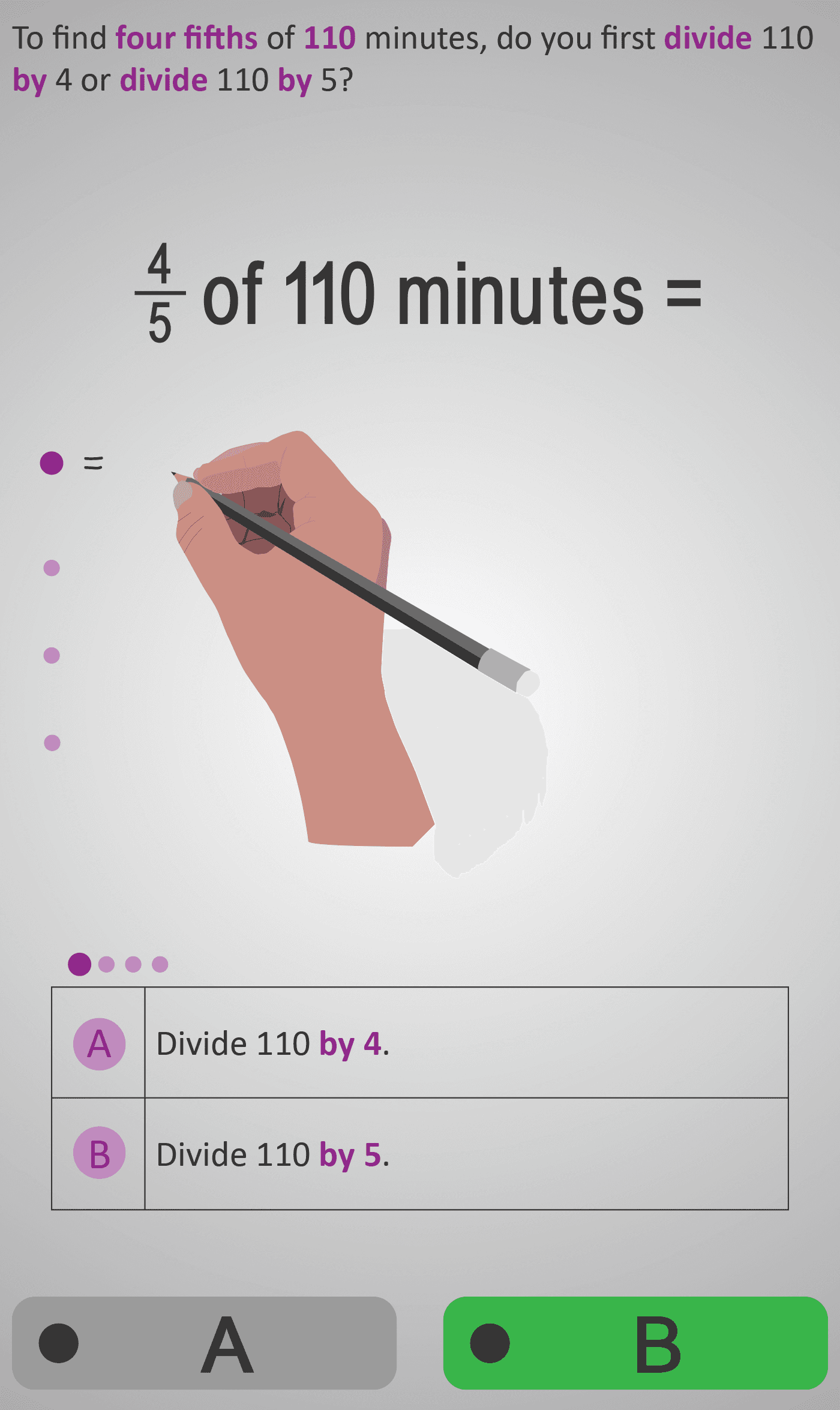
In this Phlow, learners find fractional parts of a total — for example, 4/5 of 110 minutes — by following a clear two-step process:
- Divide the total by the denominator (the number below the line).
- Multiply the result by the numerator (the number above the line).
Example: 4/5 of 110 = (110 ÷ 5) × 4 = 22 × 4 = 88. This reinforces how fractions connect division and multiplication, showing that dividing by the denominator splits the quantity into equal parts, while multiplying by the numerator selects the required number of parts.
Through step-by-step prompts and visuals, students develop both procedural fluency and conceptual clarity. Each question builds on the same logic with new numerical examples, gradually strengthening accuracy and confidence in real-world fraction problems.
Worked Example
- Find 4/5 of 110.
- Step 1: Divide 110 by 5 → 110 ÷ 5 = 22.
- Step 2: Multiply by 4 → 22 × 4 = 88.
- Answer: 4/5 of 110 = 88.
Sample Questions
- Find 2/3 of 60.
- What is 3/4 of 80?
- How many minutes is 5/6 of 120?
- Why do we divide before multiplying?
The repeated two-step sequence encourages automaticity in operation order while maintaining understanding of part–whole relationships fundamental to fraction reasoning.
Prerequisite Knowledge Required
- Understanding of basic fractions (numerator, denominator, and their meanings).
- Knowledge of multiplication and division facts up to 12×12.
- Experience finding one-half, one-third, or one-quarter of a number.
- Awareness that “of” means multiplication in fractional contexts.
Links to previous Phlows:
Fractions 3C – Halves and Thirds,
Fractions 3D – Finding a Fraction of a Number,
Fractions 4D – Fractions as Division.
Main Category
Number → Fractions and Operations
Estimated Completion Time
Approx. 10–14 seconds per question.
40 questions total → Total time: 7–10 minutes.
| Learner Profile | Estimated Time | Description |
|---|---|---|
| One Level Below | 9–10 mins | May need help recalling division/multiplication facts. |
| At Level | 7–8 mins | Performs two-step process with minimal support. |
| One Level Above | 5–6 mins | Applies fluently and checks reasoning independently. |
Cognitive Load / Step Size
Moderate. The two-step process requires sequential reasoning but builds smoothly on previous Phlows. Consistent visuals and colour cues guide learners’ focus, managing working memory demands effectively.
Language & Literacy Demand
Low to moderate. Key mathematical terms (divide, multiply, of, fraction) are supported visually and symbolically. Short, repetitive phrasing reinforces comprehension for all learners.
Clarity & Design
- Colour-coded steps for division (blue) and multiplication (purple) maintain clarity.
- Each question isolates one operation to reduce overload.
- Repetition of the same example across steps supports mastery through familiarity.
- Minimalistic design focuses attention on the logic of the process.
Curriculum Alignment (ROI Junior Cycle Mathematics)
- Strand: Number
- Strand Unit: Fractions – Understanding and Using Fractions
- Learning Outcomes:
- Apply division and multiplication to find a fraction of a given quantity.
- Explain the relationship between fractions, division, and multiplication.
- Interpret “of” as multiplication in fractional contexts.
- Solve contextual problems involving time, measurement, and quantities.
Engagement & Motivation
Moderate to high. The time-based context adds authenticity and relevance. The immediate feedback after each operation builds confidence and sustains engagement.
Error Opportunities & Misconceptions
- Dividing by the numerator instead of the denominator.
- Reversing the operation order (multiplying first).
- Forgetting that “of” means multiply.
- Confusing “part of” with subtraction.
Transferability / Real-World Anchoring
High. The concept applies to real-life contexts such as calculating fractions of time, distance, money, or ingredients. It strengthens proportional reasoning across multiple domains.
Conceptual vs Procedural Balance
Balanced. While repetition builds procedural fluency, clear explanations ensure learners grasp the conceptual link between splitting (division) and selecting (multiplication).
Learning Objectives Addressed
- Find a given fraction of a number using divide → multiply sequence.
- Understand the sequential reasoning behind “divide by denominator, multiply by numerator.”
- Apply fractional reasoning in practical contexts.
- Connect visual and numerical representations of fractions.
What Your Score Says About You
- Below 20: You may be reversing the order — divide first, then multiply.
- 21–29: You understand the method but make small arithmetic slips — review carefully.
- 31–39: Strong understanding and accuracy — consistent reasoning.
- 40 / 40: Excellent fluency — confident in applying fraction operations independently!