
Fraction 4F
Overview
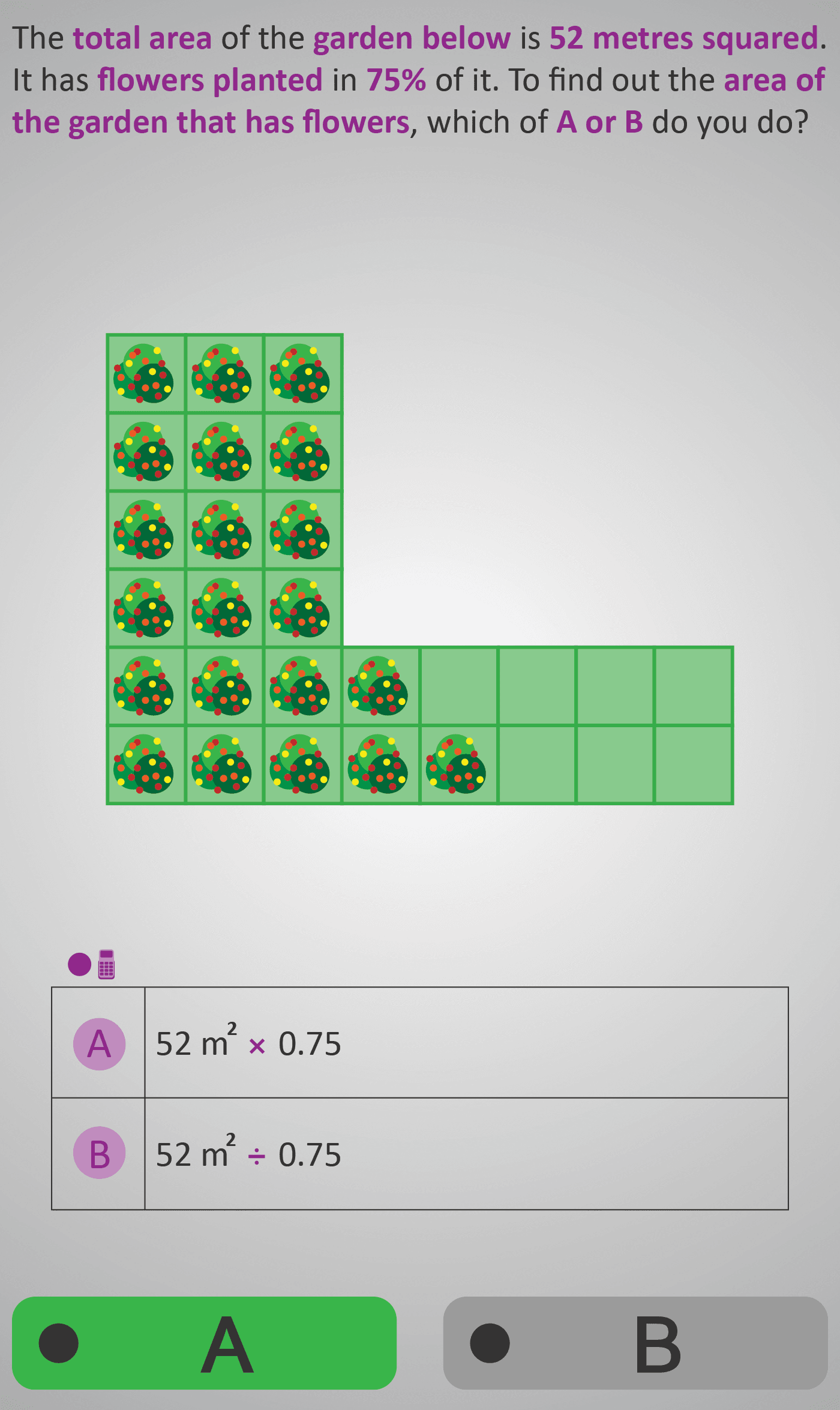
In this Phlow, learners calculate parts of an area — such as the section of a garden planted with flowers — by multiplying by a decimal or percentage. They learn that finding 75% or 40% of a total is equivalent to multiplying by 0.75 or 0.40.
For example: 52 × 0.75 = 39 and 84 × 0.40 = 33.6. This helps learners recognise that multiplying by a number less than 1 gives a smaller total — representing a part of the whole.
Visuals of flowered areas show proportional sections of a grid, reinforcing how percentages and fractions describe parts of a total area. By integrating real-world imagery and calculator use, learners connect abstract fraction-decimal relationships with concrete, everyday understanding.
Worked Example
- Find 75% of 52.
- Convert percentage to decimal → 75% = 0.75.
- Multiply → 52 × 0.75 = 39.
- Answer: 75% of 52 = 39.
Sample Questions
- Find 40% of 84.
- What is 0.6 of 90?
- Convert 25% to a decimal and find 25% of 64.
- Explain why multiplying by 0.4 gives a smaller result than the original total.
The Phlow bridges conceptual understanding (percentages, fractions, decimals) with procedural accuracy (multiplying by decimal form), reinforcing both representation and calculation in a clear, real-world framework.
Prerequisite Knowledge Required
- Understanding that ½ = 0.5 = 50% and related equivalences.
- Ability to multiply whole numbers and decimals accurately.
- Familiarity with calculator use for verification.
- Recognition that multiplying by a number less than 1 produces a smaller result.
Links to previous Phlows:
Fractions 4D – Fractions as Division,
Fractions 4E – Finding a Fraction of a Quantity,
Decimals 3C – Understanding Tenths and Hundredths.
Main Category
Number → Fractions, Decimals, and Percentages
Estimated Completion Time
Approx. 10–14 seconds per question.
40 questions total → Total time: 7–10 minutes.
| Learner Profile | Estimated Time | Description |
|---|---|---|
| One Level Below | 9–10 mins | May need reminders to convert % to decimal before multiplying. |
| At Level | 7–8 mins | Completes decimal multiplications with moderate confidence and calculator support. |
| One Level Above | 5–6 mins | Fluent in converting between fractions, decimals, and percentages. |
Cognitive Load / Step Size
Moderate. Each question builds on the same logic — identify the percentage, convert to decimal, then multiply. The consistent “garden area” context reduces extraneous load and keeps learners in flow.
Language & Literacy Demand
Low to moderate. Terms like “area”, “fraction”, and “percentage” are visually supported and colour-coded. The language load is light, letting learners focus on number reasoning.
Clarity & Design
- Grid-based visuals clearly show proportions of an area (flowers vs. blanks).
- Consistent step structure: identify → convert → multiply.
- Calculator icons reinforce digital fluency and accuracy.
- All screens are uncluttered, focusing attention on the relationship between total and part.
Curriculum Alignment (ROI Junior Cycle Mathematics)
- Strand: Number
- Strand Unit: Fractions, Decimals, and Percentages – Applying Relationships
- Learning Outcomes:
- Represent fractions, decimals, and percentages as equivalent forms.
- Multiply quantities by decimals to find proportional parts.
- Use percentages to calculate real-world proportions and areas.
- Check reasonableness of results using estimation and calculators.
Engagement & Motivation
High. Relatable, visually rich tasks (gardens and areas) make abstract concepts concrete. Visual patterning sustains attention while reinforcing proportion.
Error Opportunities & Misconceptions
- Multiplying instead of dividing or vice versa.
- Writing 75% as 75 instead of 0.75.
- Incorrect decimal input on calculators.
- Assuming multiplying by a decimal increases the total.
Transferability / Real-World Anchoring
Very strong. Skills extend to shopping discounts, budgeting, measurement conversions, and interpreting data in charts and infographics.
Conceptual vs Procedural Balance
Balanced leaning conceptual. Learners practise decimal multiplication but also understand why multiplying by decimals less than 1 reduces a total. Visual anchoring connects symbolic to real-world meaning.
Learning Objectives Addressed
- Convert between fractions, decimals, and percentages accurately.
- Multiply quantities by decimals to find parts of a whole.
- Interpret results in applied contexts (e.g. area, proportion, data).
- Check and explain results using reasoning and calculator verification.
What Your Score Says About You
- Below 20: You may be mixing up multiplication/division — review decimal conversion rules.
- 21–29: You understand the concept but sometimes mis-enter decimals — double-check calculator use.
- 31–39: Strong conceptual and procedural fluency — accurate and consistent.
- 40 / 40: Excellent mastery — confident applying decimals and percentages to real-world problems!