
Functions 4A
Overview
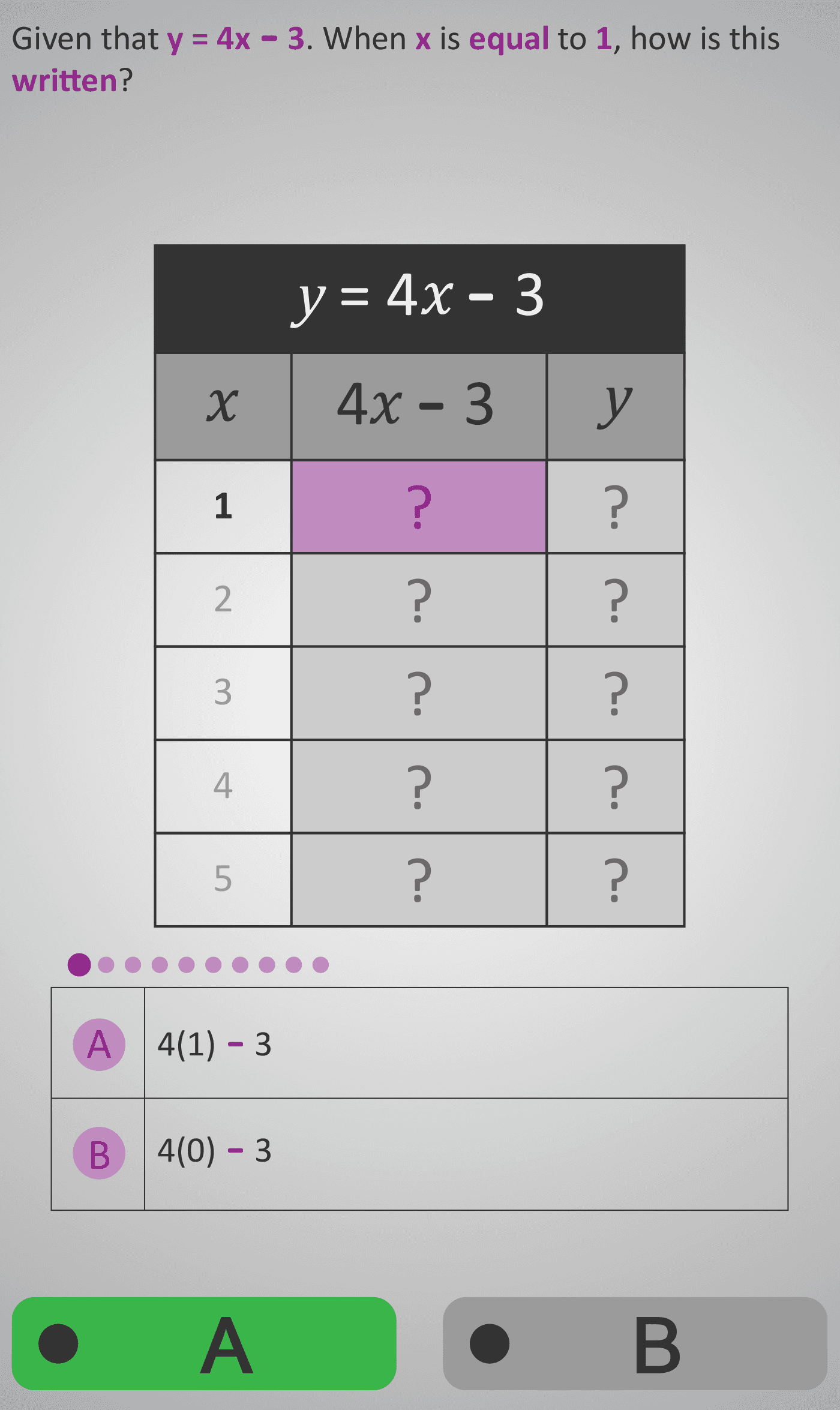
In this Phlow, learners evaluate a linear function by substituting values of x into a rule to find y. Using y = 4x − 3, they replace x with numbers from a table (1, 2, 3, 4, 5), compute 4x − 3, and record y.
Worked Example
Function: y = 4x − 3
| x | Substitute | y |
|---|---|---|
| 1 | 4(1) − 3 | 1 |
| 2 | 4(2) − 3 | 5 |
| 3 | 4(3) − 3 | 9 |
| 4 | 4(4) − 3 | 13 |
| 5 | 4(5) − 3 | 17 |
Each question isolates a single step: write the substituted expression (e.g., 4(2) − 3), then evaluate to get y.
Patterns emerge: as x increases by 1, y increases by 4.
Sample Prompts
- When x = 7, what is y in y = 4x − 3?
- Complete the table for x = 0, 1, 2, 3.
- Which expression correctly substitutes x = 5? (A) 4 + 5 − 3 (B) 4(5) − 3
- Does y go up or down when x increases? By how much each time?
Why This Matters
Substitution connects arithmetic and algebra. It prepares learners for graphing straight lines, rates of change, and solving linear equations.
Prerequisite Knowledge Required
- Basic operations: multiplication before subtraction (order of operations).
- Algebraic notation: letters represent numbers; 4x means 4 × x.
- Evaluating simple expressions step-by-step.
Linked Phlows: Expressions 3C – Using Letters for Numbers · Patterns 3D – Simple Sequences · Substitution 3E – Replacing Numbers in Formulas
Main Category
Algebra → Functions and Relationships
Estimated Completion Time
Approx. 10–14 seconds per question. 40 questions total. Total time: 7–10 minutes.
| Learner Profile | Estimated Time | Description |
|---|---|---|
| One Level Below | 9–10 mins | May need support with operation order and reading 4x as multiply. |
| At Level | 7–8 mins | Follows the rule consistently; minor calculation slips possible. |
| One Level Above | 5–6 mins | Fluent; recognises the pattern and predicts outputs mentally. |
Cognitive Load / Step Size
Moderate and well-sequenced. Each screen focuses on one action—substitute, then evaluate—keeping working memory free for accuracy.
Language & Literacy Demand
Low. Short, action-based prompts (e.g., “When x = 3, find y”). Key terms are highlighted for clarity.
Clarity & Design
- Function table shows input→output clearly.
- Purple highlights track the substituted value through the calculation.
- Consistent layout mirrors textbook forms but adds interactive feedback.
Curriculum Alignment (ROI Junior Cycle Mathematics)
- Strand: Algebra
- Learning Outcomes:
- Substitute numerical values into expressions and formulae.
- Understand a function as a rule linking two variables.
- Recognise and describe how changes in x affect y (rate/pattern).
Engagement & Motivation
High. Immediate feedback and visible patterns in the table build confidence and curiosity.
Error Opportunities & Misconceptions
- Reading 4x as “add 4” instead of “multiply by 4”.
- Doing subtraction before multiplication.
- Copying a previous y into the next row.
- Dropping the negative sign in −3.
Transferability / Real-World Anchoring
Supports modelling linear relationships (e.g., cost vs. quantity, distance vs. time) and later graphing.
Conceptual vs Procedural Balance
Balanced. Repeated procedure (substitute → evaluate) reinforces the concept that y depends on x via a rule.
Learning Objectives Addressed
- Accurately substitute values into a function.
- Evaluate linear expressions using correct operation order.
- Complete and interpret a function table.
- Describe the pattern/rate linking x and y.
What Your Score Says About You
- Less than 20: Revisit substitution order—replace x first, then calculate.
- 21–29: Understands the rule; check arithmetic accuracy.
- 31–39: Strong, consistent substitution and pattern recognition.
- 40 / 40: Excellent fluency—ready for graphing and solving linear equations.