
Gross Pay 4A
Overview
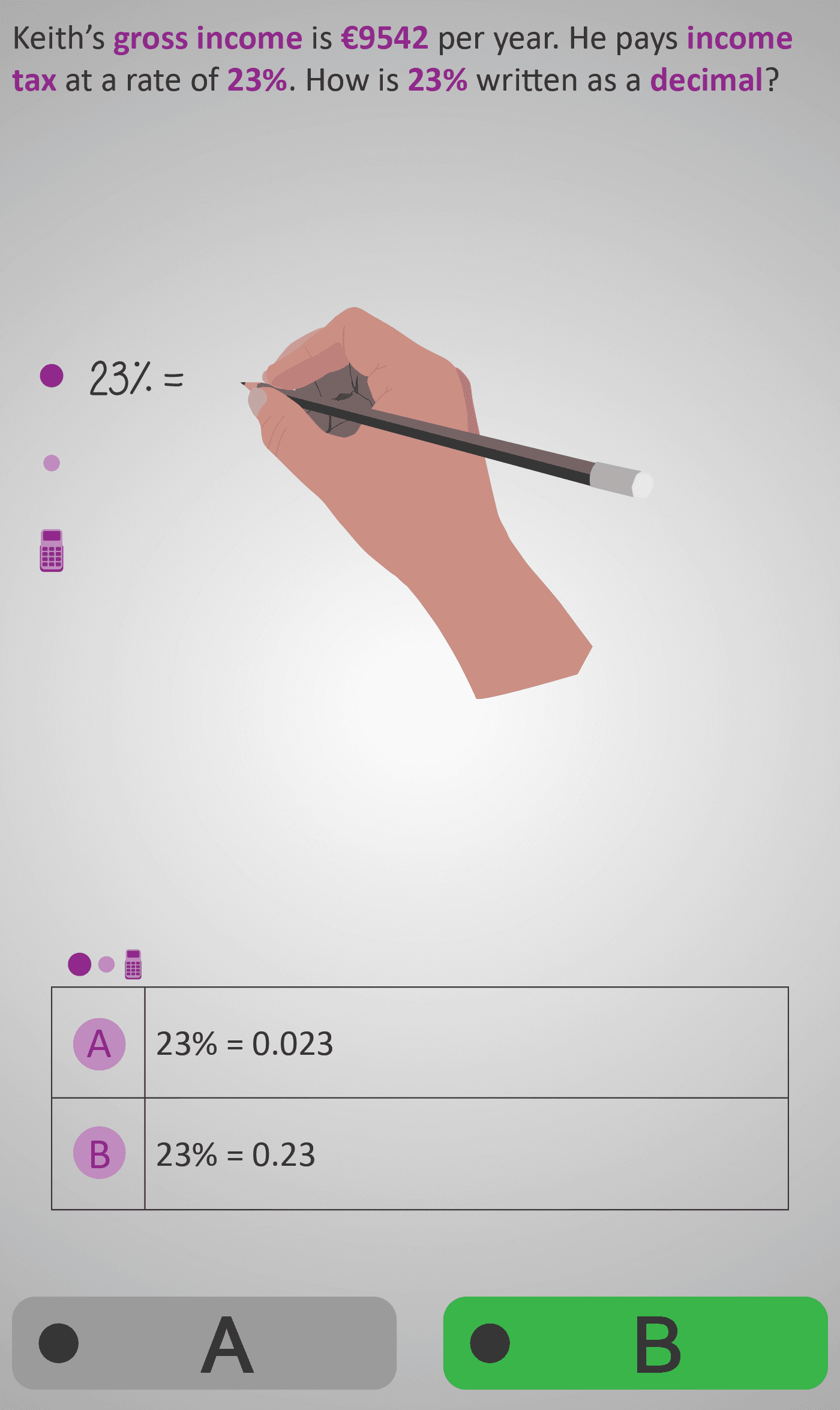
In this Phlow, learners explore how income tax is calculated from a person’s gross income. The process begins by converting a tax rate (e.g. 23%) into its decimal equivalent (0.23) and multiplying it by the annual salary to determine the total tax owed.
Each screen walks students through the sequence step-by-step — first converting the percentage, then choosing the correct operation (multiply vs. divide), and finally confirming the result using a calculator. This methodical structure reinforces the concept that multiplying by a decimal represents finding a portion of a total.
The Phlow’s realistic scenario — Keith calculating his annual income tax — bridges mathematical skill and financial literacy. Students gain confidence understanding how numbers affect real-world earnings and deductions.
Worked Example
Example: Keith earns €38,000 per year and is taxed at 23%.
      Step 1: Convert 23% → 0.23
      Step 2: Multiply 38,000 × 0.23 = 8,740
Total tax owed = €8,740
Learners then reflect: if the tax rate increased or decreased, how would the total change? This helps them internalise proportional reasoning in a practical context.
Sample Prompts
- Convert 23% to a decimal.
- Do you multiply or divide to find 23% of €38,000?
- Calculate the tax owed on €42,500 at 20%.
- What is the difference between gross pay and tax amount?
Why This Matters
Understanding how percentages translate to money empowers students to make sense of payslips, savings, discounts, and interest rates. This Phlow introduces financial numeracy — essential for adult independence and informed decision-making.
Prerequisite Knowledge Required
- Understanding of place value and decimal notation.
- Knowledge of converting percentages to decimals (divide by 100).
- Familiarity with multiplication using decimals.
- Experience using a calculator for verification.
Linked Phlows:
Fractions 3E – Fractions, Decimals, and Percentages,
Division & Multiplication 4 – Choosing the Correct Operation,
Money 3C – Applying Arithmetic to Financial Contexts.
Main Category
Arithmetic → Percentages and Real-Life Applications
Estimated Completion Time
Approx. 10–14 seconds per question.
40 questions total → Total time: 7–10 minutes.
| Learner Profile | Estimated Time | Description |
|---|---|---|
| One Level Below | 9–10 mins | May need extra support converting percentages or identifying correct operation. |
| At Level | 7–8 mins | Understands conversion and multiplication links with growing fluency. |
| One Level Above | 5–6 mins | Works fluently and interprets results confidently without calculator reliance. |
Cognitive Load / Step Size
Low to moderate. Each stage (convert → choose operation → calculate) is isolated, promoting automaticity without overload. Repetition builds fluency and reduces working memory demand.
Language & Literacy Demand
Moderate. Contextual terms like gross income and tax rate are highlighted and explained through visuals. Students focus on numerical reasoning while building financial vocabulary.
Clarity & Design
- Step-by-step structure with handwriting animation for realism.
- Calculator icon cues signal when digital computation is expected.
- Realistic euro symbols and layout reinforce authenticity and comprehension.
Curriculum Alignment (ROI Junior Cycle Mathematics)
- Strand: Number
- Strand Unit: Percentages and Real-World Applications
- Learning Outcomes:
- Express percentages as decimals and fractions.
- Solve problems involving percentages of quantities.
- Apply percentage reasoning to income, expenditure, and tax.
- Use calculators accurately for financial calculations.
Engagement & Motivation
High. The context feels meaningful — students see how maths directly affects real life. The clear logic and relatable scenario encourage curiosity about their own earnings and deductions.
Error Opportunities & Misconceptions
- Converting 23% incorrectly as 0.023 instead of 0.23.
- Dividing instead of multiplying to find a percentage of a total.
- Rounding prematurely or entering incorrect decimals on calculator.
- Confusing “gross” with “net” income.
Transferability / Real-World Anchoring
Very high. The skill extends to discounts, commissions, and interest — empowering learners to interpret financial information confidently in everyday life.
Conceptual vs Procedural Balance
Balanced (procedural leaning). The focus is on repeated practice with context-based reasoning to reinforce why multiplication by a decimal finds a percentage of a total.
Learning Objectives Addressed
- Convert percentages to decimals accurately.
- Multiply totals by decimal rates to calculate tax.
- Interpret and verify results within financial contexts.
- Distinguish between gross income and tax deduction.
What Your Score Says About You
- Less than 20: Review how to convert percentages and when to multiply or divide.
- 21–29: You understand the concept but may misplace decimal points — slow down and check inputs.
- 31–39: Excellent procedural accuracy — confident with financial reasoning.
- 40 / 40: Outstanding — full mastery of percentage–decimal conversions and real-world application.