
Gross Pay 4B
Overview
In this Phlow, learners calculate net income — the amount a person takes home after tax deductions —
by applying the relationship:
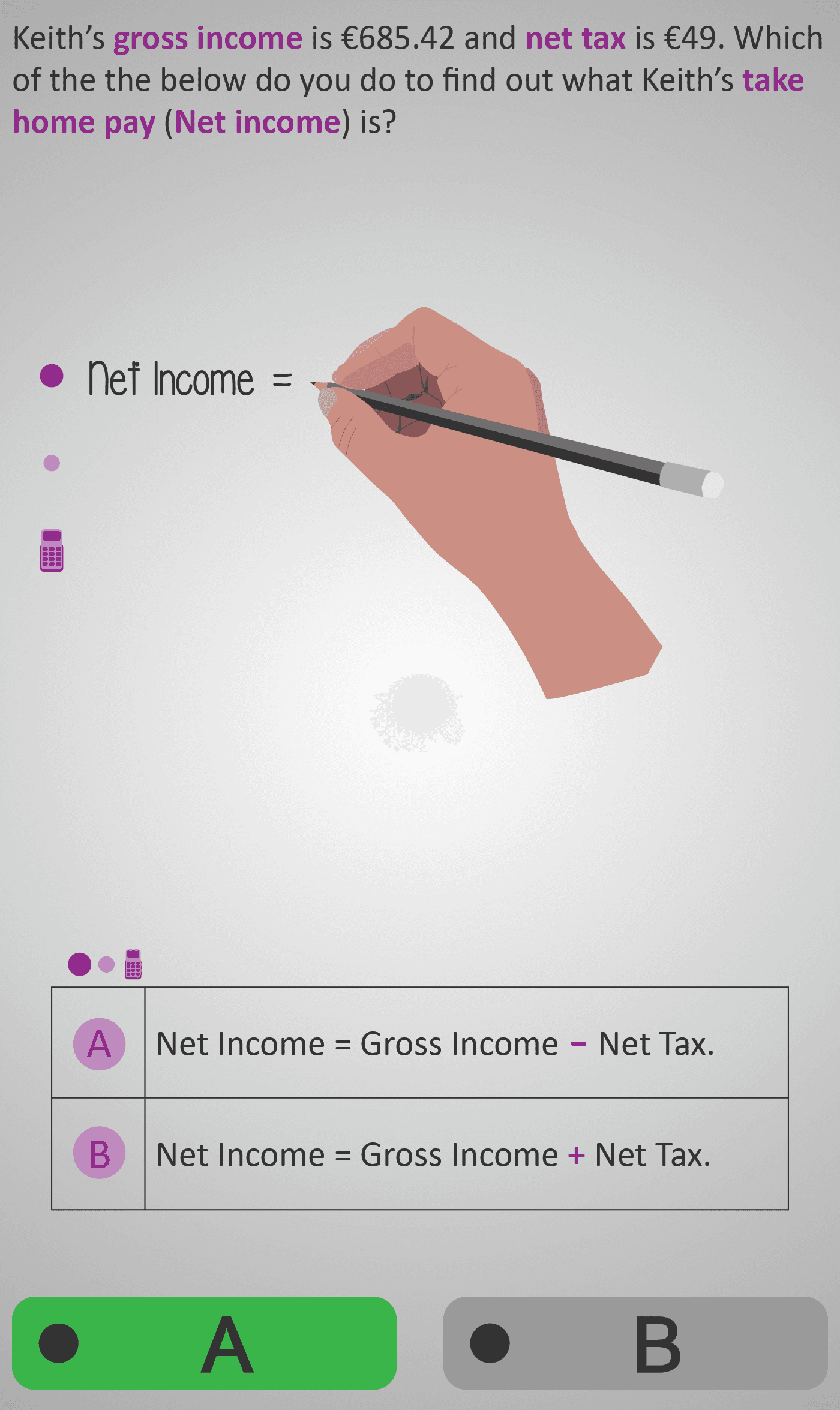
Net Income = Gross Income – Net Tax.
Students identify the correct operation (subtraction) and then apply it to realistic money examples, such as €685.42 – €49. Through step-by-step visual guidance, they see how subtraction represents “taking away” or “deducting,” connecting arithmetic operations with real-life financial meaning.
The Phlow reinforces the concept of net vs. gross pay, showing that gross is before deductions and net is after deductions. Learners also practise verifying results using a calculator, developing accuracy and confidence in personal finance contexts like pay slips and budgeting.
Worked Example
Example: Keith’s gross income is €685.42 and his tax is €49.
      Step 1: Identify operation → Subtraction
      Step 2: €685.42 – €49 = €636.42
Net income = €636.42
This reinforces the logic of deductions — tax reduces what’s left to take home, so subtraction represents that change numerically and conceptually.
Sample Prompts
- Which operation would you use to find take-home pay?
- Subtract €49 from €685.42 — what is the result?
- What does “net” mean in the context of income?
- How can you check your calculation using a calculator?
Why This Matters
Understanding deductions and net income helps students make sense of real-world financial systems like tax, wages, and savings. By connecting subtraction to everyday contexts, learners see mathematics as a tool for independence and informed money management.
Prerequisite Knowledge Required
- Fluency with addition and subtraction involving decimals.
- Understanding of gross and net income concepts.
- Familiarity with using a calculator to check results.
- Recognition that subtraction means “taking away” or “deducting.”
Linked Phlows:
Gross Pay 4A – Calculating Tax from Income,
Division & Multiplication 4 – Operation Selection,
Money 3B–3C – Working with Euro Values.
Main Category
Arithmetic → Money and Real-World Calculations
Estimated Completion Time
Approx. 10–14 seconds per question.
40 questions total → Total time: 7–10 minutes.
| Learner Profile | Estimated Time | Description |
|---|---|---|
| One Level Below | 9–10 mins | May hesitate on operation choice or misread decimals. |
| At Level | 7–8 mins | Applies subtraction accurately and verifies results confidently. |
| One Level Above | 5–6 mins | Quickly interprets financial context and solves mentally. |
Cognitive Load / Step Size
Low. Each task focuses on a single cognitive action — identifying the operation, applying subtraction, or checking results. Visual and contextual cues minimise extraneous load, supporting comprehension through familiarity.
Language & Literacy Demand
Low to moderate. Text is brief, supported by colour-coded euro amounts. Keywords like gross income, net income, and tax are highlighted in purple, helping students link terms to meaning visually.
Clarity & Design
- Realistic euro examples support relevance.
- Calculator icons indicate computational steps.
- Consistent handwriting animation reinforces stepwise reasoning.
- Minimal interface maintains focus on operation meaning.
Curriculum Alignment (ROI Junior Cycle Mathematics)
- Strand: Number
- Strand Unit: Money and Real-Life Problem Solving
- Learning Outcomes:
- Subtract one money amount from another to find differences.
- Interpret and calculate net amounts after deductions.
- Apply arithmetic reasoning to everyday financial contexts.
- Use calculators to check accuracy and reasonableness.
Engagement & Motivation
High. The relatable example of take-home pay strengthens intrinsic motivation and shows how maths applies directly to life decisions and financial understanding.
Error Opportunities & Misconceptions
- Adding instead of subtracting to find net income.
- Misaligning decimal places during calculation.
- Mixing up definitions of net and gross.
- Assuming tax is added rather than deducted.
Transferability / Real-World Anchoring
Very high. Skills directly apply to reading pay slips, managing budgets, and interpreting receipts. Learners connect arithmetic reasoning to real financial behaviour.
Conceptual vs Procedural Balance
Balanced (conceptual emphasis). Students not only practise subtraction but internalise why it represents take-home pay after deductions.
Learning Objectives Addressed
- Identify subtraction as the correct operation for finding net income.
- Subtract tax or deductions from gross income accurately.
- Check and interpret take-home pay results using a calculator.
- Link arithmetic meaningfully to personal finance and budgeting.
What Your Score Says About You
- Less than 20: Review when to use subtraction for financial contexts.
- 21–29: Good progress — revise definitions of gross vs. net.
- 31–39: Strong procedural and conceptual understanding — confident with context.
- 40 / 40: Excellent mastery — fluent and accurate in financial reasoning and application.