
Gross Pay 4C
Overview
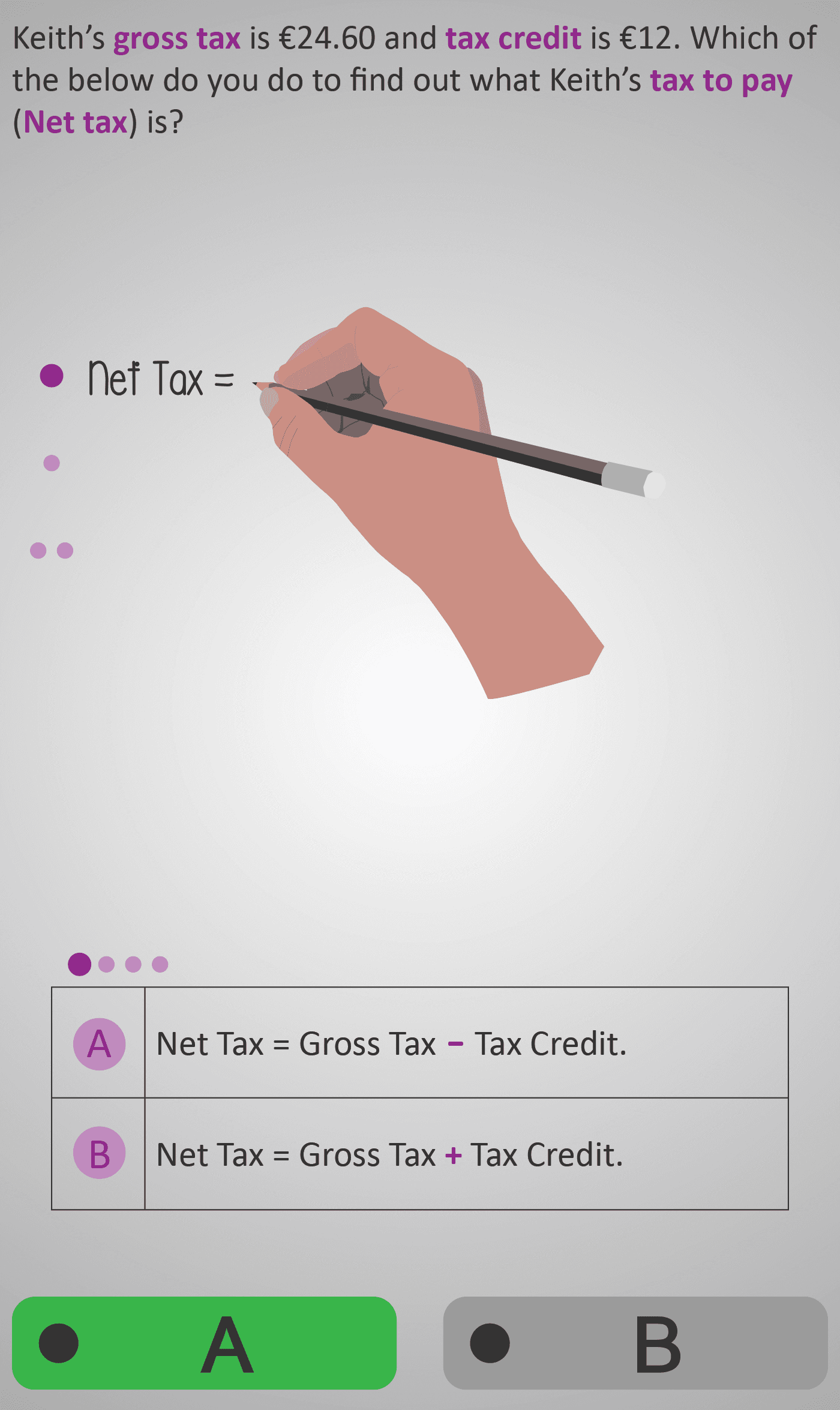
In this Phlow, learners determine net tax — the amount of tax actually paid after tax credits are applied — using the formula:
Net Tax = Gross Tax – Tax Credit.
The activity introduces the concept of a tax credit — an amount that reduces how much tax someone owes. Students practise subtracting the credit from the gross tax and rounding their final answer to the nearest euro. The clear handwriting animation and step-by-step examples connect abstract arithmetic with real-world financial processes.
Learners are encouraged to estimate mentally before using a calculator, reinforcing number sense and arithmetic reasoning. The task consolidates earlier learning from Gross Pay 4A and 4B, while adding a new financial insight: how credits offer relief and fairness within taxation systems.
Worked Example
Example: Keith’s gross tax is €3,240, and his tax credit is €700.
      Step 1: Write the formula → Net Tax = Gross Tax – Tax Credit
      Step 2: Substitute the values → 3,240 – 700 = 2,540
      Step 3: Round to the nearest euro if necessary
Net Tax = €2,540
The worked example reinforces that subtraction represents a reduction — showing clearly how tax credits reduce what must be paid, not add to it.
Sample Prompts
- What does a tax credit do?
- Calculate net tax if gross tax is €1,250 and credit is €200.
- Round €1,472.80 to the nearest euro.
- Why do we subtract the credit instead of adding it?
Why This Matters
This Phlow links mathematical subtraction to financial fairness. Understanding how tax credits reduce payments helps students make sense of payslips, deductions, and government systems — essential knowledge for adult financial literacy.
Prerequisite Knowledge Required
- Ability to subtract decimals and round to the nearest euro.
- Understanding of “gross” versus “net” terminology.
- Experience using calculators for money problems.
- Prior exposure to gross income and net income calculations.
Linked Phlows:
Gross Pay 4A – Calculating Tax from Income,
Gross Pay 4B – Finding Take-Home Pay,
Money 3C – Subtraction with Decimals.
Main Category
Arithmetic → Money and Percentages
Estimated Completion Time
Approx. 10–14 seconds per question.
40 questions total → Total time: 7–10 minutes.
| Learner Profile | Estimated Time | Description |
|---|---|---|
| One Level Below | 9–10 mins | Needs extra support understanding how credits reduce tax or rounding rules. |
| At Level | 7–8 mins | Understands conceptually that credits reduce tax owed and applies subtraction accurately. |
| One Level Above | 5–6 mins | Performs calculations and rounding instantly with strong number intuition. |
Cognitive Load / Step Size
Low to moderate. The task builds smoothly from familiar subtraction to a slightly more complex context involving financial terminology. Colour-coded values and consistent phrasing (“Gross Tax – Tax Credit”) keep transitions clear and manageable.
Language & Literacy Demand
Moderate. Financial terms (gross tax, net tax, tax credit) are highlighted in purple and repeated for reinforcement. The stepwise structure ensures that all students can follow even with varying literacy levels.
Clarity & Design
- Formula animation supports visual recall of the process.
- Colour coding (purple highlights) reinforces focus on key steps.
- Rounded totals at the end link estimation to precision.
- Consistent layout across Gross Pay Phlows supports familiarity and confidence.
Curriculum Alignment (ROI Junior Cycle Mathematics)
- Strand: Number
- Strand Unit: Money – Financial Calculations and Real-Life Applications
- Learning Outcomes:
- Apply subtraction to find net values after deductions.
- Understand how tax credits reduce gross tax.
- Round money amounts accurately to the nearest euro.
- Solve real-world tax and income problems using arithmetic reasoning.
Engagement & Motivation
High. Realistic examples and visual clarity help students connect maths with fairness, reward, and everyday life, promoting intrinsic motivation through relevance and understanding.
Error Opportunities & Misconceptions
- Adding instead of subtracting the credit.
- Confusing credit with debt (thinking it increases tax).
- Rounding errors (e.g., rounding €12.60 down instead of up).
- Omitting the euro symbol or decimal when presenting results.
Transferability / Real-World Anchoring
Very high. Understanding net vs. gross values transfers to many financial contexts — from bills and discounts to budgeting and personal tax management.
Conceptual vs Procedural Balance
Balanced. The arithmetic is straightforward, but the conceptual layer — why subtraction represents reduction through tax credits — strengthens comprehension and meaning.
Learning Objectives Addressed
- Subtract tax credits from gross tax to find net tax.
- Round monetary results accurately to the nearest euro.
- Understand the financial impact of tax credits.
- Relate financial terms to mathematical operations confidently.
What Your Score Says About You
- Less than 20: Review subtraction and rounding steps — focus on understanding credits reduce tax owed.
- 21–29: You understand subtraction but may mix up rounding or terminology.
- 31–39: You calculate confidently and interpret financial meaning correctly.
- 40 / 40: Excellent — full mastery of both arithmetic and conceptual understanding of net tax.