
Gross Pay 4D
Overview
In this Phlow, learners practise finding gross pay — the total earnings before tax — by multiplying time worked by the rate of pay. They explore examples such as:
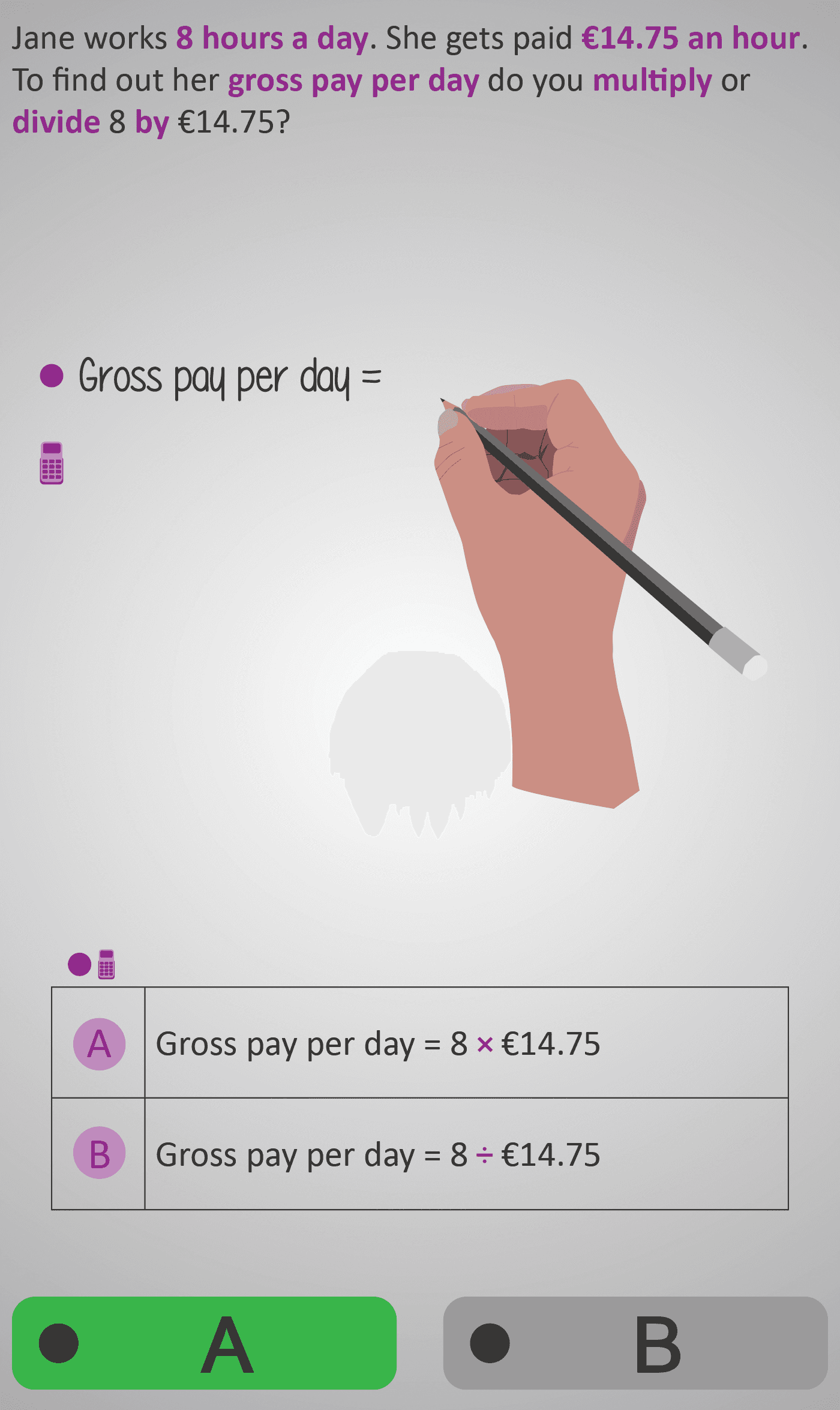
      Jane earns €14.75 per hour and works 8 hours → Gross pay per day = €118.
      Simon earns €88.22 per day and works 6 days → Gross pay per week = €529.32.
Each task reinforces the link between multiplication and repeated addition, showing how multiplying a rate by the number of hours or days worked gives total income. Students practise interpreting word problems, selecting the correct operation, and verifying results with a calculator — all within realistic, relatable employment scenarios.
This Phlow strengthens both procedural fluency and conceptual understanding, helping students see how arithmetic operations underpin financial literacy and everyday decision-making.
Worked Example
Example: Jane works 8 hours at €14.75/hour.
      Step 1: Identify operation → Multiply rate × hours
      Step 2: €14.75 × 8 = €118
Gross pay per day = €118
Through such examples, students recognise that multiplication represents total accumulation — combining equal units (hours or days) into a single total.
Sample Prompts
- What does “gross pay” mean?
- How do you find total pay from rate and time worked?
- Why do we multiply instead of divide?
- Use a calculator to check: €88.22 × 6 = ?
Why This Matters
Understanding gross pay empowers learners to make sense of their future pay slips, hourly rates, and weekly earnings. It turns arithmetic into a practical life skill and helps build confidence in numeracy for work and independence.
Prerequisite Knowledge Required
- Understanding of multiplication and division as inverse operations.
- Ability to multiply decimals and handle money values accurately.
- Familiarity with hourly and daily pay rates.
- Basic calculator use for verification and rounding.
Linked Phlows:
Gross Pay 4A–4C – Working with Tax and Income,
Multiplication & Division 4 – Operation Selection,
Money 3C – Working with Decimals and Currency.
Main Category
Arithmetic → Money and Real-World Problem Solving
Estimated Completion Time
Approx. 10–14 seconds per question.
40 questions total → Total time: 7–10 minutes.
| Learner Profile | Estimated Time | Description |
|---|---|---|
| One Level Below | 9–10 mins | May hesitate on operation choice or alignment of decimals. |
| At Level | 7–8 mins | Accurately identifies when to multiply and checks answers efficiently. |
| One Level Above | 5–6 mins | Solves confidently and recognises pay patterns mentally. |
Cognitive Load / Step Size
Moderate. Each question builds sequentially — identify rate, choose operation, perform calculation — maintaining focus and reinforcing reasoning. Alternating daily and weekly contexts strengthens transfer and keeps engagement high.
Language & Literacy Demand
Moderate. Vocabulary such as “gross pay,” “per hour,” and “rate” is introduced through repetition and colour emphasis. Clear syntax and consistent phrasing reduce reading demand, allowing attention to remain on maths reasoning.
Clarity & Design
- Handwriting animation visually demonstrates operation choice and process.
- Purple highlights mark rates, units, and totals for quick comprehension.
- Calculator icons indicate computation steps, supporting numeracy confidence.
- Clean visual layout promotes focus and consistency across screens.
Curriculum Alignment (ROI Junior Cycle Mathematics)
- Strand: Number
- Strand Unit: Money – Earnings and Real-Life Calculations
- Learning Outcomes:
- Multiply a rate by a quantity to find total amounts.
- Apply operations to practical wage and income problems.
- Interpret gross pay as income before deductions.
- Use calculators accurately for financial problem-solving.
Engagement & Motivation
High. Realistic work scenarios with relatable names and earnings make learning meaningful. Students enjoy seeing the immediate connection between maths and everyday working life.
Error Opportunities & Misconceptions
- Dividing instead of multiplying when finding total pay.
- Confusing “per hour” and “per day” rates.
- Forgetting to multiply both rate and time values.
- Rounding errors or misplaced decimal points.
Transferability / Real-World Anchoring
Very high. Skills extend to calculating overtime, commissions, and budgets — vital for employment, entrepreneurship, and financial literacy.
Conceptual vs Procedural Balance
Balanced leaning procedural. The Phlow reinforces multiplication procedures while contextualising their purpose — showing how operations directly determine total income.
Learning Objectives Addressed
- Identify when to multiply to find total earnings.
- Calculate daily and weekly gross pay using given data.
- Verify results using calculator or estimation.
- Recognise gross pay as income before deductions.
What Your Score Says About You
- Less than 20: Review when to multiply or divide for wage calculations.
- 21–29: Good progress — double-check rounding and rate selection.
- 31–39: Strong understanding — accurate and consistent with realistic examples.
- 40 / 40: Excellent — full fluency and understanding of how multiplication determines total pay.