
Hyp Adj Opp 4
Overview
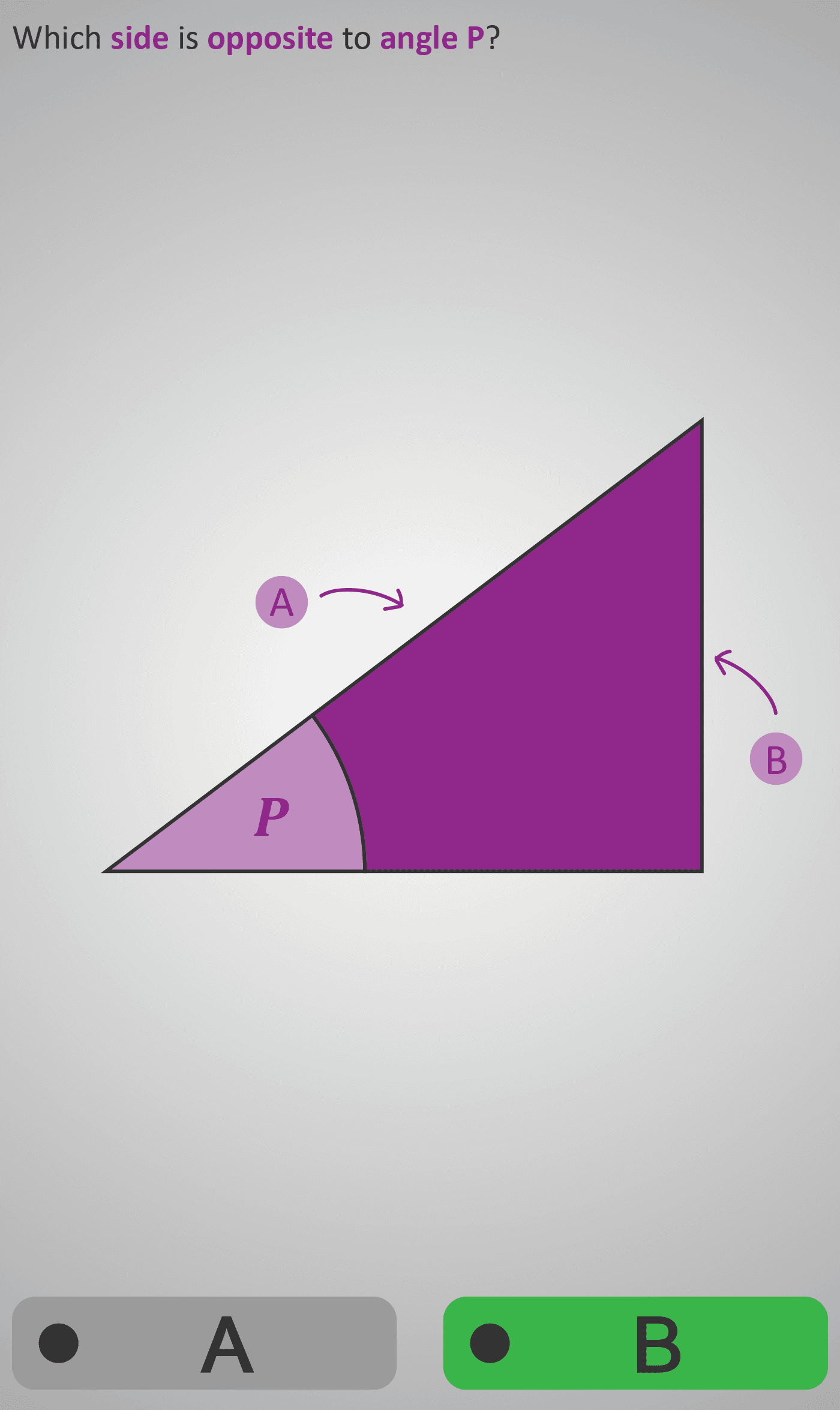
In this Phlow, learners practise recognising the three key sides of a right-angled triangle relative to a chosen angle:
- Hypotenuse – the longest side, always opposite the right angle.
- Opposite – the side directly across from the given angle.
- Adjacent – the side next to the given angle that is not the hypotenuse.
Each question presents a triangle labelled with one or more angles (e.g. ∠P, ∠Y, ∠K), asking students to select which side corresponds to the given term. Later screens add numerical side lengths, reinforcing recognition through both spatial and quantitative cues.
By repeatedly identifying sides in different orientations, learners develop intuitive geometric awareness — a vital foundation before learning the trigonometric ratios sine, cosine, and tangent.
Worked Example
Example: Triangle ∠P = 30°, ∠R = 90°
      Step 1: The hypotenuse is the side opposite the right angle (longest side).
      Step 2: The opposite side is across from ∠P.
      Step 3: The adjacent side is beside ∠P but not the hypotenuse.
Students visualise each side’s position and understand how its role changes depending on the reference angle.
Sample Prompts
- Which side is opposite angle P?
- Which side is adjacent to angle Y?
- Identify the hypotenuse in this triangle.
- Which side is the longest and opposite the right angle?
Why This Matters
Recognising the hypotenuse, adjacent, and opposite sides is an essential step in geometry and trigonometry. This understanding supports later skills such as applying trigonometric ratios, solving for unknown sides, and reasoning about real-world angles in construction, physics, and navigation.
Prerequisite Knowledge Required
- Familiarity with right-angled triangles and the concept of angles.
- Understanding of “opposite” and “adjacent” in everyday contexts.
- Knowledge that the hypotenuse is always the longest side, opposite the right angle.
Linked Phlows:
Triangle Types 3A–3C – Classifying Triangles,
Angles 3D – Naming and Recognising Angles.
Main Category
Geometry → Trigonometric Foundations
Estimated Completion Time
Approx. 10–14 seconds per question.
40 questions total → Total time: 7–10 minutes.
| Learner Profile | Estimated Time | Description |
|---|---|---|
| One Level Below | 9–10 mins | Needs strong visual cues and repeated reinforcement to distinguish sides. |
| At Level | 7–8 mins | Consistently identifies sides correctly across orientations. |
| One Level Above | 5–6 mins | Instantly recognises side relationships and anticipates trigonometric reasoning. |
Cognitive Load / Step Size
Low to moderate. Each question isolates one geometric decision (e.g., “Which side is opposite angle P?”). The gradual inclusion of side lengths introduces numerical reasoning without increasing intrinsic load.
Language & Literacy Demand
Low. Instructions are concise and visually supported. Key terms (opposite, adjacent, hypotenuse) are colour-coded and reinforced through consistent phrasing. Focus remains on visual and spatial reasoning rather than text comprehension.
Clarity & Design
- Clear purple highlights mark sides and angles for visual focus.
- Directional arrows guide recognition of “opposite” and “adjacent.”
- Consistent triangle layout across screens builds familiarity.
- Simple, distraction-free visuals reinforce clarity and accuracy.
Curriculum Alignment (ROI Junior Cycle Mathematics)
- Strand: Geometry and Trigonometry
- Strand Unit: Right-Angled Triangles
- Learning Outcomes:
- Identify sides in a right-angled triangle relative to a given angle.
- Recognise the consistent role of the hypotenuse as opposite the right angle.
- Distinguish between adjacent and opposite sides visually and numerically.
- Develop readiness for trigonometric ratio application.
Engagement & Motivation
Moderate to high. The visual pattern-recognition format is satisfying and intuitive. Learners enjoy identifying sides correctly as triangles rotate, giving a strong sense of mastery and progress.
Error Opportunities & Misconceptions
- Confusing adjacent and opposite when the triangle rotates.
- Assuming the longest visible side is always the hypotenuse without identifying the right angle.
- Forgetting that “opposite” depends on the specific reference angle.
Transferability / Real-World Anchoring
Strong. Understanding these side relationships underpins trigonometry and supports practical applications in construction, physics, navigation, and architectural design.
Conceptual vs Procedural Balance
Conceptual. This Phlow focuses on understanding geometric relationships rather than performing calculations — laying the groundwork for trigonometric reasoning in later Phlows.
Learning Objectives Addressed
- Identify the hypotenuse, adjacent, and opposite sides relative to a given angle.
- Recognise the hypotenuse as the side opposite the right angle.
- Understand spatial side relationships through consistent visual reasoning.
- Develop readiness for sine, cosine, and tangent ratios.
What Your Score Says About You
- Less than 20: You may be unsure how side positions change as the triangle rotates — review using visual cues.
- 21–29: You understand the idea but sometimes mix up adjacent and opposite.
- 31–39: You are confident and accurate identifying sides relative to angles.
- 40 / 40: Excellent — full fluency and readiness for trigonometry.