
Mean 4
Overview
In this Phlow, learners calculate the mean (average) of a set of numbers using the formal two-step process:
      Step 1: Add all the numbers together.
      Step 2: Divide the total by how many numbers there are.
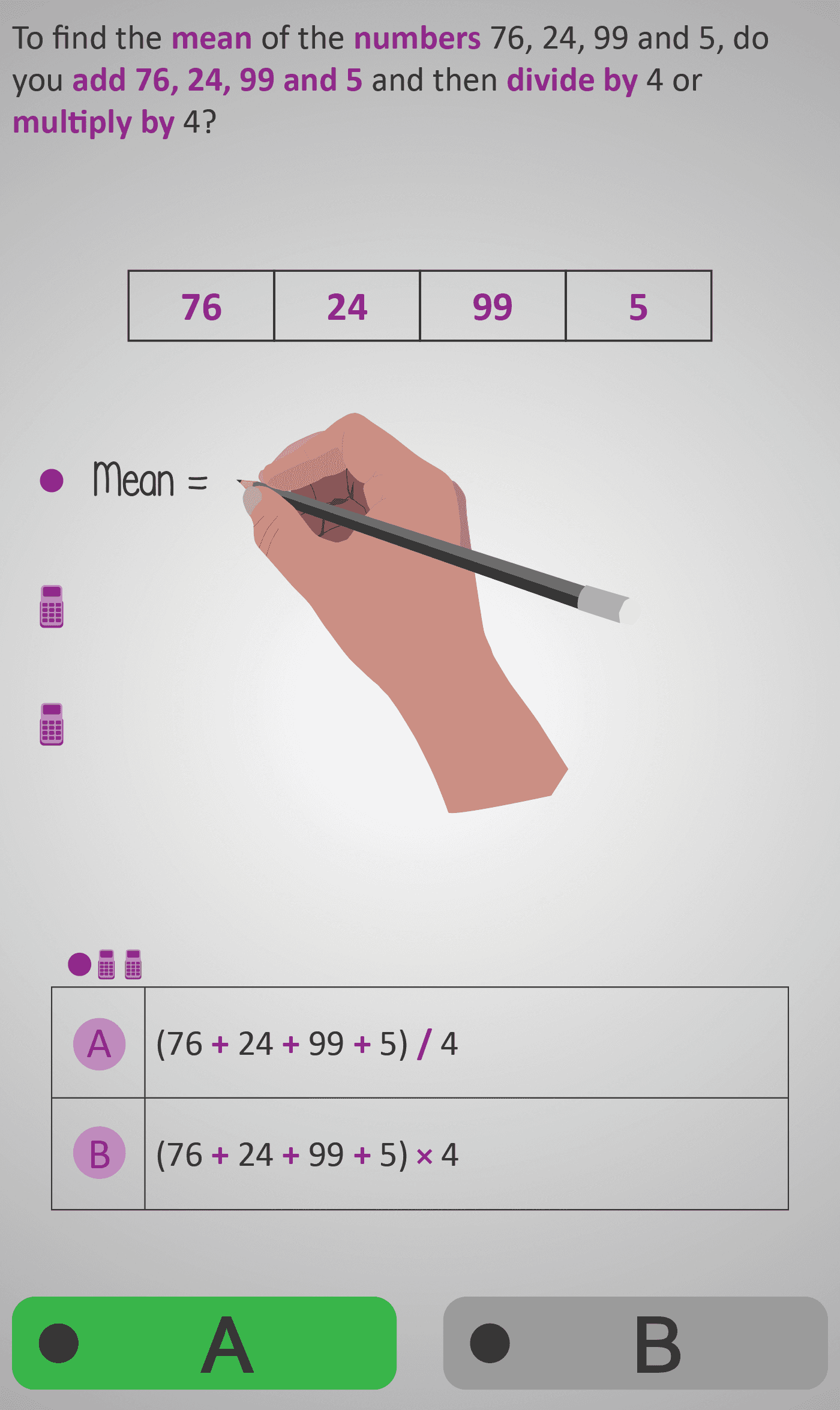
Using the example 76, 24, 99, and 5, students learn to set up and simplify the calculation:
      Mean = (76 + 24 + 99 + 5) ÷ 4
      Mean = 204 ÷ 4 = 51
Each stage isolates a single reasoning step — identifying operations, substituting values, simplifying, and calculating — ensuring procedural clarity and supporting learners who benefit from visual and structured guidance. The handwriting animation demonstrates how the mean formula unfolds, reinforcing understanding through motion and sequencing.
Worked Example
Example: Find the mean of 10, 14, 18, and 8.
      Step 1: Add → 10 + 14 + 18 + 8 = 50
      Step 2: Divide → 50 ÷ 4 = 12.5
Mean = 12.5
Students see how each operation contributes to fairness — the idea that the mean represents an even share or central point in the data.
Sample Prompts
- What two operations do you need to find the mean?
- Why do we divide by the number of items?
- Calculate the mean of 12, 8, 15, and 5.
- Which value best represents the “average” of these numbers?
Why This Matters
Understanding the mean helps learners interpret data fairly and consistently. It’s a vital mathematical skill that connects to everyday reasoning — from exam averages to sports statistics and budgeting. This Phlow bridges arithmetic and data analysis, preparing students for more advanced statistics in later levels.
Prerequisite Knowledge Required
- Confidence adding and dividing whole numbers.
- Understanding of order of operations (brackets before division).
- Familiarity with what “average” means in real-world contexts.
Linked Phlows:
Add & Divide 3A – Basic Operations,
Fractions 3C – Division as Equal Sharing,
Mean 3A – Introduction to Averages.
Main Category
Statistics → Averages and Data Handling
Estimated Completion Time
Approx. 10–14 seconds per question.
40 questions total → Total time: 7–10 minutes.
| Learner Profile | Estimated Time | Description |
|---|---|---|
| One Level Below | 9–10 mins | May hesitate on operation order or divide by the wrong count. |
| At Level | 7–8 mins | Performs addition and division steps accurately and consistently. |
| One Level Above | 5–6 mins | Estimates mentally and verifies results quickly using a calculator. |
Cognitive Load / Step Size
Moderate. The visual breakdown of each stage keeps working memory demand low. Each step (add → divide → simplify) builds on the previous one, encouraging fluency through repetition without overloading learners.
Language & Literacy Demand
Low to moderate. Key words such as “mean,” “divide,” and “simplify” are highlighted visually. The structure of sentences remains short and instructional, ensuring accessibility while maintaining mathematical precision.
Clarity & Design
- Consistent handwriting animation reinforces procedural sequence.
- Calculator symbols guide learners when computation is required.
- Clear layout separates each operation for step-by-step focus.
- Minimal clutter — visuals directly support the formula for mean.
Curriculum Alignment (ROI Junior Cycle Mathematics)
- Strand: Statistics and Probability
- Strand Unit: Representing and Interpreting Data
- Learning Outcomes:
- Calculate the mean of a numerical dataset.
- Interpret the mean as a fair or balanced value.
- Apply addition and division to real datasets.
- Demonstrate procedural accuracy when computing averages.
Engagement & Motivation
Moderate to high. The sense of discovery in calculating a final mean keeps learners engaged. The real-world relevance of “averages” enhances intrinsic motivation and contextual understanding.
Error Opportunities & Misconceptions
- Forgetting to divide by the number of data points.
- Adding incorrectly due to skipped numbers or misalignment.
- Dividing before adding (operation order error).
- Confusing the mean with median or mode.
Transferability / Real-World Anchoring
High. Understanding the mean supports practical numeracy across areas like budgeting, sports performance tracking, and interpreting survey data — bridging mathematics and everyday decision-making.
Conceptual vs Procedural Balance
Balanced. The Phlow builds procedural skill (add then divide) while reinforcing conceptual meaning through its clear structure and “equal share” interpretation.
Learning Objectives Addressed
- Apply the mean formula to numerical sets.
- Perform addition and division accurately using calculators.
- Understand the mean as an equal distribution measure.
- Strengthen arithmetic fluency within data contexts.
What Your Score Says About You
- Less than 20: You may confuse the order of operations or divide by the wrong total.
- 21–29: You understand the concept but may make small arithmetic errors — check your steps carefully.
- 31–39: You’re confident calculating and interpreting the mean.
- 40 / 40: Excellent — you can compute means quickly and understand their meaning across contexts.