
Measure 4
Overview
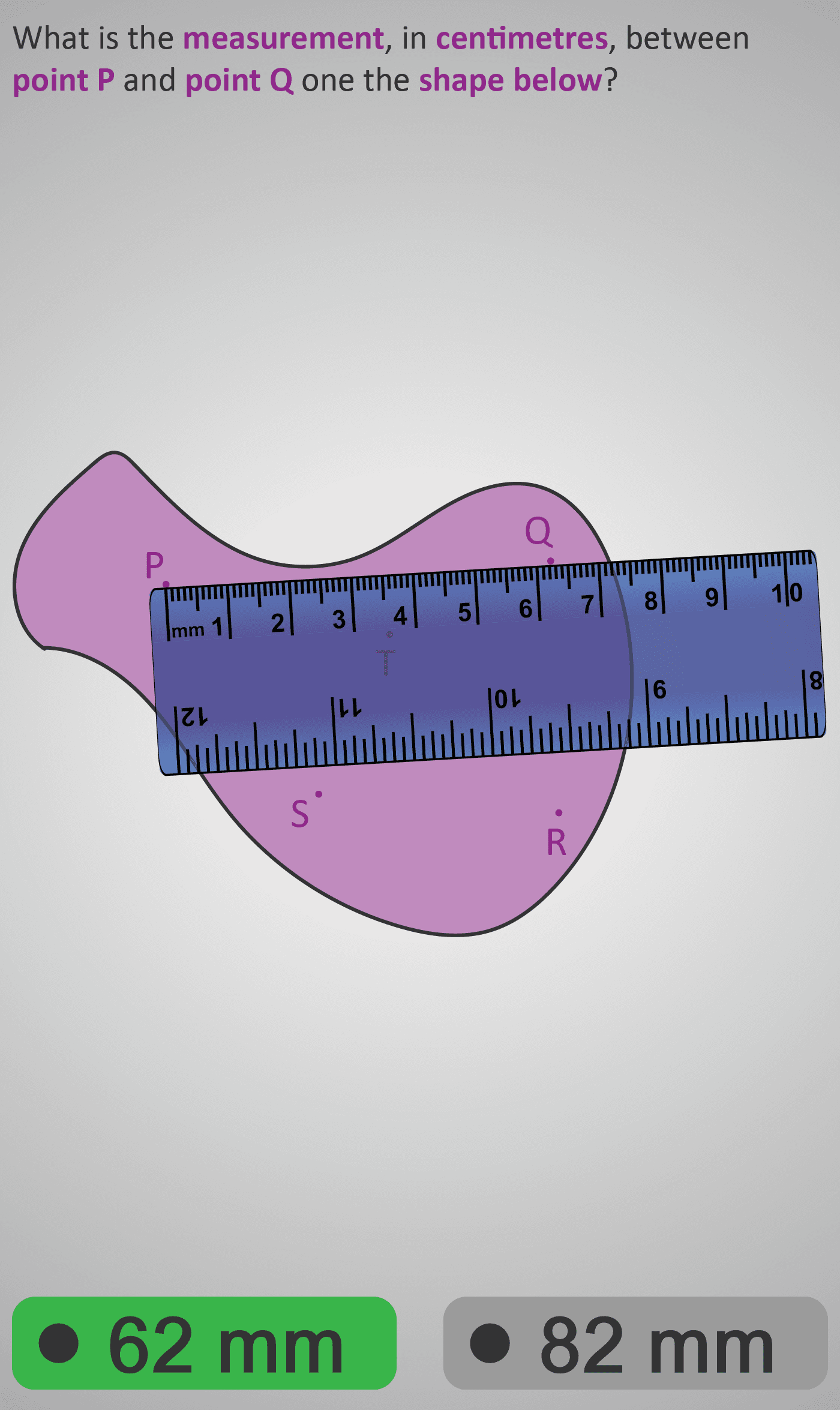
In this Phlow, learners measure distances between marked points (e.g., B–E, K–M, Y–Z, P–Q) on various shapes using a digital ruler marked in millimetres (mm) and centimetres (cm). They must identify the correct measurement between two possible answers (e.g., “43 mm or 53 mm”), practising accuracy and attention to scale.
The Phlow reinforces key ideas:
- 1 cm = 10 mm
- Measurements should start from the zero mark, not the ruler's edge
- Precision matters when reading small-scale values
Each question presents the ruler at a slightly different orientation — horizontal, angled, or curved — requiring students to adapt visually while maintaining consistent measurement logic. Through this variety, learners strengthen spatial awareness and gain confidence reading metric scales.
Worked Example
Example: Measure the distance from point K to point M.
      Step 1: Align the ruler’s zero mark with point K.
      Step 2: Read the value where point M lines up on the scale.
      Step 3: Identify if the distance is closer to 43 mm or 53 mm.
      Step 4: Convert if needed: 43 mm = 4.3 cm.
Answer: 43 mm (4.3 cm)
Sample Prompts
- What is the distance between points Y and Z?
- Does the ruler start at zero or the edge?
- Which measurement is correct — 62 mm or 72 mm?
- Convert 36 mm to centimetres.
Why This Matters
Accurate measurement is a core mathematical and practical skill. This Phlow builds visual precision and prepares students for real-world applications such as technical drawing, design, construction, and geometry. It connects mathematical knowledge to hands-on understanding of scale and proportion.
Prerequisite Knowledge Required
- Understanding centimetres and millimetres as standard units of length.
- Ability to count in 10s and perform simple decimal conversions (e.g. 43 mm = 4.3 cm).
- Knowledge of how to align rulers correctly for measurement.
Linked Phlows:
Measure 3A – Identifying Longer and Shorter Objects,
Units 3B – Understanding cm vs mm,
Compare Length 3C – Estimating Without a Ruler.
Main Category
Measurement → Length and Scale
Estimated Completion Time
Approx. 10–14 seconds per question.
40 questions total → Total time: 7–10 minutes.
| Learner Profile | Estimated Time | Description |
|---|---|---|
| One Level Below | 9–10 mins | May misread scales or confuse mm and cm. |
| At Level | 7–8 mins | Reads accurately and adjusts quickly to ruler orientation. |
| One Level Above | 5–6 mins | Measures confidently and converts mentally between units. |
Cognitive Load / Step Size
Low to moderate. The Phlow uses consistent question structure and gradual variation (orientation and scale) to maintain engagement without overload. Visual repetition strengthens accuracy and confidence.
Language & Literacy Demand
Low. Short, predictable instructions and strong visual emphasis on key terms (“cm”, “mm”, “point”) ensure accessibility. Understanding is primarily visual rather than text-dependent.
Clarity & Design
- Ruler graphics are crisp and scaled accurately.
- Purple overlays highlight measurement points for focus.
- Clear labels (A–Z) avoid ambiguity.
- Orientations vary for visual engagement and real-world realism.
Curriculum Alignment (ROI Junior Cycle Mathematics)
- Strand: Measurement
- Strand Unit: Length
- Learning Outcomes:
- Measure lengths accurately in millimetres and centimetres using a ruler.
- Record, compare, and convert distances between units.
- Apply knowledge of scale to real-world contexts.
- Develop visual precision and spatial awareness.
Engagement & Motivation
Moderate to high. The interactive measuring format feels hands-on and authentic. Learners enjoy the realism of digital ruler manipulation and the satisfaction of identifying the correct distance.
Error Opportunities & Misconceptions
- Starting from the edge of the ruler instead of zero.
- Miscounting small mm divisions between cm marks.
- Confusing 10 mm with 1 cm.
- Reading from the wrong side of the ruler.
Transferability / Real-World Anchoring
Very high. Measuring accurately is essential for drawing, map work, engineering, carpentry, and scientific investigation — making this Phlow directly relevant to practical skill development.
Conceptual vs Procedural Balance
Primarily procedural with conceptual reinforcement. Students repeatedly practise measurement reading while deepening understanding of metric relationships and precision techniques.
Learning Objectives Addressed
- Accurately measure lengths using mm and cm scales.
- Convert between millimetres and centimetres.
- Apply correct ruler alignment and reading conventions.
- Build visual precision and estimation skills for geometry and design.
What Your Score Says About You
- Less than 20: You may be misreading ruler alignment or confusing mm and cm — review the zero point.
- 21–29: You understand the method but sometimes miscount divisions or convert incorrectly.
- 31–39: You measure accurately and interpret scales confidently.
- 40 / 40: Excellent — precise, consistent, and ready for advanced geometry and scaling work.