
Median 4A
Overview
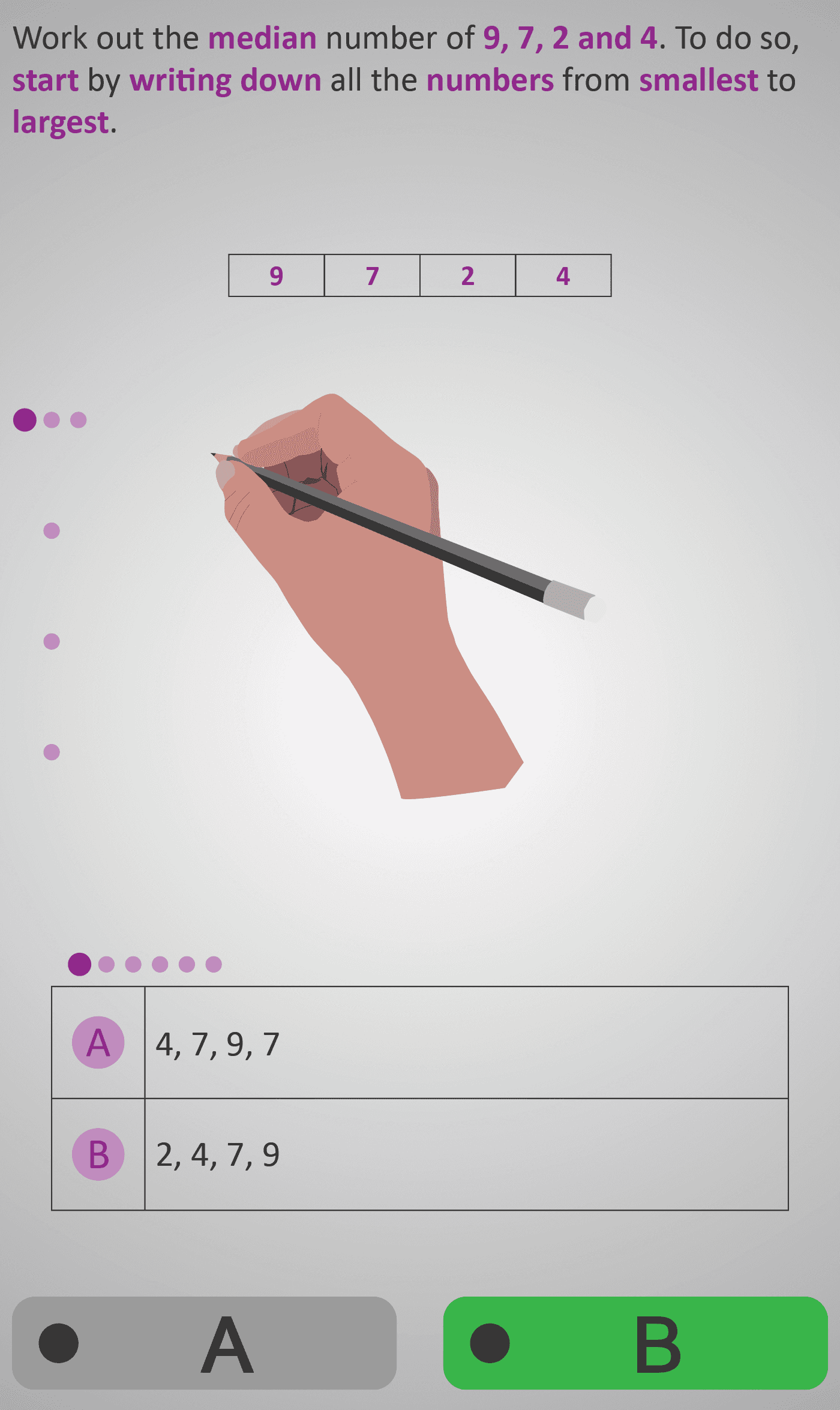
In this Phlow, learners discover how to find the median — the middle value in an ordered set of numbers — through a clear, step-by-step visual process. The example uses the data set 9, 7, 2, 4, guiding students through each stage:
- Order the numbers from smallest to largest → 2, 4, 7, 9.
- Cross out numbers from both ends until two remain.
- Add the two middle numbers (4 + 7) and divide by 2.
- Calculate → 11 ÷ 2 = 5.5.
Each step is visually represented through handwriting animation and interactive crossing-out. This design helps learners see why the median represents the “middle” of the data rather than just memorising steps. It connects arithmetic procedure with conceptual balance, encouraging reasoning and accuracy.
Worked Example
Example: Find the median of 5, 9, 3, and 7.
      Step 1: Order → 3, 5, 7, 9
      Step 2: Cross out from the ends → 3, 9 removed → 5 and 7 remain
      Step 3: Add → 5 + 7 = 12
      Step 4: Divide → 12 ÷ 2 = 6
      Median = 6
Sample Prompts
- Which number is the median of 8, 4, 6, 10, 2?
- What must you always do before finding the median?
- Why do we divide by 2 when two middle numbers remain?
- How is the median different from the mean?
Why This Matters
The median is a core measure of central tendency — it tells us the “middle” of a data set. Understanding how to find it helps learners interpret data more fairly, especially when outliers are present. This Phlow prepares students for analysing larger and grouped data sets in later levels.
Prerequisite Knowledge Required
- Ability to order numbers from smallest to largest.
- Competence in addition and division of whole numbers.
- Understanding “middle” or “halfway between” as a numerical concept.
Linked Phlows:
Mean 3A – Introducing Averages,
Order 3B – Arranging Numbers,
Divide 3C – Division as Equal Sharing.
Main Category
Statistics → Measures of Central Tendency
Estimated Completion Time
Approx. 10–14 seconds per question.
40 questions total → Total time: 7–10 minutes.
| Learner Profile | Estimated Time | Description |
|---|---|---|
| One Level Below | 9–10 mins | Needs extra time ordering numbers or recalling the “divide by 2” step. |
| At Level | 7–8 mins | Orders and finds the median accurately using the cross-out method. |
| One Level Above | 5–6 mins | Identifies the median mentally and explains reasoning efficiently. |
Cognitive Load / Step Size
Moderate. Each question isolates one micro-step — ordering, crossing out, or averaging — ensuring clarity without overloading memory. Visual repetition strengthens both conceptual and procedural mastery.
Language & Literacy Demand
Low to moderate. Short, clear instructions are paired with animations that show each action. Key terms (median, ends, middle, divide) are colour-coded in purple to support comprehension and retention.
Clarity & Design
- Handwriting animation mirrors real classroom demonstrations.
- Cross-out lines show logic visually — reducing abstraction.
- Calm colour palette and soft backgrounds focus attention on process.
- Purple emphasis highlights key steps (order, divide, middle).
Curriculum Alignment (ROI Junior Cycle Mathematics)
- Strand: Statistics and Probability
- Strand Unit: Representing and Interpreting Data
- Learning Outcomes:
- Identify the median of a numerical data set.
- Order data and locate central values accurately.
- Apply the “average of two middle numbers” rule.
- Differentiate between mean and median.
Engagement & Motivation
High. The interactive cross-out approach feels like solving a puzzle, maintaining curiosity and engagement. Step-by-step feedback gives a sense of mastery and progress, supporting flow-based learning.
Error Opportunities & Misconceptions
- Forgetting to order the numbers first.
- Mixing up mean and median.
- Crossing from the middle outward instead of ends inward.
- Forgetting to divide by 2 when two middle numbers remain.
Transferability / Real-World Anchoring
Strong conceptual transfer. Understanding median supports interpreting test results, surveys, and performance data. It’s a core concept in statistics, economics, and social sciences where fair representation of data is vital.
Conceptual vs Procedural Balance
Balanced. Students not only practise the correct method but also grasp why the median represents the central balance of a set.
Learning Objectives Addressed
- Order a set of numbers correctly before analysis.
- Identify and average middle values when necessary.
- Explain why the median represents the data’s centre.
- Differentiate between mean and median.
What Your Score Says About You
- Less than 20: You may be skipping the ordering step or confusing the median with the mean.
- 21–29: You understand the method but may forget a key step or make small arithmetic errors.
- 31–39: You calculate the median confidently and understand its purpose.
- 40 / 40: Excellent — full fluency with both method and reasoning, ready for grouped data.