
Modal 4
Overview
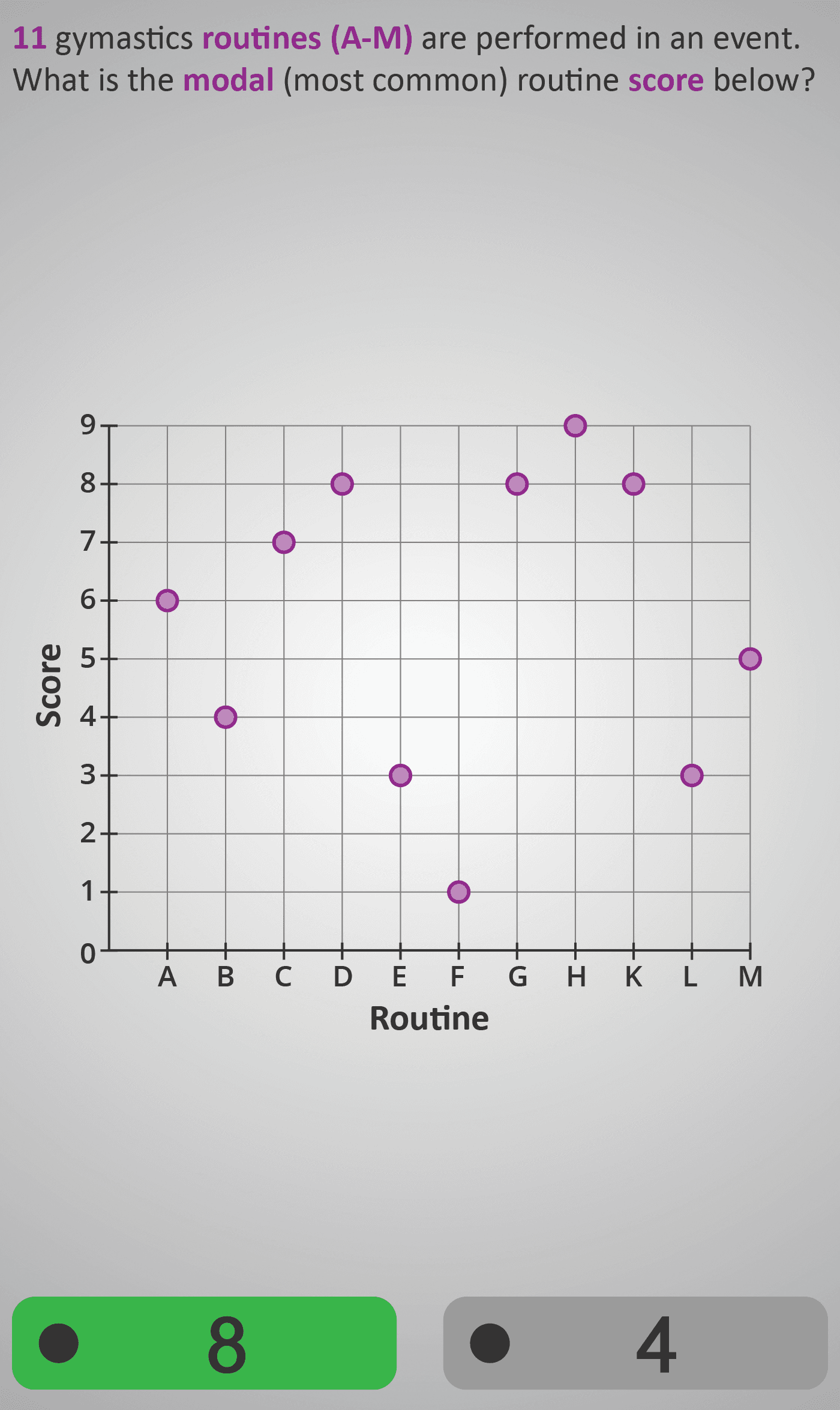
In this Phlow, learners identify the mode — the most frequently occurring value — by analysing visual data displayed as dot or scatter graphs. Using gymnastics routine scores (A–M) as the context, each graph shows 11 routines plotted against their respective scores.
Students are asked: “What is the modal (most common) routine score?” They interpret the visual frequency of dots or points to determine which score appears most often. This reinforces understanding that the mode can be identified not only from number lists or tables, but also from graphical data representations.
The task builds conceptual understanding of frequency and distribution through repeated, varied examples. Each question isolates one visual reasoning skill — pattern recognition — while maintaining consistent visual structure for ease of interpretation.
Worked Example
Example: A dot plot shows scores of 5, 6, 7, 6, 8, 6, 9, 5, 6, 7, 8.
      Step 1: Count how many times each score appears.
      Step 2: Identify which score occurs most frequently.
      Step 3: Score 6 appears 4 times — this is the modal score.
Answer: Mode = 6
Sample Prompts
- Which score appears most often in this graph?
- What does the word “mode” mean?
- Is the modal score always the highest score?
- Can a data set have more than one mode?
Why This Matters
The mode is one of the three key measures of central tendency. Recognising it visually helps students connect data patterns to real-life interpretations, such as identifying common trends in sports, sales, or survey results. This Phlow transitions learners from symbolic to visual data reasoning — a key skill in modern data literacy.
Prerequisite Knowledge Required
- Understanding that “mode” means the most common value.
- Ability to read dot plots, bar charts, or scatter graphs.
- Familiarity with counting frequencies and comparing them.
Linked Phlows:
Data 3B – Reading Values from Charts,
Mode 3A – Finding Mode from Lists or Tables,
Mean 4A,
Median 4A.
Main Category
Statistics → Representing and Interpreting Data
Estimated Completion Time
Approx. 10–14 seconds per question.
40 questions total → Total time: 7–10 minutes.
| Learner Profile | Estimated Time | Description |
|---|---|---|
| One Level Below | 9–10 mins | Needs support interpreting axes and spotting repeated values. |
| At Level | 7–8 mins | Reads graphs confidently and identifies the most frequent score correctly. |
| One Level Above | 5–6 mins | Recognises frequency patterns and identifies modes almost instantly. |
Cognitive Load / Step Size
Moderate. Each screen focuses on one decision — identifying the mode — but requires simultaneous interpretation of graphical and numerical cues. Variation in graph layouts maintains engagement while building flexibility and fluency.
Language & Literacy Demand
Low to moderate. Instructions are short and supported by visual graphs. Key terms (“mode,” “most common,” “score”) are colour-coded in purple. Students rely more on visual observation than text, reducing reading demand.
Clarity & Design
- Graphs are clean, balanced, and use purple data points for consistency.
- Axes are clearly labelled — x-axis for routines (A–M), y-axis for scores.
- Minimal clutter allows focus on frequency and pattern recognition.
- Design adheres to UDL principles — supporting visual, numerical, and textual understanding.
Curriculum Alignment (ROI Junior Cycle Mathematics)
- Strand: Statistics and Probability
- Strand Unit: Representing and Interpreting Data
- Learning Outcomes:
- Identify the mode in data displayed graphically.
- Interpret and compare frequency patterns using dot and scatter plots.
- Recognise that some data sets have multiple or no modes.
- Understand mode as a measure of frequency and typical value.
Engagement & Motivation
Strong. The gymnastics theme adds context and challenge. Students enjoy the “spot the pattern” aspect of identifying the modal value. The interactive visual format reinforces curiosity and builds mastery through immediate feedback.
Error Opportunities & Misconceptions
- Confusing the highest score with the most common score.
- Miscounting dots at a given score level.
- Reading the wrong axis or grid spacing.
- Assuming all data sets have one mode (ignoring bimodal or no-mode cases).
Transferability / Real-World Anchoring
Strong. The skill applies to interpreting survey results, sports performance, sales trends, and real-world graphs. Students learn to recognise patterns and frequency distributions — a vital component of data literacy.
Conceptual vs Procedural Balance
Conceptual emphasis. The Phlow prioritises visual understanding of frequency over computation. Learners grasp that “most common” is not the same as “highest,” developing deeper insight into data patterns.
Learning Objectives Addressed
- Identify the mode from visual data representations.
- Distinguish “most frequent” from “highest” or “average.”
- Interpret frequency visually to draw conclusions.
- Recognise when data is unimodal, bimodal, or has no mode.
What Your Score Says About You
- Less than 20: You may be mistaking the highest value for the mode — review how to count frequencies.
- 21–29: You understand the concept but need more practice reading patterns visually.
- 31–39: You interpret graphs confidently and identify the mode with accuracy.
- 40 / 40: Excellent — fluent visual recognition of patterns and frequency across all graph types.