
Mode 4A
Overview
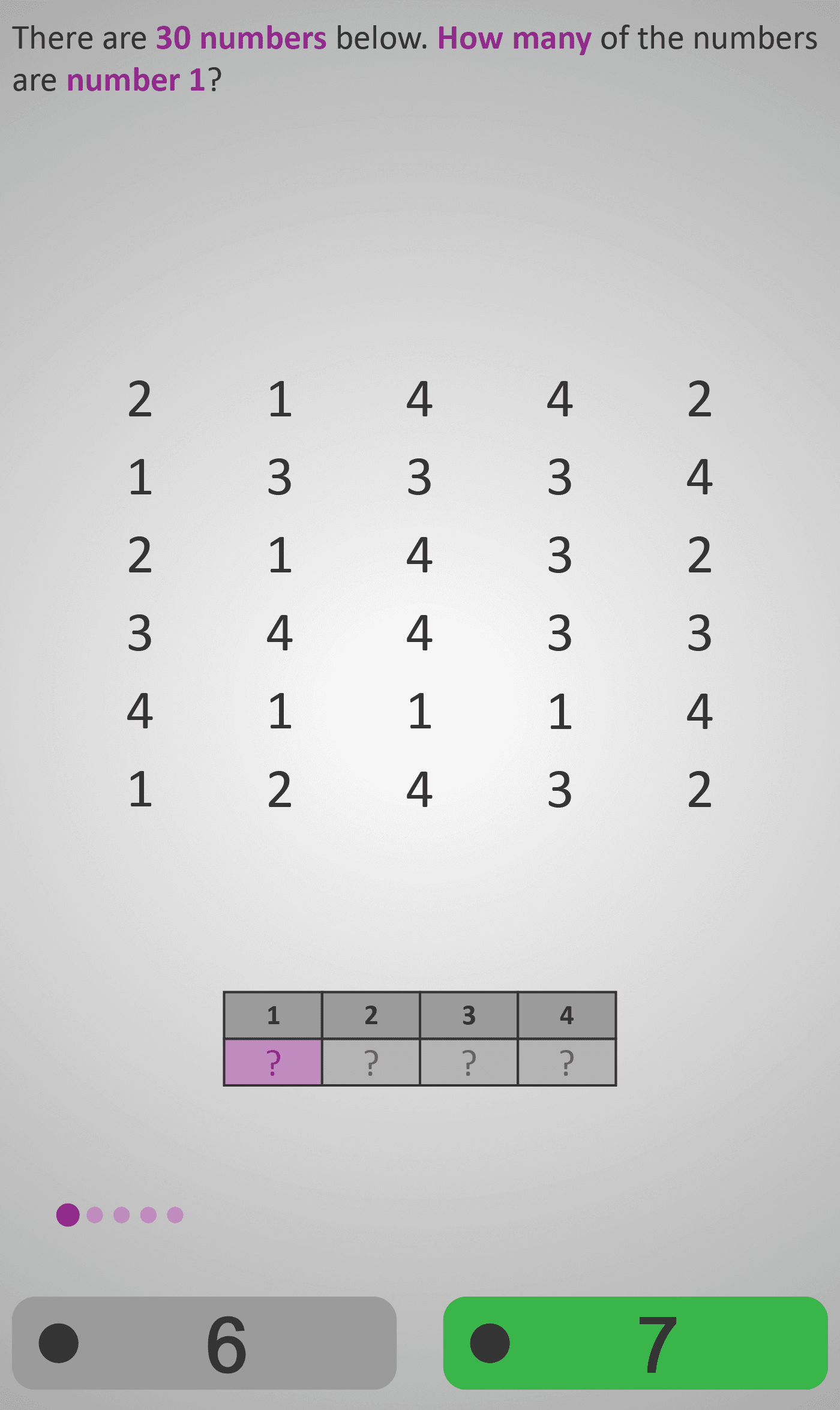
In this Phlow, learners explore the concept of mode — the most common number in a data set — using a simple, visual grid. The activity presents 30 numbers (1–4) arranged in a grid format. Students count how often each number appears, record this in a frequency table, and then identify which value occurs most frequently.
The process unfolds gradually to strengthen understanding:
- Count how many 1s appear → record in the first table cell.
- Repeat for 2s, 3s, and 4s.
- Compare the frequencies to identify which number occurs most often.
This structured, step-by-step design supports learners in connecting raw visual data with numerical representation. It bridges early counting skills with statistical reasoning — preparing students for interpreting larger data sets, charts, and frequency tables.
Worked Example
Example grid: 30 numbers between 1 and 4
      Step 1: Count each number.
        1 → 7 times
        2 → 10 times
        3 → 6 times
        4 → 7 times

      Step 2: Complete the frequency table.

      Step 3: Identify the number with the highest frequency → 2
      Mode = 2
Sample Prompts
- How many 3s can you find in the grid?
- Which number appears most often?
- What does “mode” mean in this context?
- How does the table help you see the answer more clearly?
Why This Matters
Understanding the mode develops students’ ability to organise, summarise, and describe data — skills essential in data handling and real-life problem solving. This Phlow lays a practical foundation for working with surveys, results, and experiments where data frequency matters.
Prerequisite Knowledge Required
- Counting accuracy and comparing small whole numbers.
- Understanding that “most common” means appearing most often.
- Familiarity with reading and interpreting simple grids or tables.
Linked Phlows:
Data 3A – Reading Simple Tables,
Mode 3B – Finding Mode from Lists,
Modal 4 – Identifying Mode from Graphs.
Main Category
Statistics → Representing and Interpreting Data
Estimated Completion Time
Approx. 10–14 seconds per question.
40 questions total → Total time: 7–10 minutes.
| Learner Profile | Estimated Time | Description |
|---|---|---|
| One Level Below | 9–10 mins | May double-count or lose track while scanning. Benefits from finger-tracking or tally marks. |
| At Level | 7–8 mins | Counts efficiently and recognises frequency patterns across rows and columns. |
| One Level Above | 5–6 mins | Quickly estimates frequencies and visualises tallies mentally. |
Cognitive Load / Step Size
Low to moderate. Each screen isolates one step — counting, recording, comparing — keeping cognitive demand manageable. Visual highlighting directs focus, and repetition reinforces the relationship between counting and frequency.
Language & Literacy Demand
Low. Instructions are concise, with minimal text and repeated phrasing. Colour-coded words (e.g., “number 2,” “how many”) support understanding, while visuals carry most of the instructional weight.
Clarity & Design
- Numbers are evenly spaced in a clean grid for easy scanning.
- Purple highlights indicate the current number to count.
- The frequency table fills progressively, linking count to data representation.
- The final step compares all values visually to identify the mode.
Curriculum Alignment (ROI Junior Cycle Mathematics)
- Strand: Statistics and Probability
- Strand Unit: Representing and Interpreting Data
- Learning Outcomes:
- Organise data into frequency tables.
- Identify the mode of a small data set.
- Interpret and describe frequency as a measure of occurrence.
- Link visual data to numerical representation.
Engagement & Motivation
High. The grid-based task feels game-like — learners enjoy the visual puzzle of spotting and counting numbers. Immediate feedback after each count sustains attention and rewards accuracy.
Error Opportunities & Misconceptions
- Skipping rows or miscounting numbers.
- Confusing total count (30) with individual frequencies.
- Selecting the highest number rather than the most frequent one.
- Incorrectly transferring data into the frequency table.
Transferability / Real-World Anchoring
Strong. Counting and frequency recognition underpin all later data-handling and survey analysis skills. Students see how frequency connects to real-world contexts — votes, surveys, results, or experiments.
Conceptual vs Procedural Balance
Balanced. The activity combines clear procedural steps with a conceptual grasp of what “most common” means. Students learn to interpret frequency rather than memorise a rule.
Learning Objectives Addressed
- Count and record frequencies from visual data.
- Identify the mode as the most frequent value.
- Complete and interpret a frequency table.
- Connect raw visual data with summarised numerical information.
What Your Score Says About You
- Less than 20: You may be skipping rows or mixing up “highest” with “most frequent.” Review your scanning technique.
- 21–29: You understand the process but make small counting or recording errors.
- 31–39: You’re accurate and confident identifying frequency patterns.
- 40 / 40: Excellent — you can extract, summarise, and interpret frequency data quickly and correctly.