
Mode 4B
Overview
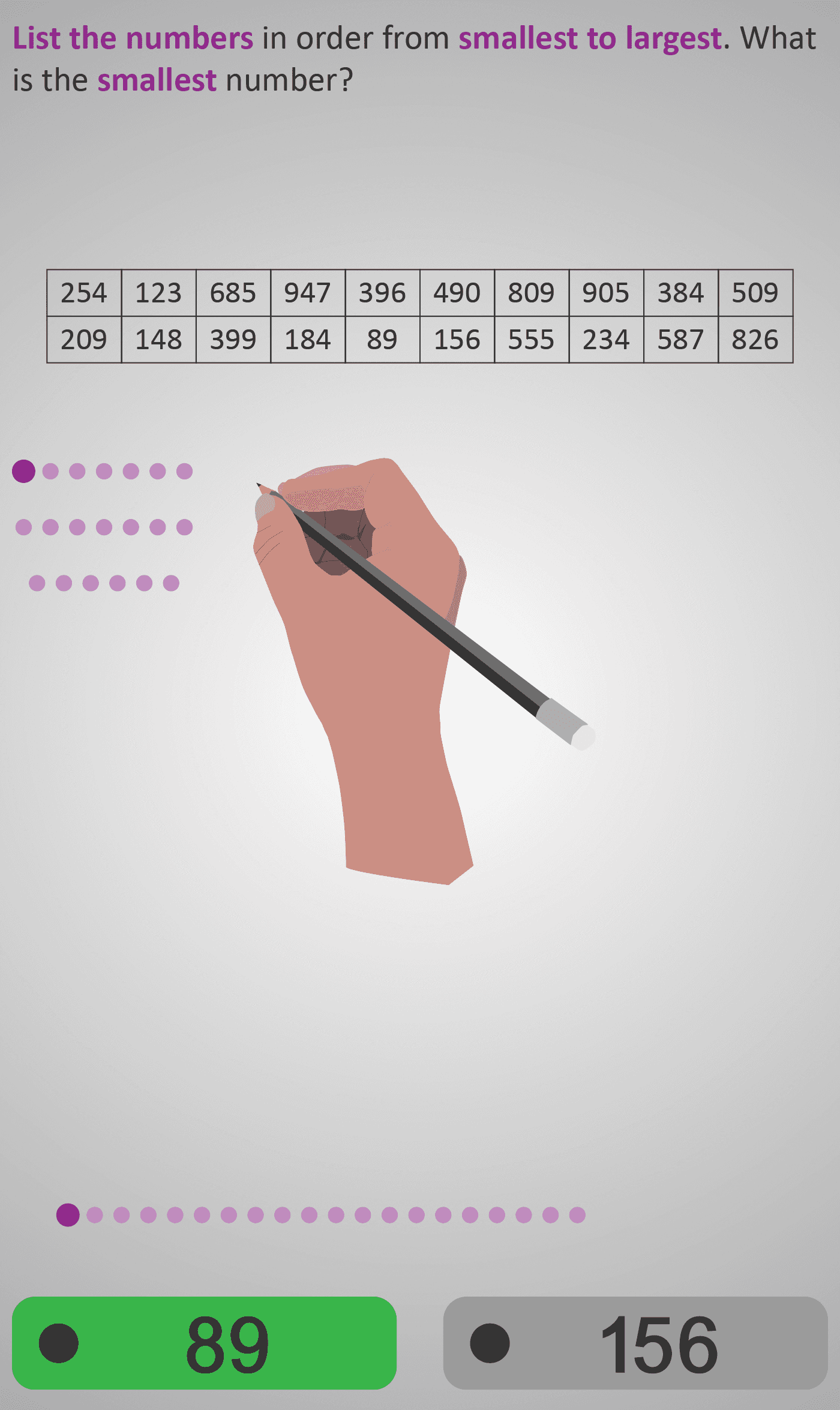
In this Phlow, learners refine their understanding of the mode by ordering a larger set of numbers (typically 15–20 values) before identifying which one appears most frequently.
Each screen presents an ordered-list challenge that unfolds step by step:
- Identify the smallest number and write it first.
- Continue selecting the next smallest number in sequence.
- Once all numbers are listed, observe which number repeats most often — that is the mode.
This sequence reinforces the connection between ordering data (used for finding medians) and counting frequency (used for finding the mode). It consolidates earlier Phlows, like Mode 4A (data grids), and prepares learners for advanced data interpretation in Mode 5 and Median 5.
Worked Example
      Data set: 23, 12, 16, 12, 18, 19, 23, 21, 12, 18, 17
      Step 1: Order → 12, 12, 12, 16, 17, 18, 18, 19, 21, 23, 23
      Step 2: Count → 12 appears 3 times
      Step 3: Mode = 12
Sample Prompts
- Which number comes next in order?
- Which value appears most often?
- How is ordering different from finding the mode?
- Can there be more than one mode?
Why This Matters
Sorting and recognising frequency are core data-handling skills. This Phlow strengthens focus, accuracy, and number fluency, showing students how ordered data reveals patterns naturally. These skills transfer directly to spreadsheet use, statistical reasoning, and real-world data interpretation.
Prerequisite Knowledge Required
- Understanding of place value and how to compare numbers.
- Basic counting and tallying skills (from Mode 4A).
- Knowledge that mode = most common value.
Linked Phlows:
Mode 4A – Finding Mode from Small Grids,
Median 4A–4B – Ordering to Find Middle Values,
Modal 4 – Identifying Mode from Graphs.
Main Category
Statistics → Representing and Interpreting Data
Estimated Completion Time
Approx. 10–14 seconds per question.
40 questions total → Total time: 7–10 minutes.
| Learner Profile | Estimated Time | Description |
|---|---|---|
| One Level Below | 9–10 min | May struggle scanning and ordering, possibly mistaking smallest/largest for the mode. |
| At Level | 7–8 min | Orders accurately and identifies repeated values confidently. |
| One Level Above | 5–6 min | Recognises ordering and repetition patterns quickly with minimal checking. |
Cognitive Load / Step Size
Moderate. The larger data sets increase visual and working-memory demand, but each question isolates a single, small decision — e.g., “What’s smallest?” → “What’s next?” The sequential reveal and structured layout help maintain flow and focus.
Language & Literacy Demand
Low to moderate. Instructions use short, consistent phrases such as “smallest,” “next,” and “most common.” Purple highlights reinforce key terms. The layout allows learners to rely on visual cues rather than text-heavy instructions.
Clarity & Design
- Two-row number grid ensures clear scanning and easy visual comparison.
- Handwriting animation models proper ordering.
- Purple boxes highlight current focus values.
- Linear flow mirrors the logic of sorting and pattern recognition.
- Minimalist design keeps all attention on numbers and repetition.
Curriculum Alignment (ROI Junior Cycle Mathematics)
- Strand: Statistics and Probability
- Strand Unit: Representing and Interpreting Data
- Learning Outcomes:
- Order numerical data from smallest to largest.
- Identify the mode (most common value) within a dataset.
- Distinguish between ordering (for median) and counting frequency (for mode).
- Interpret ordered data to describe patterns and distributions.
Engagement & Motivation
The “ordering puzzle” format encourages curiosity and persistence. Students see immediate visual progress as numbers fall into sequence, leading to satisfying discoveries when identifying the most common value.
Error Opportunities & Misconceptions
- Confusing smallest or largest with mode.
- Misreading multi-digit numbers (e.g., 209 vs. 290).
- Overlooking duplicates when scanning.
- Forgetting to complete ordering before identifying the mode.
Transferability / Real-World Anchoring
High. Sorting and frequency recognition underpin data literacy — vital for analysing scores, prices, survey results, or performance trends. The exercise mirrors spreadsheet sorting and real-world statistical reasoning.
Conceptual vs Procedural Balance
Balanced. Learners practise systematic ordering (procedure) while deepening their conceptual understanding of frequency patterns and repetition.
Learning Objectives Addressed
- Order data accurately from smallest to largest.
- Identify the most common (modal) value within a data set.
- Develop precision in spotting repetition patterns.
- Connect ordered lists to statistical reasoning and data interpretation.
What Your Score Says About You
- Less than 20: You may be confusing ordering steps with finding the mode or overlooking repeated numbers.
- 21–29: You can order data correctly but need more practice spotting duplicates quickly.
- 31–39: You are confident and accurate at both ordering and identifying modes.
- 40 / 40: Complete mastery — fluent ordering, pattern recognition, and interpretation of frequency data.