
Money 4
Overview
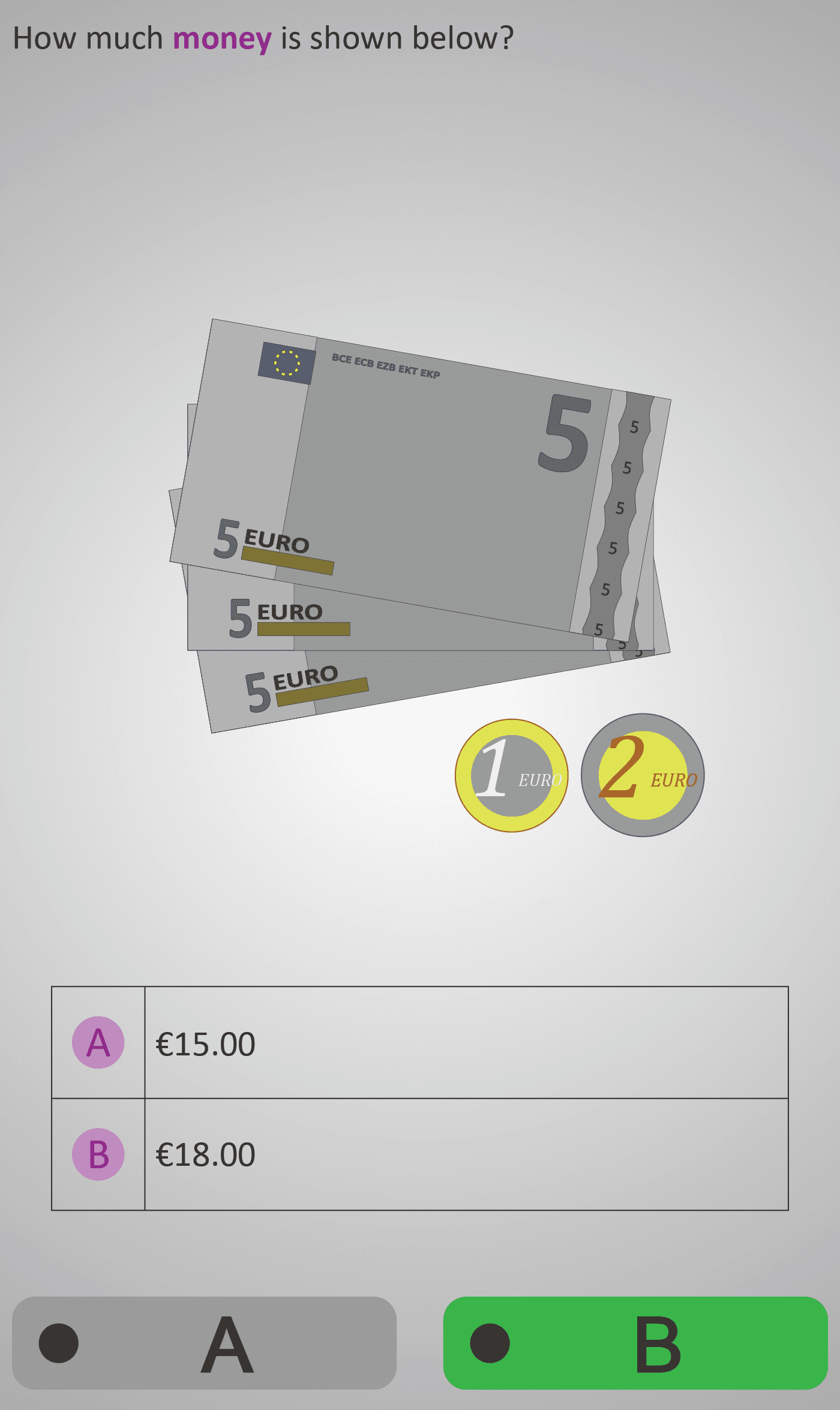
In this Phlow, learners practise adding together euro notes and coins to find the total amount of money shown. Each screen displays a realistic arrangement of familiar euro denominations — typically a mix of €5, €10, €20, €50, and €100 notes, alongside €1, €2, and cent coins.
Students carefully add these values and select the correct total from two possible options. Early screens include small, simple combinations (e.g. three €5 notes and two €1 coins), while later examples introduce larger totals and decimals to develop fluency with euro–cent notation.
This Phlow builds practical money-handling skills while reinforcing arithmetic, place value, and decimal addition. It also prepares learners for future Phlows involving change, budgeting, and multi-step money problems. Through repetition and visual recognition, students develop accuracy and confidence when calculating total amounts of money.
Worked Example
      Example: €20 note + €5 note + €2 coin + €1 coin + 50c coin
      Step 1: Add whole euros → 20 + 5 + 2 + 1 = €28
      Step 2: Add cents → €28 + €0.50 = €28.50
      Total = €28.50
Sample Prompts
- How much money is shown below?
- What is the total amount in euros and cents?
- Which coins and notes make up €15.70?
- How can you check your total another way?
Why This Matters
Money problems are one of the most direct applications of arithmetic. By recognising denominations, adding accurately, and interpreting totals, learners gain confidence in both mathematical reasoning and everyday financial literacy. This Phlow transforms classroom learning into life skills students can use in real transactions.
Prerequisite Knowledge Required
- Understanding of place value (units, tens, hundreds).
- Recognition of euro coins and notes and their denominations.
- Experience adding whole numbers and decimals.
Linked Phlows:
Money 3 – Simple Coin Combinations,
Add 4 – Column Addition of Whole Numbers,
Decimal 4A – Euros and Cents in Decimal Form.
Main Category
Measurement → Money
Estimated Completion Time
Approx. 10–14 seconds per question.
40 questions total → Total time: 7–10 minutes.
| Learner Profile | Estimated Time | Description |
|---|---|---|
| One Level Below | 9–10 min | May re-count notes and coins multiple times; slower with decimals. |
| At Level | 7–8 min | Adds totals confidently and checks accuracy when decimals appear. |
| One Level Above | 5–6 min | Recognises denominations instantly and sums mentally with ease. |
Cognitive Load / Step Size
Moderate. Each question isolates one key skill — adding money — while slightly varying the combination of notes and coins. The visuals lower cognitive demand by clearly displaying denominations, with complexity increasing gradually through larger totals and decimal inclusion.
Language & Literacy Demand
Low. The question wording remains consistent (“How much money is shown below?”), allowing students to focus entirely on numeric reasoning. Realistic graphics and colour-coded denominations reduce reliance on text comprehension.
Clarity & Design
- Large, high-contrast images of notes and coins for easy recognition.
- Realistic euro designs reinforce familiarity and trust in context.
- Two-option answers simplify decision-making and maintain focus.
- Gradual increase in colour variety and denomination size cues progression in difficulty.
- Balanced visual layout ensures clarity without cognitive overload.
Curriculum Alignment (ROI Junior Cycle Mathematics)
- Strand: Measures
- Strand Unit: Money
- Learning Outcomes:
- Identify and understand the value of euro coins and notes.
- Add and combine euro and cent amounts accurately.
- Express totals correctly using € and c symbols.
- Develop fluency interpreting and calculating money in practical contexts.
Engagement & Motivation
High. The Phlow uses familiar, real-world currency that students recognise and use daily. The progression from small to larger totals maintains engagement, while the realistic visuals make learning both purposeful and relatable.
Error Opportunities & Misconceptions
- Omitting a coin or note from the total.
- Adding euros and cents incorrectly (e.g. €15.50 + €2.70 = €17.20 instead of €18.20).
- Confusing similar coins (2c vs 20c).
- Forgetting to convert cents to euros when calculating totals.
Transferability / Real-World Anchoring
Very high. These skills apply directly to real financial literacy tasks — counting change, reading prices, handling transactions, and managing budgets. The Phlow strengthens confidence and independence in everyday money use.
Conceptual vs Procedural Balance
Mostly procedural with conceptual reinforcement. Students repeatedly add money values (procedure) while reinforcing the concept of place value, equivalence, and decimal structure through visual learning.
Learning Objectives Addressed
- Recognise and count euro notes and coins accurately.
- Add money values including decimals and mixed denominations.
- Distinguish between similar-looking coins and notes.
- Strengthen arithmetic fluency through real-world application.
What Your Score Says About You
- Less than 20: You may be missing smaller coins or adding euros and cents incorrectly.
- 21–29: You can identify coins correctly but need more fluency when combining totals.
- 31–39: You show strong money sense and accurate addition skills.
- 40 / 40: Excellent mastery — you can instantly and accurately calculate total euro values.