
Multiples 4
Overview
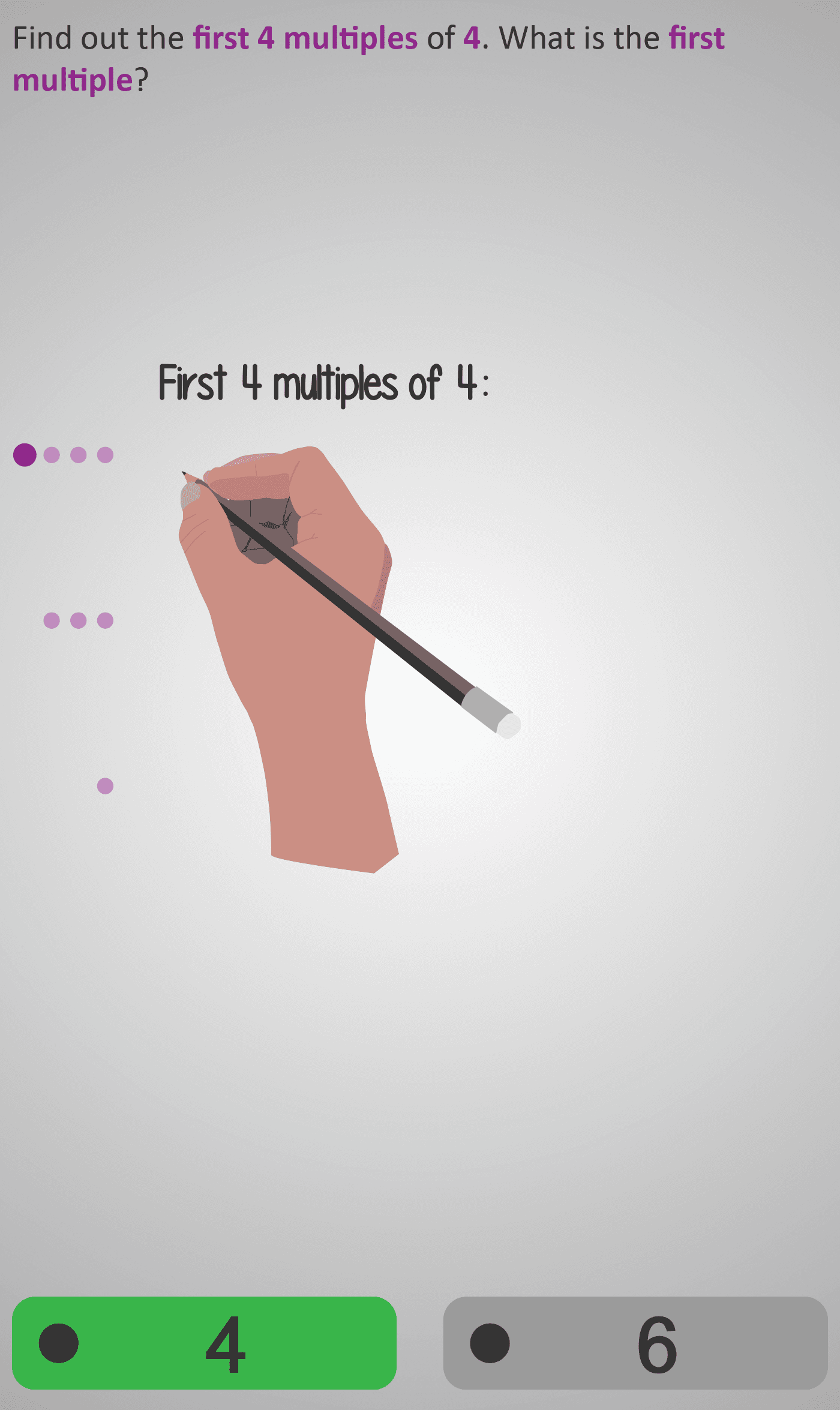
In this Phlow, learners explore multiples — numbers that result from multiplying a base number by 1, 2, 3, and so on. Students start by listing the first few multiples of a number (e.g. 4 → 4, 8, 12, 16, 20), then do the same for another (e.g. 6 → 6, 12, 18, 24, 30). They then compare these lists to identify the lowest common multiple (LCM) — the smallest number appearing in both sequences.
Each screen isolates a small step:
- Find the first multiple of a number.
- Continue the sequence by multiplying by 2, 3, 4, etc.
- Compare two sets of multiples to identify their overlap — the LCM.
This structured progression helps students recognise number patterns, internalise the structure of multiplication tables, and understand how multiples underpin larger mathematical ideas such as ratios, fractions, and common denominators. By writing and visualising each step, they strengthen both procedural fluency and conceptual understanding.
Worked Example
      Step 1: Multiples of 4 → 4, 8, 12, 16, 20
      Step 2: Multiples of 6 → 6, 12, 18, 24, 30
      Step 3: Common multiples → 12, 24, 36…
      LCM = 12
Sample Prompts
- What are the first 5 multiples of 3?
- Which number appears in both lists?
- What is the lowest common multiple of 4 and 6?
- How do multiples relate to times tables?
Why This Matters
Understanding multiples and LCMs is foundational for higher-level maths such as fractions, ratios, and algebraic reasoning. It supports pattern recognition, prediction, and flexible problem solving. This Phlow develops a visual and logical sense of how numbers interconnect within multiplication systems.
Prerequisite Knowledge Required
- Understanding of multiplication as repeated addition.
- Recall of times tables up to at least 6 × 6.
- Ability to distinguish between factors and multiples.
Linked Phlows:
Factors 3 & 4 – Identifying Factors,
Multiply 4A–4C – Multiplication Fluency,
Common Factors 4A – Comparing Number Sets.
Main Category
Number → Multiplication & Number Patterns
Estimated Completion Time
Approx. 10–14 seconds per question.
40 questions total → Total time: 7–10 minutes.
| Learner Profile | Estimated Time | Description |
|---|---|---|
| One Level Below | 9–10 min | Needs to recall times tables or count in steps manually; slower identifying overlaps. |
| At Level | 7–8 min | Generates multiples fluently and compares sets accurately. |
| One Level Above | 5–6 min | Predicts multiples and common values mentally with ease. |
Cognitive Load / Step Size
Moderate. Each task isolates one decision — generating, extending, or comparing multiples. The repetition stabilises pattern recognition without cognitive overload, while switching between different numbers keeps engagement active.
Language & Literacy Demand
Low to moderate. Core vocabulary (multiple, lowest common, sequence) is reinforced with visual examples and short, predictable phrasing. Text remains simple and numerically focused.
Clarity & Design
- Handwriting-style animations demonstrate step-by-step multiple generation.
- Clean white background and clear spacing between sequences aid focus.
- Purple highlights draw attention to the LCM and key mathematical relationships.
- Layout mirrors a teacher-led worked example, ensuring intuitive flow.
Curriculum Alignment (ROI Junior Cycle Mathematics)
- Strand: Number
- Strand Unit: Operations and Number Patterns
- Learning Outcomes:
- Generate multiples of given numbers.
- Recognise and extend multiplication patterns.
- Identify the lowest common multiple (LCM) of two numbers.
- Develop fluency in multiplication and numerical relationships.
Engagement & Motivation
The visible pattern growth makes this Phlow naturally engaging. Learners experience satisfaction from completing sequences and spotting connections. The LCM stage provides a “puzzle-like” reward for sustained attention and pattern recognition.
Error Opportunities & Misconceptions
- Confusing factors with multiples (e.g., thinking 2 is a multiple of 4).
- Skipping multiples due to incomplete times table recall.
- Choosing a common multiple that isn’t the lowest.
- Adding instead of multiplying when extending sequences.
Transferability / Real-World Anchoring
High. Multiples and LCMs are used in everyday reasoning — synchronising cycles (e.g. bus schedules), matching patterns in design, scaling recipes, or coordinating repeated events. These transferable reasoning skills prepare learners for algebraic and proportional problem solving.
Conceptual vs Procedural Balance
Balanced. Students practise generating sequences (procedure) while reasoning about overlap and pattern structure (concept). This dual approach links multiplication facts with conceptual number relationships.
Learning Objectives Addressed
- Identify and extend number patterns through multiplication.
- Recognise multiples and describe relationships between them.
- Determine the lowest common multiple (LCM) of two numbers.
- Develop fluent, flexible understanding of multiplication systems.
What Your Score Says About You
- Less than 20: You may be confusing multiples with factors or missing parts of the sequence — review your multiplication tables.
- 21–29: You understand how to find multiples but may struggle identifying shared ones.
- 31–39: You confidently generate and compare multiples accurately.
- 40 / 40: Excellent mastery — you instantly recognise and predict multiples and common values.