
Number Line 4
Overview
In this Phlow, learners refine their understanding of decimal placement on a number line. The activity begins with simple tasks such as identifying which value lies between 0 and 1 (e.g., 0.4 or 0.7), then progresses to more complex intervals like 1.3, 1.9, or 6.5, requiring learners to reason proportionally across units.
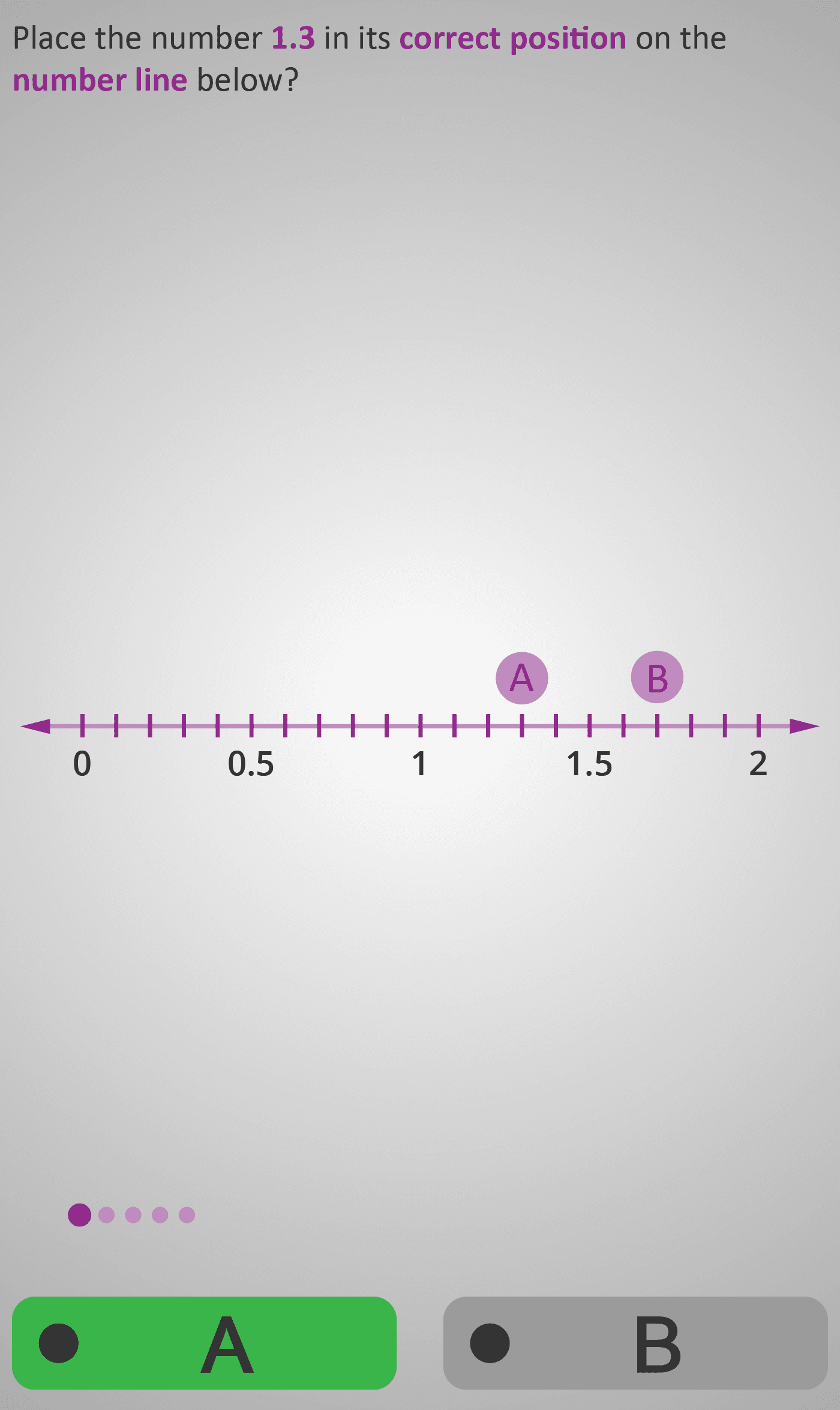
Each screen displays a clean, evenly spaced number line with labelled whole numbers and tick marks representing tenths. Students either identify which decimal lies at a marked point or place a given decimal in its correct position. The questions gradually build precision, transitioning from recognition to estimation and comparative reasoning.
This Phlow strengthens proportional thinking, decimal magnitude understanding, and spatial estimation — key foundations for measurement, fractions, and coordinate geometry. Learners “see” decimals as meaningful parts of a whole, bridging numerical and visual reasoning.
Worked Example
      Between 0 and 1, there are ten equal parts.
      Each small mark represents one tenth (0.1).
      Example: Point halfway between 0.4 and 0.5 = 0.45.
      Learners use spatial reasoning to judge accurate placement.
Sample Prompts
- Which point shows 0.6 on the number line?
- Place 1.4 in its correct position between 1 and 2.
- Which number is halfway between 2.0 and 3.0?
- Estimate where 6.5 would appear on this number line.
Why This Matters
Mastering decimals on a number line deepens understanding of scale, precision, and value relationships. This visual–numerical integration prepares learners for interpreting measurements, graph scales, and data visualisation. It is a vital bridge between primary arithmetic and higher-level mathematical reasoning.
Prerequisite Knowledge Required
- Counting forwards and backwards in whole numbers.
- Understanding tenths and decimal notation (0.1, 0.2, 0.3…).
- Experience placing halves or quarters on a number line (from earlier levels).
Linked Phlows:
Fractions 3B – Linking Fractions and Decimals,
Number Line 3 – Placing Halves and Quarters,
Place Value 4A – Understanding Decimal Digits.
Main Category
Number Sense → Decimals and Measurement
Estimated Completion Time
Approx. 10–14 seconds per question.
40 questions total → Total time: 7–10 minutes.
| Learner Profile | Estimated Time | Description |
|---|---|---|
| One Level Below | 9–10 min | Counts each tick carefully, double-checking decimal positions for accuracy. |
| At Level | 7–8 min | Quickly interprets decimal spacing and estimates values confidently. |
| One Level Above | 5–6 min | Mentally maps decimals to spatial intervals and predicts values instantly. |
Cognitive Load / Step Size
Moderate and well-balanced. Learners progress from direct recognition (e.g., “What is halfway between 0 and 1?”) to multi-step proportional reasoning across several units. Visual repetition supports fluency without monotony.
Language & Literacy Demand
Low. Instructions are concise and repetitive (“Place the number … on the number line”). The task relies on visual reasoning rather than text comprehension, ensuring accessibility for all reading levels and EAL learners.
Clarity & Design
- Clean, high-contrast design with consistent purple highlights for decimals.
- Equal tick spacing between whole numbers reinforces proportional structure.
- Question marks or lettered points guide visual attention without clutter.
- Linear simplicity ensures focus on numerical reasoning and scale perception.
Curriculum Alignment (ROI Junior Cycle Mathematics)
- Strand: Number
- Strand Unit: Operations – Decimals and Number Sense
- Learning Outcomes:
- Read, write, and locate decimal numbers on a number line.
- Compare and order decimals by magnitude.
- Develop proportional reasoning and estimation skills using spatial representation.
Engagement & Motivation
This Phlow feels like a visual puzzle rather than a calculation exercise. Learners gain satisfaction from accurate placement and enjoy testing their own estimation instincts. The immediate visual feedback promotes confidence and curiosity.
Error Opportunities & Misconceptions
- Counting the wrong number of tick marks between whole numbers.
- Confusing 0.4 with 0.04 (decimal place misconception).
- Assuming each tick equals 0.5 instead of 0.1.
- Placing larger decimals to the left of smaller ones.
Transferability / Real-World Anchoring
Strong. Skills directly transfer to reading real-world scales — thermometers, rulers, graphs, and measuring instruments. Understanding decimal placement supports measurement accuracy and quantitative reasoning across STEM subjects.
Conceptual vs Procedural Balance
Strongly conceptual. Success relies on understanding decimal size, place value, and proportional spacing — not memorisation. Students internalise that decimals represent divisions of one unit and can visualise this meaning on a scale.
Learning Objectives Addressed
- Understand decimals as parts of a whole unit.
- Locate decimals accurately between whole numbers on a number line.
- Compare and order decimals using visual reasoning.
- Connect numeric notation with geometric representation.
What Your Score Says About You
- Less than 20: You may need more practice connecting decimals to visual scale. Try using a ruler or measuring tool.
- 21–29: You’re developing good intuition for decimal spacing — keep practising estimation.
- 31–39: You demonstrate strong decimal reasoning and confident visual placement.
- 40 / 40: Excellent mastery — you can visualise decimal magnitudes instantly and interpret scales precisely.