
Numbers 4A
Overview
In this Phlow, learners practise comparing 4-digit numbers to identify which is greater or smaller. Each question presents two numbers side by side — for example, 4286 or 4826? — and students must decide which is larger or smaller.
Through repetition, learners strengthen their understanding of place value — thousands, hundreds, tens, and ones — while building fluency in scanning multi-digit numbers from left to right. This Phlow focuses on logical comparison rather than arithmetic, teaching learners to look for the first digit that differs rather than performing subtraction.
The progression moves from clearly different numbers (e.g. 2099 vs 5948) to subtle digit shifts (e.g. 7727 vs 7772), helping students refine accuracy, speed, and visual discrimination. By the end, they can confidently interpret magnitude relationships in multi-digit numbers — a core skill for estimation, rounding, and more advanced numerical operations.
Worked Example
      Compare 4286 and 4826:
      Step 1: Look at the thousands digit → 4 = 4 (same)
      Step 2: Look at the hundreds digit → 2 < 8
      Therefore, 4286 < 4826
Sample Prompts
- Which number is smaller: 3948 or 3984?
- Which number is greater: 7727 or 7772?
- Order these numbers from smallest to largest.
- How do you know which number is bigger?
Why This Matters
Understanding multi-digit comparisons is essential for number sense and real-world numeracy. It forms the basis for rounding, estimating, interpreting data, and recognising numerical patterns. This Phlow helps learners develop confidence, fluency, and precision in comparing numbers efficiently.
Prerequisite Knowledge Required
- Understanding of place value (thousands, hundreds, tens, ones).
- Familiarity with “greater than” and “less than” symbols and meanings.
- Experience comparing 2- and 3-digit numbers.
Linked Phlows:
Numbers 3B – Comparing 2- and 3-Digit Numbers,
Place Value 4A – Understanding Digit Significance,
Rounding 4B – Rounding to the Nearest Hundred or Thousand.
Main Category
Number Sense → Place Value and Comparison
Estimated Completion Time
Approx. 10–14 seconds per question.
40 questions total → Total time: 7–10 minutes.
| Learner Profile | Estimated Time | Description |
|---|---|---|
| One Level Below | 9–10 min | May read digits one by one or confuse order; benefits from reminders to scan left to right. |
| At Level | 7–8 min | Recognises digit hierarchy and compares efficiently using quick mental checks. |
| One Level Above | 5–6 min | Identifies magnitude instantly with intuitive pattern recognition and minimal effort. |
Cognitive Load / Step Size
Low to moderate. Each question follows the same comparison structure, building automaticity through repetition. Later tasks increase complexity subtly by varying digit patterns, promoting precision and sustained attention without overloading memory.
Language & Literacy Demand
Low. The questions are numerically focused (“Which number is greater?”). The minimal text ensures accessibility for learners with diverse reading levels — comprehension depends on numerical, not linguistic, reasoning.
Clarity & Design
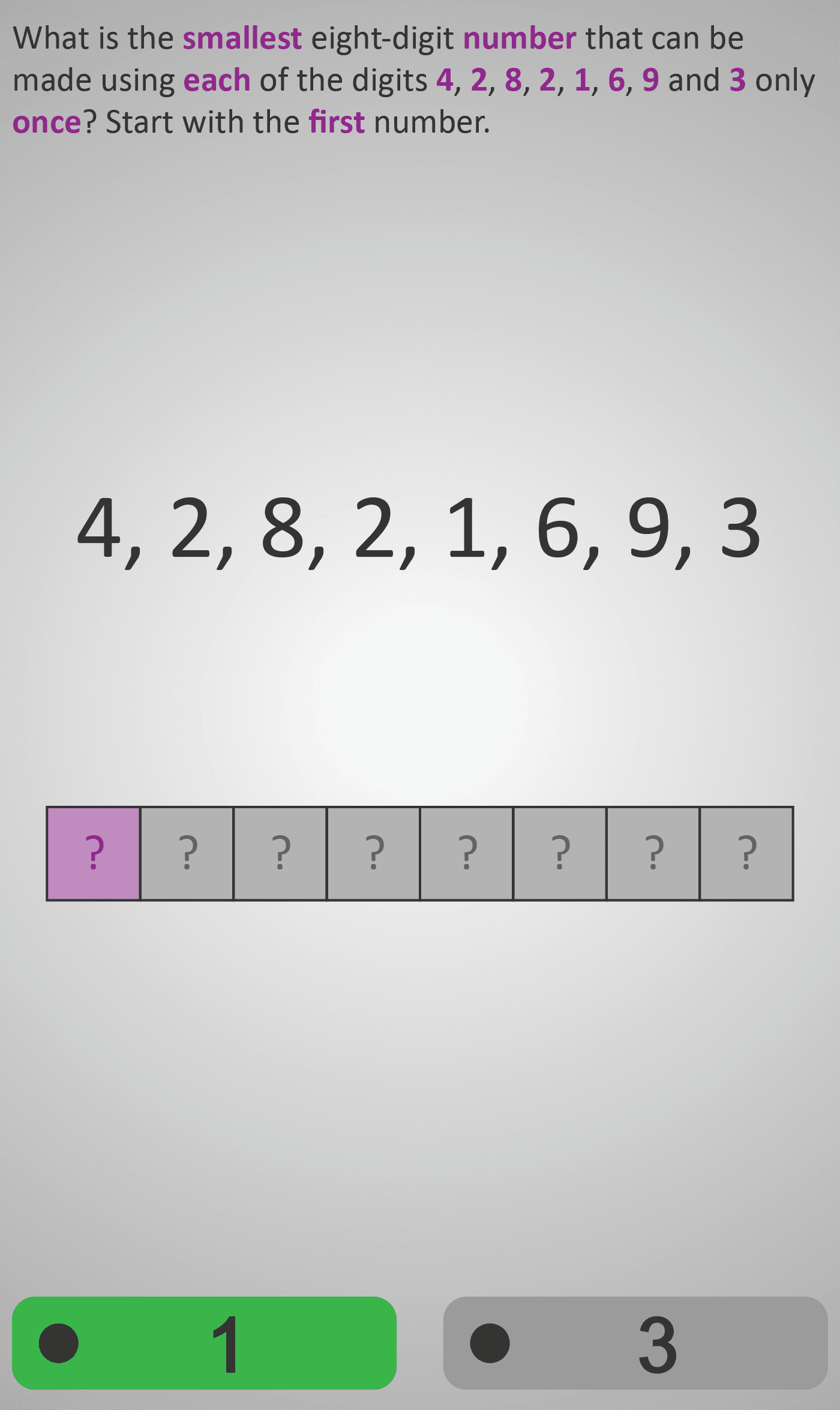
- Monochrome number blocks clearly separate comparison pairs.
- Purple highlighting directs focus to the target numbers.
- Minimalist background ensures attention remains on the comparison task.
- Predictable layout (left–right options) encourages quick pattern recognition and confidence.
Curriculum Alignment (ROI Junior Cycle Mathematics)
- Strand: Number
- Strand Unit: Place Value, Comparing & Ordering Numbers
- Learning Outcomes:
- Compare numbers up to and beyond 10,000 using place value reasoning.
- Identify which of two or more numbers is greater or smaller.
- Understand how digit value depends on its position within a number.
Engagement & Motivation
The fast-paced, visual nature of the activity feels like a logic challenge rather than a worksheet. Students enjoy the instant feedback and pattern satisfaction, which keeps motivation and focus high.
Error Opportunities & Misconceptions
- Comparing digits from right to left instead of left to right.
- Confusing repeated digit patterns (e.g., 7727 vs 7772).
- Overlooking the first differing digit and misjudging magnitude.
- Misreading digit order in large numbers (common dyscalculia pattern).
Transferability / Real-World Anchoring
Strong. Comparing large numbers underpins everyday numeracy — reading prices, analysing data, evaluating scores, and estimating totals. It builds intuitive understanding for financial literacy, measurement, and decision-making.
Conceptual vs Procedural Balance
Balanced. The task is procedurally simple (choose greater/smaller) but conceptually rooted in place value reasoning. Learners develop insight into why one number is larger, not just which one.
Learning Objectives Addressed
- Compare and order 4-digit numbers using place value.
- Recognise and interpret magnitude differences accurately.
- Develop fluency in reading and comparing multi-digit numbers.
- Apply place value understanding to real-world number interpretation.
What Your Score Says About You
- Less than 20: You may be comparing digits inconsistently — revisit place value basics and scan numbers left to right.
- 21–29: You understand the rule but sometimes miss the first differing digit.
- 31–39: You compare efficiently and accurately — strong understanding of digit hierarchy.
- 40 / 40: Excellent mastery — instant recognition of multi-digit magnitude and strong number sense.