
Numbers 4B
Overview
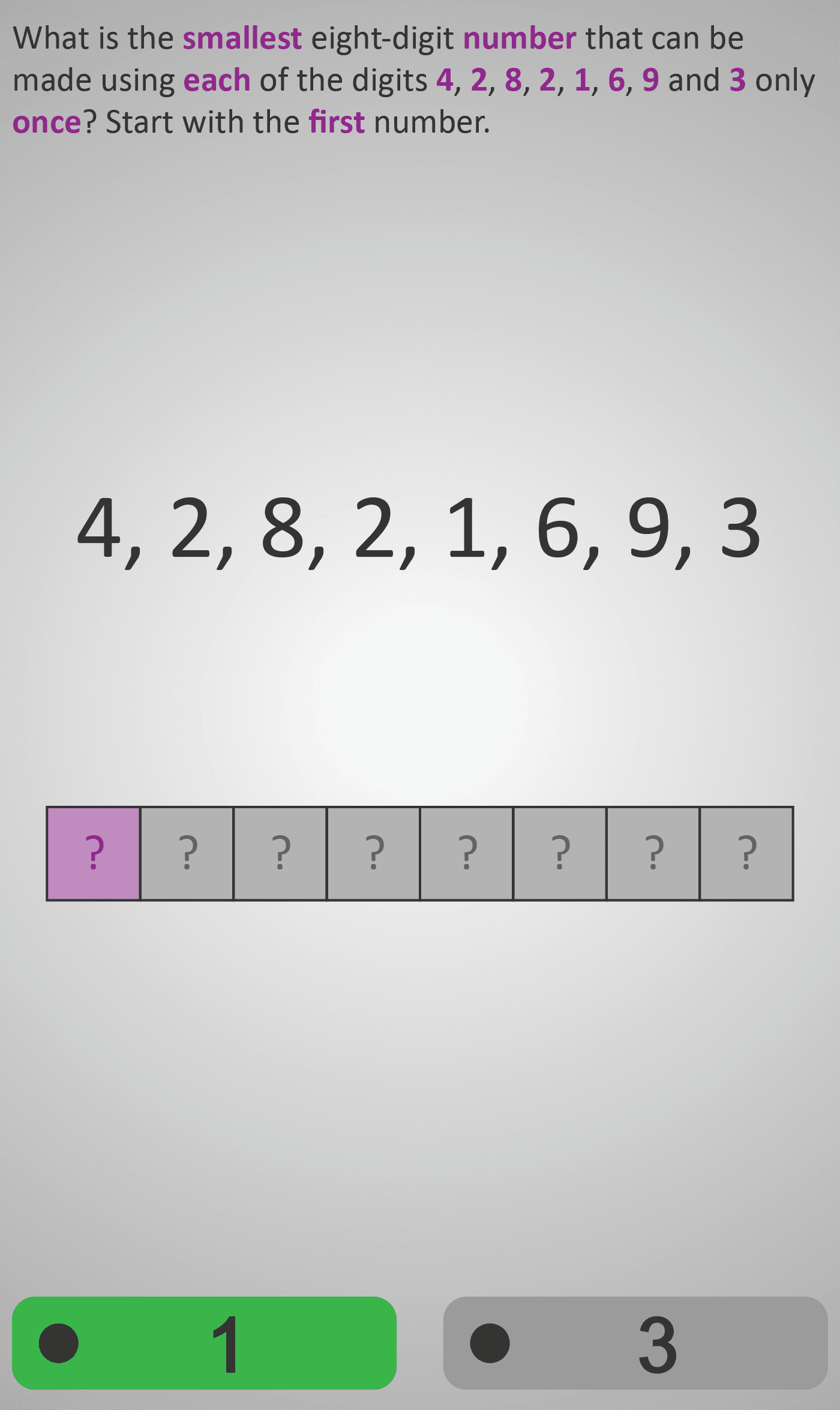
In this Phlow, learners build the smallest possible 8-digit number from the digits {4, 2, 8, 2, 1, 6, 9, 3}, using each exactly once. The interactive layout shows an eight-box number tray and two large options at each step (e.g., “1 or 3?”). Students select the smaller remaining digit to place in the next position from left to right.
One digit (2) appears twice, so learners must remember that two 2s are available. Near the end, occasional distractors like “10” test whether learners truly understand that only single digits can be used. When complete, the correct smallest number is 12234689.
This Phlow strengthens understanding of place value, ordering, and logical sequencing. Learners experience why early digits (thousands, millions) have more influence than later ones and how duplicate digits affect outcomes.
Worked Example
      Digits: 4, 2, 8, 2, 1, 6, 9, 3

      Step 1: Choose smallest → 1
      Step 2: Remaining {2, 2, 3, 4, 6, 8, 9} → choose 2
      Step 3: Remaining {2, 3, 4, 6, 8, 9} → choose 2
      Step 4: Remaining {3, 4, 6, 8, 9} → choose 3
      Continue until final number = 12234689
Sample Prompts
- Which digit will make your number smallest so far?
- Why must the first digit be the smallest available?
- How does using 2 twice change your options?
- Which number should come last — 8 or 9?
Why This Matters
Building numbers from given digits strengthens understanding of numerical hierarchy and constraint reasoning. It connects place value knowledge to real-world logic tasks such as forming PINs, IDs, or sorting data by smallest to largest. Learners develop efficient decision-making and pattern recognition under mild cognitive load — an ideal flow-state activity.
Prerequisite Knowledge Required
- Understanding of place value up to millions (Place Value 3).
- Ability to compare and order multi-digit numbers (Compare & Order Numbers 3).
- Experience arranging numbers in ascending/descending order (Ascending & Descending Order 3).
Main Category
Number → Place Value & Ordering
Estimated Completion Time
Approx. 10–14 seconds per question.
40 questions total → Total time: 7–10 minutes.
Cognitive Load / Step Size
Low intrinsic load due to binary (two-choice) steps, but moderate working-memory demand to remember which digits remain — especially the duplicate 2. Step size is uniform, keeping flow consistent while slightly increasing challenge toward the final places.
Language & Literacy Demand
Minimal. Instructions use clear, repeated verbs like “choose”, “next”, and “smallest”. Text is minimal and highly visual, making the Phlow accessible for all learners regardless of reading level.
Clarity & Design
- Large, bold digits and a simple eight-box tray.
- Two big option buttons ensure clarity and easy decision-making.
- Progress dots indicate remaining steps.
- Occasional distractors (e.g., “10”) are visually distinct but conceptually fair.
Curriculum Alignment (ROI Junior Cycle Mathematics)
- Strand: Number
- Strand Unit: Place Value and Ordering
- Learning Outcomes:
- Use place value understanding to compare and order integers.
- Construct numbers from given digits and justify reasoning.
- Explain why earlier digits have greater positional weight.
Engagement & Motivation
The task feels like a puzzle game rather than a test. Fast feedback, simple visuals, and visible progress sustain motivation. The duplicate 2 keeps it slightly unpredictable, maintaining interest without frustration.
Error Opportunities & Misconceptions
- Confusing “smallest” with “largest”.
- Using only one of the two 2s.
- Choosing digits by appearance rather than value (e.g., picking 3 before 2).
- Thinking “10” is a valid single digit.
- Forgetting that early positions affect total magnitude more than later ones.
Transferability / Real-World Anchoring
High transfer value. Skills apply to sorting data, forming numerical codes, and understanding numerical order in contexts such as budgeting, coding, or measurements. It also introduces logic structures useful in combinatorics and permutation problems.
Conceptual vs Procedural Balance
Procedural with conceptual reinforcement. The repeated binary choices build procedural fluency, while brief conceptual prompts (“Why must your first choice be the smallest?”) encourage reflection on place value logic.
Learning Objectives Addressed
- Use place value reasoning to order and construct multi-digit numbers.
- Understand how digit position affects overall magnitude.
- Work within constraints — each digit used once, duplicates allowed where given.
- Explain strategies for minimising or maximising a number logically.
What Your Score Says About You
- Less than 20: You can spot small vs large but may not yet apply place value reasoning automatically. Review “Compare & Order Numbers 3”.
- 21–29: You understand the logic but occasionally slip with duplicates or later steps — slow down and double-check remaining digits.
- 31–39: You apply place value reasoning consistently — strong progress.
- 40 / 40: Mastery. You handle constraints confidently and understand place value influence completely — ready for permutations and mixed challenges.