
Patterns 4A
Overview
In this Phlow, learners explore visual patterns and sequences, extending their understanding of order and prediction beyond numbers to include shape transformations and repetitions.
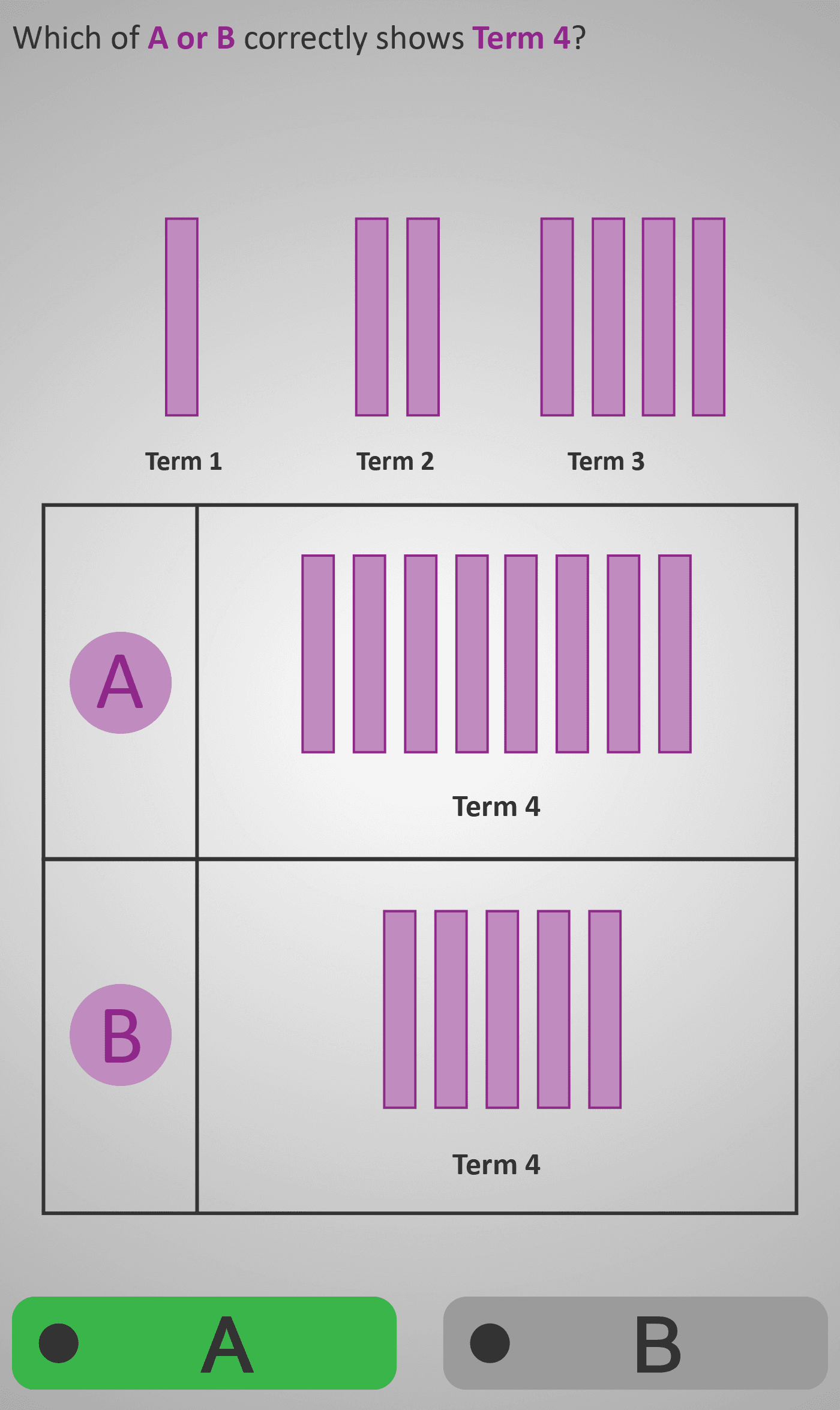
Each sequence shows Terms 1–3, followed by two possible Term 4 options (A or B). Students identify which option correctly continues the pattern by applying reasoning about shape, number, or orientation.
Patterns evolve across multiple dimensions:
- Shape progression (triangle → square → pentagon → hexagon)
- Number of objects (1 bar → 2 bars → 4 bars → 8 bars)
- Layered or nested growth (e.g. circles gaining one ring per step)
- Partial removal or rotation (e.g. segments missing or shifting)
Worked Example
      Term 1: △
      Term 2: ☐
      Term 3: ⬠
      Question: Which of the following is Term 4?
        A: ⬡      B: ☐
      Correct answer: A (hexagon)
      Rule: Each new term adds one side to the shape.
Sample Prompts
- What changes from one term to the next?
- Does the pattern grow, repeat, rotate, or reduce?
- Which option follows the same rule?
Why This Matters
Pattern recognition underpins algebraic thinking, coding logic, and scientific observation. By learning to identify and explain rules, students move from seeing patterns as visual coincidences to understanding them as predictable systems governed by consistent logic.
Prerequisite Knowledge Required
- Recognition of basic 2D shapes (triangle, square, pentagon, hexagon, circle).
- Understanding ordinal position (first, second, third, fourth).
- Awareness of simple visual growth or repetition patterns.
Linked Phlows:
Patterns 3A – Identifying visual repeats,
Number Patterns 3B – Extending numeric sequences,
Algebra 4A – Introducing rule-based thinking.
Main Category
Algebra → Patterns and Sequences
Estimated Completion Time
Approx. 10–14 seconds per question.
40 questions total → Total time: 7–10 minutes.
| Learner Profile | Estimated Time | Description |
|---|---|---|
| One Level Below | 9–10 min | Needs extra time to interpret changing visual features or rotation rules. |
| At Level | 7–8 min | Quickly recognises progression and tests possible rules mentally. |
| One Level Above | 5–6 min | Abstracts rules immediately and can describe them algebraically. |
Cognitive Load / Step Size
Well-balanced. Each sequence focuses on a single transformation (shape, number, or orientation), allowing learners to isolate and practise one reasoning type at a time. Difficulty increases gradually as patterns shift from literal to more abstract.
Language & Literacy Demand
Low. Minimal text ensures accessibility — the phrase “Which of A or B correctly shows Term 4?” appears consistently. The visual sequences carry meaning, allowing students to reason independently of literacy level.
Clarity & Design
- Consistent purple–grey palette highlights shape change, not colour.
- Predictable layout (Terms 1–3 → A/B) builds rhythm and comfort.
- Geometric precision ensures accuracy and visual clarity.
- Immediate contrast between “rule-following” and “rule-breaking” reinforces logical consistency.
Curriculum Alignment (ROI Junior Cycle Mathematics)
- Strand: Algebra
- Strand Unit: Patterns and Relationships
- Learning Outcomes:
- Recognise, describe, and extend shape and number patterns.
- Predict subsequent terms using logical rules.
- Identify repeating or growing patterns in multiple contexts.
- Connect pattern recognition to algebraic reasoning.
Engagement & Motivation
The puzzle-like structure keeps learners engaged through curiosity and instant feedback. Each success reinforces a sense of mastery, and the visual challenge fosters sustained concentration. The intuitive design ensures continuous flow and intrinsic motivation.
Error Opportunities & Misconceptions
- Focusing on irrelevant visual features (colour, size) instead of rule.
- Assuming repetition when the pattern is actually growing.
- Miscounting elements or missing rotations.
- Failing to distinguish between additive and multiplicative growth.
Transferability / Real-World Anchoring
High transfer value. Pattern recognition underlies mathematics, coding, art, music, and design. Students connect these skills to everyday reasoning — spotting regularity, predicting outcomes, and understanding systems.
Conceptual vs Procedural Balance
Primarily conceptual. The goal is understanding the why of the pattern, not just identifying the next image. Students learn to describe the governing rule — a key precursor to algebraic generalisation.
Learning Objectives Addressed
- Identify and continue visual and numeric patterns accurately.
- Describe pattern rules using logical reasoning.
- Distinguish between different types of pattern change (growth, rotation, repetition).
- Develop readiness for algebraic “nth term” thinking.
What Your Score Says About You
- Less than 20: You may be spotting surface features rather than underlying rules — compare term changes more closely.
- 21–29: You recognise most patterns but occasionally miss alternating or compound rules.
- 31–39: You demonstrate strong rule-based reasoning — excellent visual logic.
- 40 / 40: Mastery. You generalise rules instantly and can describe them algebraically.