
Patterns 4B
Overview
In this Phlow, learners explore how visual growth patterns can be represented and reasoned about using fractions. This bridges pattern recognition, proportional reasoning, and early algebraic thinking.
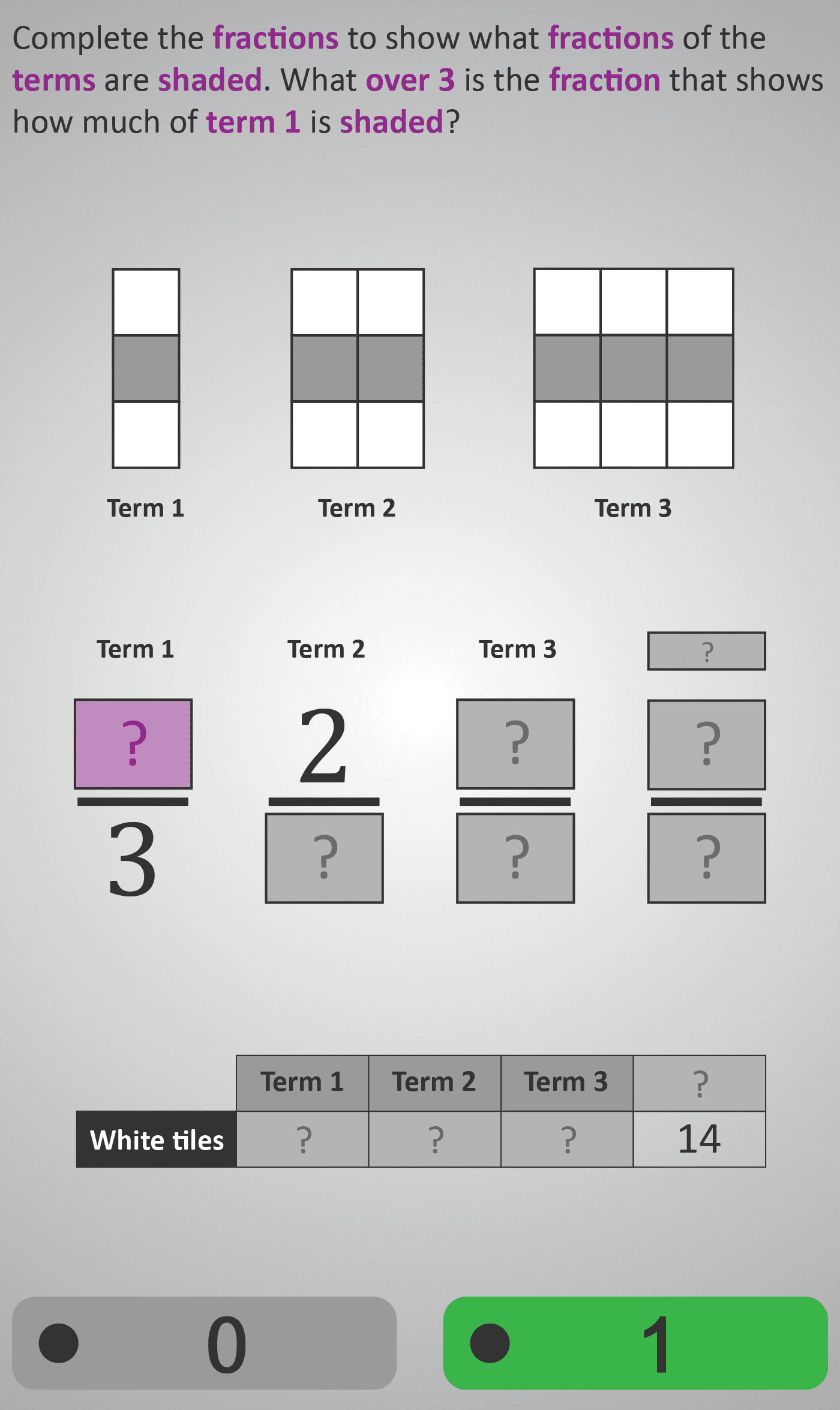
Each sequence shows a growing grid of shaded and white tiles. Students analyse how the shaded portion changes term by term and express this change as a fraction. They identify patterns both visually (by counting tiles) and symbolically (by writing the fractions).
Key reasoning steps include:
- Completing and simplifying fractions to represent shading patterns.
- Recognising how numerators and denominators increase together.
- Identifying equivalent fractions within the sequence (e.g., 1/3 → 2/6 → 3/9 → 7/21).
- Predicting the next term using proportional or multiplicative reasoning.
Worked Example
      Term 1: 1 shaded tile out of 3 total → 1/3
      Term 2: 2 shaded tiles out of 6 total → 2/6
      Term 3: 3 shaded tiles out of 9 total → 3/9
      Question: What fraction represents Term 4?
      A: 4/12     B: 7/21
      Correct answer: B (pattern ×3)
Sample Prompts
- How does the number of shaded tiles change each term?
- What happens to the denominator as the sequence grows?
- Are the fractions equivalent?
- Predict what the next term’s fraction will be.
Why This Matters
This Phlow helps learners see the structure of fractions through patterns, strengthening both conceptual and symbolic understanding. It bridges arithmetic (fractions and ratios) and algebraic reasoning (rules and relationships), developing students’ ability to generalise patterns numerically and visually.
Prerequisite Knowledge Required
- Understanding of unit fractions and equivalence (e.g., 1/3 = 2/6).
- Basic sequence recognition (Terms 1–3 → predict Term 4 or 5).
- Ability to identify numerator and denominator parts of a fraction.
- Familiarity with shaded and unshaded regions in visual models.
Linked Phlows:
Fractions 3C – Shading and parts of a whole,
Patterns & Sequences 4A – Visual term prediction,
Ratio 4A – Comparing shaded vs. white growth.
Main Category
Algebra / Fractions → Patterns and Relationships
Estimated Completion Time
Approx. 10–14 seconds per question.
40 questions total → Total time: 7–10 minutes.
| Learner Profile | Estimated Time | Description |
|---|---|---|
| One Level Below | 9–10 min | Needs time to interpret fraction growth visually and symbolically. |
| At Level | 7–8 min | Connects numerator/denominator growth to the pattern rule efficiently. |
| One Level Above | 5–6 min | Can describe and generalise the pattern algebraically. |
Cognitive Load / Step Size
Moderate and cumulative. Each question builds gently, adding one conceptual layer at a time: counting → fraction notation → equivalence → prediction. Visual scaffolds (tile grids, fraction tables) keep intrinsic load manageable while maintaining deep reasoning.
Language & Literacy Demand
Medium. Mathematical keywords (“numerator”, “denominator”, “fraction”, “term”) are highlighted in purple. Sentence structure is consistent, and most information is conveyed visually through clear fraction layouts and tile patterns. Encourages mathematical vocabulary without overloading text comprehension.
Clarity & Design
- Clean grid visuals show term-by-term tile growth.
- Fraction expressions are aligned below diagrams for immediate comparison.
- Purple accents emphasise key operations and new terms.
- Sequential highlighting (Term 1 → Term 2 → Term 3 → unknown) guides attention smoothly.
Curriculum Alignment (ROI Junior Cycle Mathematics)
- Strand: Algebra / Number
- Strand Unit: Patterns and Relationships; Fractions
- Learning Outcomes:
- Recognise, describe, and extend visual and numerical patterns.
- Connect fractional and proportional reasoning to algebraic models.
- Express growth rules symbolically using terms and fractions.
- Understand equivalence and scaling in fraction patterns.
Engagement & Motivation
The combination of visual puzzles and fraction logic keeps learners engaged. Each step offers a satisfying “aha” moment as they see the rule emerge. The design encourages self-correction and flow — perfect for reinforcing understanding through discovery.
Error Opportunities & Misconceptions
- Swapping numerator and denominator.
- Counting total or shaded tiles incorrectly.
- Assuming additive rather than multiplicative growth (e.g., +3 vs ×3).
- Misinterpreting shaded vs. white parts.
Transferability / Real-World Anchoring
Strong transfer value. Skills apply to proportional reasoning in design, scaling, ratios, and data representation. Learners grasp that fraction and ratio relationships describe growth patterns — essential for understanding functions and change later.
Conceptual vs Procedural Balance
Strongly conceptual. Students are reasoning about why the fractions grow as they do, not just calculating. Procedural fluency (fraction writing, simplification) emerges through repeated, meaningful practice.
Learning Objectives Addressed
- Identify visual and numeric patterns across sequential terms.
- Express fractional relationships symbolically and visually.
- Connect proportional reasoning with pattern extension.
- Transition from concrete tile models to algebraic generalisation.
What Your Score Says About You
- Less than 20: You may see the pattern visually but not connect it to fraction growth — check how denominators change.
- 21–29: You follow the rule but may miss consistency between shaded and white tiles.
- 31–39: Strong grasp — you understand both visual and numerical scaling clearly.
- 40 / 40: Mastery — you can explain the fraction pattern algebraically and generalise any term.