
Patterns 4D
Overview
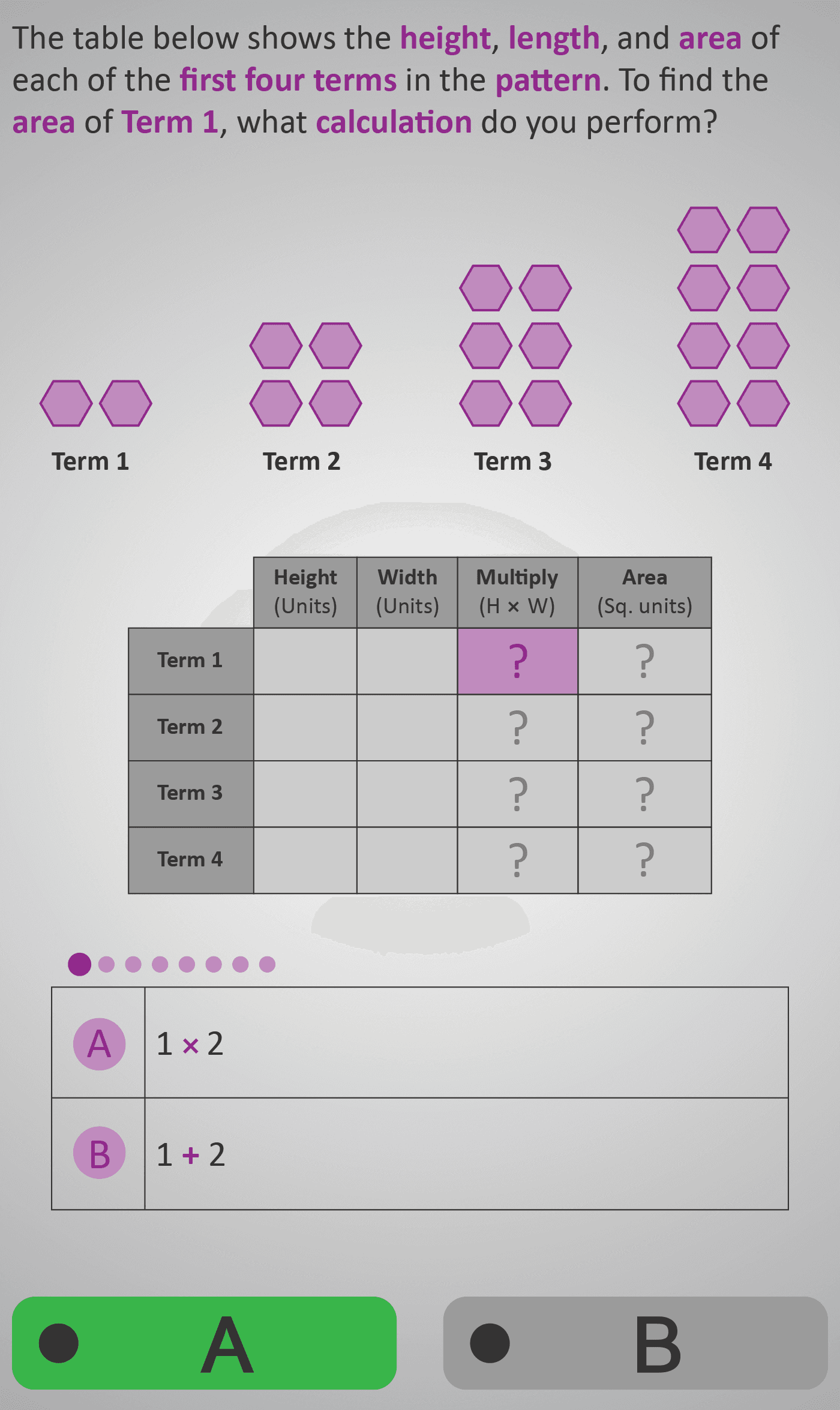
In this Phlow, learners investigate how area grows within a pattern by linking visual reasoning to tabular data and multiplication. Each term adds another row of hexagons, increasing height while keeping width constant, helping students recognise and describe how the area expands systematically.
Learners complete and interpret a table showing height, width, multiplication (H × W), and resulting area:
      Term | Height | Width | Multiply (H×W) | Area
      ---------------------------------------------
       1   |   1    |   2   |     1×2        |  2
       2   |   2    |   2   |     2×2        |  4
       3   |   3    |   2   |     3×2        |  6
       4   |   4    |   2   |     4×2        |  8
This pattern leads students to express a general rule: Area = Height × 2. Each question guides learners through a progression of reasoning steps:
- Identify the correct operation (×, not +).
- Complete missing values for height, width, or area.
- Predict new areas and explain the rule behind the pattern.
Worked Example
      Pattern Rule:
      Width = 2 squares (constant)
      Height = Term number

      Area = Height × Width = Term × 2

      Term 1: 1×2 = 2
      Term 2: 2×2 = 4
      Term 3: 3×2 = 6
      Term 4: 4×2 = 8

      General Rule → Area = Term × 2
Sample Prompts
- What operation connects height and width?
- How does the area grow as the term number increases?
- What stays the same across all terms?
- Can you describe the rule for the pattern?
Why This Matters
This Phlow bridges arithmetic and algebra by showing that area patterns can be represented using functional rules. It strengthens conceptual understanding of multiplication, structure, and proportionality — essential for geometry, data analysis, and algebraic thinking in later levels.
Prerequisite Knowledge Required
- Understand area as length × width for rectangles or grids.
- Be fluent with multiplication facts and repeated addition.
- Recognise patterns that increase by a consistent rule.
- Read and fill in data tables accurately.
Linked Phlows:
Patterns & Sequences 4C – Interpreting numeric growth in real contexts,
Area 3A – Calculating area of rectangular shapes,
Multiplication 3B – Repeated addition and grouping.
Main Category
Measurement / Algebra → Connecting Patterns and Area
Estimated Completion Time
Approx. 10–14 seconds per question.
40 questions total → Total time: 7–10 minutes.
| Learner Profile | Estimated Time | Description |
|---|---|---|
| One Level Below | 9–10 min | May rely on counting shapes instead of applying the multiplication rule. |
| At Level | 7–8 min | Uses the table systematically to apply and verify the rule. |
| One Level Above | 5–6 min | Generalises immediately (Area = Height × 2) and predicts unseen terms easily. |
Cognitive Load / Step Size
Moderate and well-sequenced. Each step adds one layer of complexity — identifying operations, completing missing numbers, or extending the pattern. The combination of visual pattern and numeric table supports dual coding, allowing learners to reason both concretely and abstractly.
Language & Literacy Demand
Low to medium. Vocabulary is consistent (height, width, multiply, area, term), and visuals provide meaning context. Key terms are highlighted in purple to support focus, ensuring accessibility for diverse learners.
Clarity & Design
- Dual representation: hexagon diagram + numeric table reinforces understanding.
- Consistent column layout helps track relationships clearly.
- Purple emphasis on operations (e.g., 2×3) guides learner attention.
- Clean design and progression markers maintain flow and engagement.
Curriculum Alignment (ROI Junior Cycle Mathematics)
- Strand: Algebra / Measures
- Strand Unit: Patterns and Relationships; Area
- Learning Outcomes:
- Represent and analyse patterns using tables and diagrams.
- Recognise multiplicative relationships in structured growth patterns.
- Connect repeated addition and multiplication to the concept of area.
- Describe and predict terms using general rules and reasoning.
Engagement & Motivation
High engagement from the visual–numeric link: learners “discover” the rule as they calculate. The pattern’s logical simplicity makes success feel intuitive, while prediction tasks sustain curiosity. The Phlow blends geometry and arithmetic fluency to promote confidence in structured reasoning.
Error Opportunities & Misconceptions
- Using addition instead of multiplication (e.g., 1+2 instead of 1×2).
- Mixing up height and width columns.
- Treating area as “number of tiles” instead of as a multiplicative relationship.
- Forgetting that width remains constant while height changes.
Transferability / Real-World Anchoring
Strong. Skills connect directly to interpreting data grids, architectural layouts, and proportional scaling. Students see that patterns in geometry can be expressed as rules — a crucial step toward functional thinking.
Conceptual vs Procedural Balance
Balanced leaning toward conceptual. Students practise area calculation (procedure) but discover why the relationship holds. The table format encourages relational understanding and rule formation — bridging arithmetic and algebra.
Learning Objectives Addressed
- Calculate area using height × width.
- Recognise numerical and visual growth patterns in tables.
- Generalise relationships (Area = Height × constant).
- Predict new terms and explain rule-based reasoning.
What Your Score Says About You
- Less than 20: You may still count tiles manually — focus on applying the multiplication rule consistently.
- 21–29: You understand area and multiplication but occasionally mix height or width values — check your table entries.
- 31–39: You use the rule effectively and extend it with confidence — strong grasp of multiplicative patterns.
- 40 / 40: Mastery — you generalise like a mathematician, describing area growth through functional relationships.