
Percentage 4A
Overview
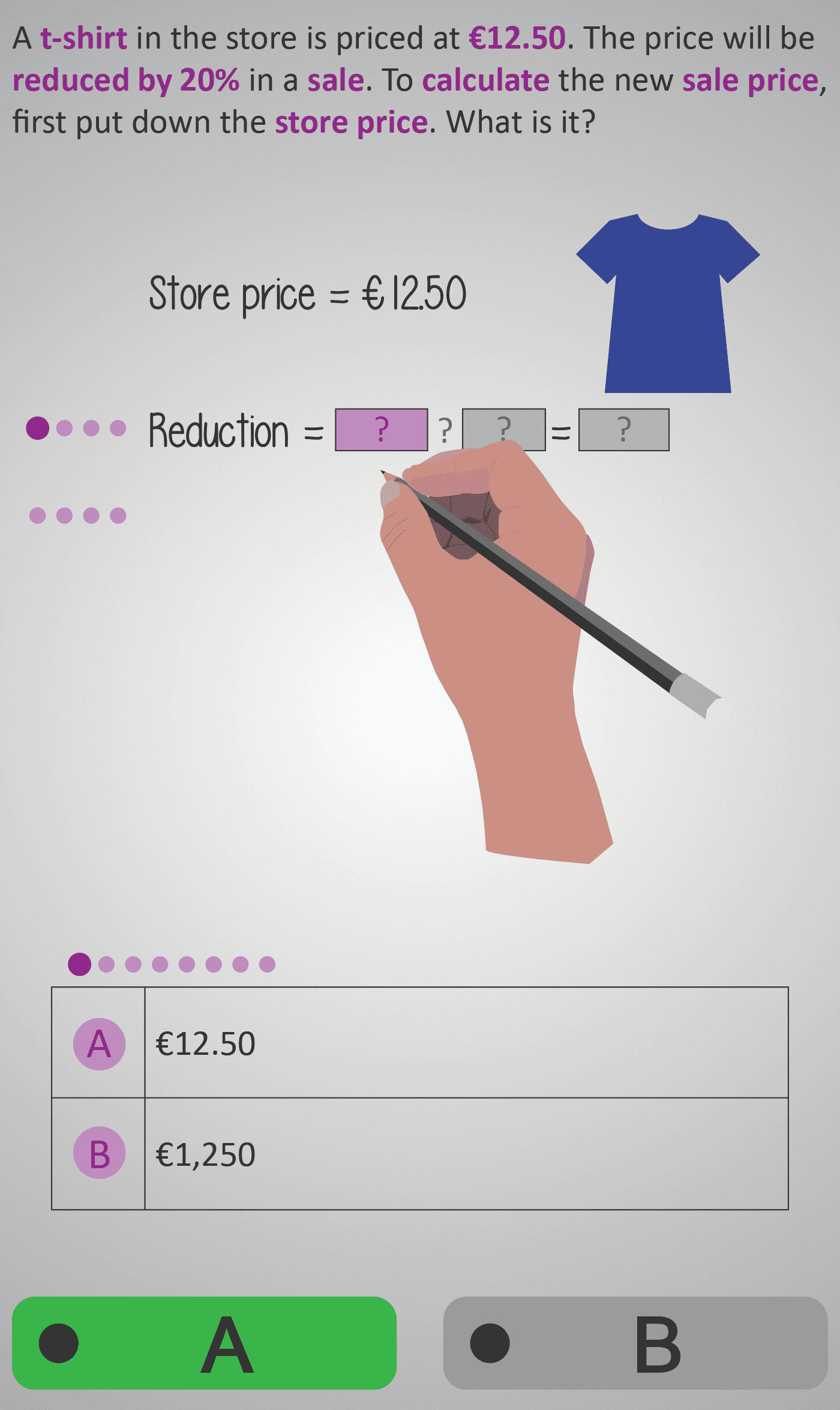
In this Phlow, learners calculate a sale price after a 20% reduction on a €12.50 T-shirt. The scenario mirrors a realistic shopping experience where discounts must be calculated manually. The task unfolds step-by-step to reinforce both the procedure and the reasoning behind each operation.
The learner progresses through four key actions:
- Identify the store price (€12.50).
- Convert 20% into its decimal equivalent (0.20).
- Find the reduction: 12.50 × 0.20 = €2.50.
- Subtract to find the final sale price: 12.50 − 2.50 = €10.00.
Learners actively choose between operations at each stage (multiply or subtract), ensuring engagement and reinforcing conceptual understanding of how each mathematical action affects the price.
Worked Example
      Original Price: €12.50
      Discount: 20% = 0.20

      Step 1: €12.50 × 0.20 = €2.50 (reduction)
      Step 2: €12.50 − €2.50 = €10.00 (sale price)
Sample Prompts
- What does “20% off” mean?
- What is 20% of €12.50?
- How do we find the sale price from the reduction?
- Which operation should we use here: multiply or subtract?
Why This Matters
This Phlow helps students apply percentage reasoning in everyday life. By embedding arithmetic operations within a familiar shopping context, learners build confidence using decimals and percentages meaningfully, not just mechanically.
Prerequisite Knowledge Required
- Convert percentages to decimals (e.g., 20% = 0.20).
- Multiply and subtract with decimals accurately.
- Understand money notation (€ and two decimal places).
Linked Phlows:
Fractions 3C – Converting Fractions to Decimals,
Decimals 3B – Multiplying by Decimals,
Money 3A – Adding and Subtracting Prices.
Main Category
Arithmetic → Percentages
Estimated Completion Time
Approx. 10–14 seconds per question.
40 questions total → Total time: 7–10 minutes.
Cognitive Load / Step Size
Well-calibrated step size. Each phase introduces one additional concept — conversion, multiplication, subtraction — while maintaining visual continuity. Purple highlights mark the current operation, guiding attention and reducing working-memory strain.
Language & Literacy Demand
Moderate. Sentences are short and action-oriented (“Find the reduction”, “Subtract the discount”). Key words such as “percentage,” “reduction,” and “sale price” are consistently reinforced and highlighted in purple.
Clarity & Design
- Consistent T-shirt and price-tag visuals across all steps.
- Handwriting animation reinforces calculation sequence.
- Colour coding: purple for focus, green for correct response.
- Minimal on-screen clutter ensures step-by-step focus.
Curriculum Alignment (ROI Junior Cycle Mathematics)
- Strand: Number
- Learning Outcome: Explore the relationship between percentages, fractions, and decimals, and apply percentages to real-world contexts such as price reductions.
Engagement & Motivation
A familiar retail context keeps learners invested — everyone relates to discounts and sales. The clear goal (finding the sale price) provides instant feedback and satisfaction, maintaining flow through intuitive challenge–reward balance.
Error Opportunities & Misconceptions
- Multiplying by 20 instead of 0.20.
- Subtracting before finding the reduction.
- Misplacing decimals during multiplication.
- Forgetting that subtraction gives the final sale price, not the reduction itself.
Transferability / Real-World Anchoring
Excellent. The concept directly applies to shopping, online discounts, and budgeting — skills essential for everyday financial literacy and independence.
Conceptual vs Procedural Balance
Procedural base with conceptual reinforcement. Each procedural step is contextualised — learners understand why they multiply (to find a portion) and why they subtract (to find what remains).
Learning Objectives Addressed
- Convert percentages to decimals accurately.
- Find percentage reductions through multiplication.
- Calculate sale prices by subtraction from the original cost.
- Apply percentage reasoning confidently in money contexts.
What Your Score Says About You
- Less than 20: Needs more fluency with decimals and percentage conversion.
- 21–29: Understands steps but may confuse operation order or decimal placement.
- 31–39: Confident and accurate, with rare slips in arithmetic detail.
- 40 / 40: Mastery — fully understands the logic and procedure of percentage reductions.