
Percentage 4B
Overview
In this Phlow, learners connect fractions and percentages through a simple, relatable data context — a class survey on hair colour. They learn to express data as fractions and then convert to percentages in a clear, logical sequence.
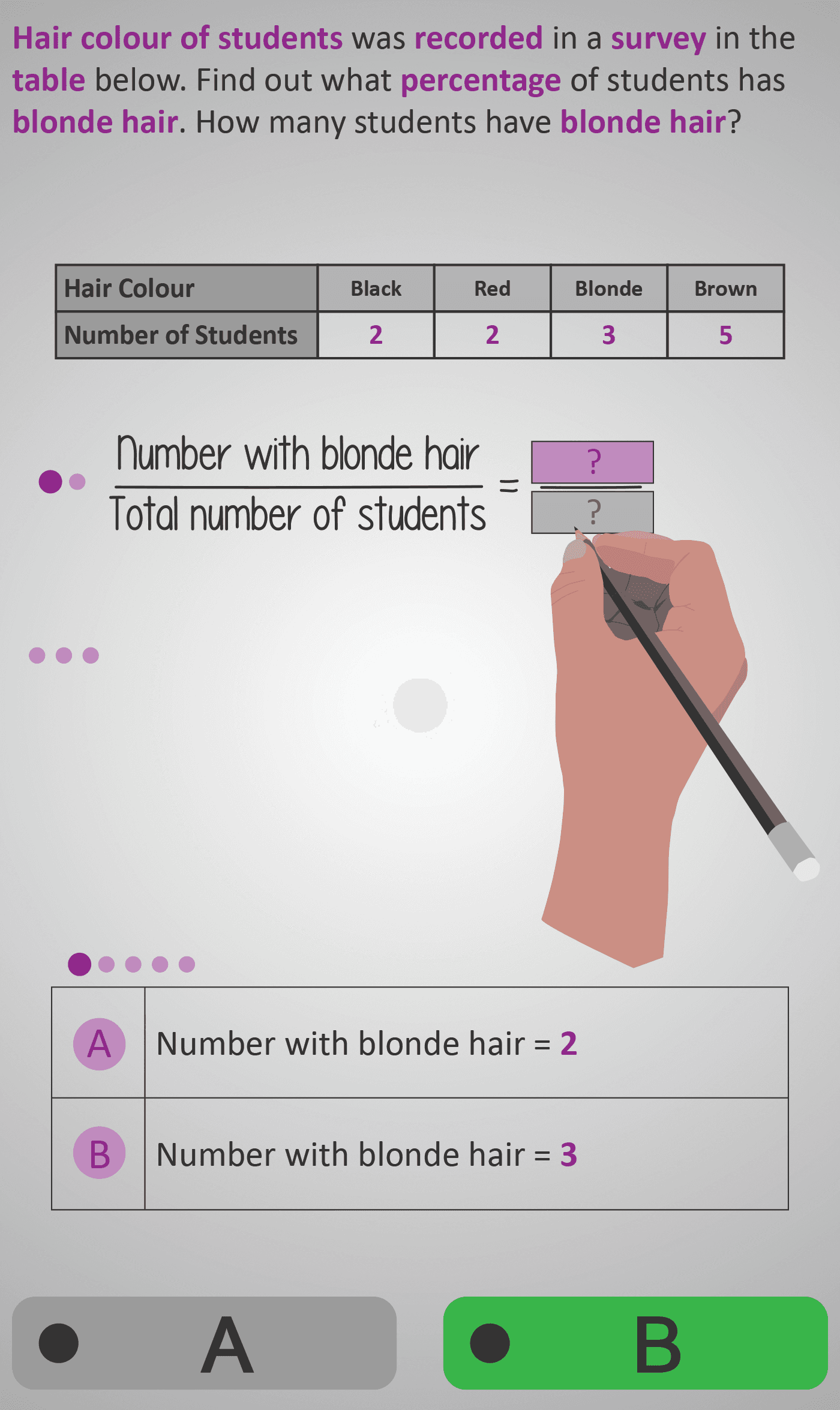
Students work through each micro-step to calculate the percentage of students with blonde hair:
- Identify the number with blonde hair (3).
- Identify the total number of students (12).
- Form the fraction 3/12.
- Simplify: 3/12 → 1/4.
- Convert: 1/4 = 25%.
Visual scaffolds — the table, fraction bar, and colour-coded highlights — guide learners through simplification and conversion in a low-stress, stepwise flow.
Worked Example
      Hair Colour Survey (12 students)
      -------------------------------
      Black: 4
      Brown: 3
      Blonde: 3
      Red: 2

      Fraction for Blonde = 3 / 12
      Simplify → 1 / 4
      Convert → 25%
Sample Prompts
- Which number goes on top of the line?
- Why can we simplify 3/12 to 1/4?
- What percentage does 1/4 represent?
- What does 25% mean in this survey context?
Why This Matters
This Phlow bridges the gap between fractions, decimals, and percentages by showing how each describes the same relationship in different forms. The survey theme builds statistical literacy — understanding percentages as tools for summarising real data.
Prerequisite Knowledge Required
- Understand fractions as parts of a whole.
- Know how to simplify fractions by dividing numerator and denominator.
- Recall benchmark conversions (½ = 50%, ¼ = 25%).
Linked Phlows:
Fractions 3A – Parts of a Whole,
Decimals 3C – Decimal and Fraction Equivalence,
Percentage 4A – Finding Reductions and Sale Prices.
Main Category
Arithmetic → Fractions → Percentages
Estimated Completion Time
Approx. 10–14 seconds per question.
40 questions total → Total time: 7–10 minutes.
Cognitive Load / Step Size
Balanced and linear. Each micro-step isolates one concept — numerator identification, denominator understanding, simplification, and conversion — building fluency without overload. The visual repetition of the fraction structure (“above / below the line”) reinforces correct reasoning and aids working memory.
Language & Literacy Demand
Low to moderate. Sentences are concise and supported by visuals. Mathematical vocabulary (“fraction,” “convert,” “percentage”) is contextualised and repeated. Tables and animations reduce reading dependence and support EAL learners.
Clarity & Design
- Simple table layout keeps data visible and easy to interpret.
- Fraction bar and purple highlight focus attention on numerator and denominator.
- Consistent handwriting animation illustrates simplification clearly.
- All visuals serve the learning goal — no decorative clutter.
Curriculum Alignment (ROI Junior Cycle Mathematics)
- Strand: Number
- Learning Outcome: Connect fractions, decimals, and percentages; express one as another and interpret these forms in real-world data contexts.
Engagement & Motivation
The class-survey context feels authentic and personally relevant, helping students see maths as a tool for describing and comparing real data. The satisfaction of “translating” 3/12 → 1/4 → 25% keeps motivation high through meaningful reasoning.
Error Opportunities & Misconceptions
- Reversing numerator and denominator (e.g. 12/3).
- Skipping simplification or applying it incorrectly.
- Thinking 3/12 = 3%.
- Confusing ¼ with 0.4 instead of 0.25.
Transferability / Real-World Anchoring
High. The survey setup mirrors how percentages appear in everyday statistics — from polls to reports — strengthening real-world numeracy and data interpretation skills.
Conceptual vs Procedural Balance
Conceptually strong. While students follow a procedure (simplify → convert), each action is tied to meaning — what the numerator and denominator represent in context. The design promotes understanding over memorisation.
Learning Objectives Addressed
- Construct fractions from data (part ÷ total).
- Simplify fractions before conversion.
- Apply known fraction–percentage equivalences.
- Interpret survey results using percentages.
What Your Score Says About You
- Less than 20: Unsure about numerator/denominator roles or conversion meaning.
- 21–29: Understands concept but may misapply simplification or conversion.
- 31–39: Strong conceptual grasp; only minor arithmetic slips.
- 40 / 40: Mastery — interprets, simplifies, and converts confidently and accurately.