
Percentage 4C
Overview
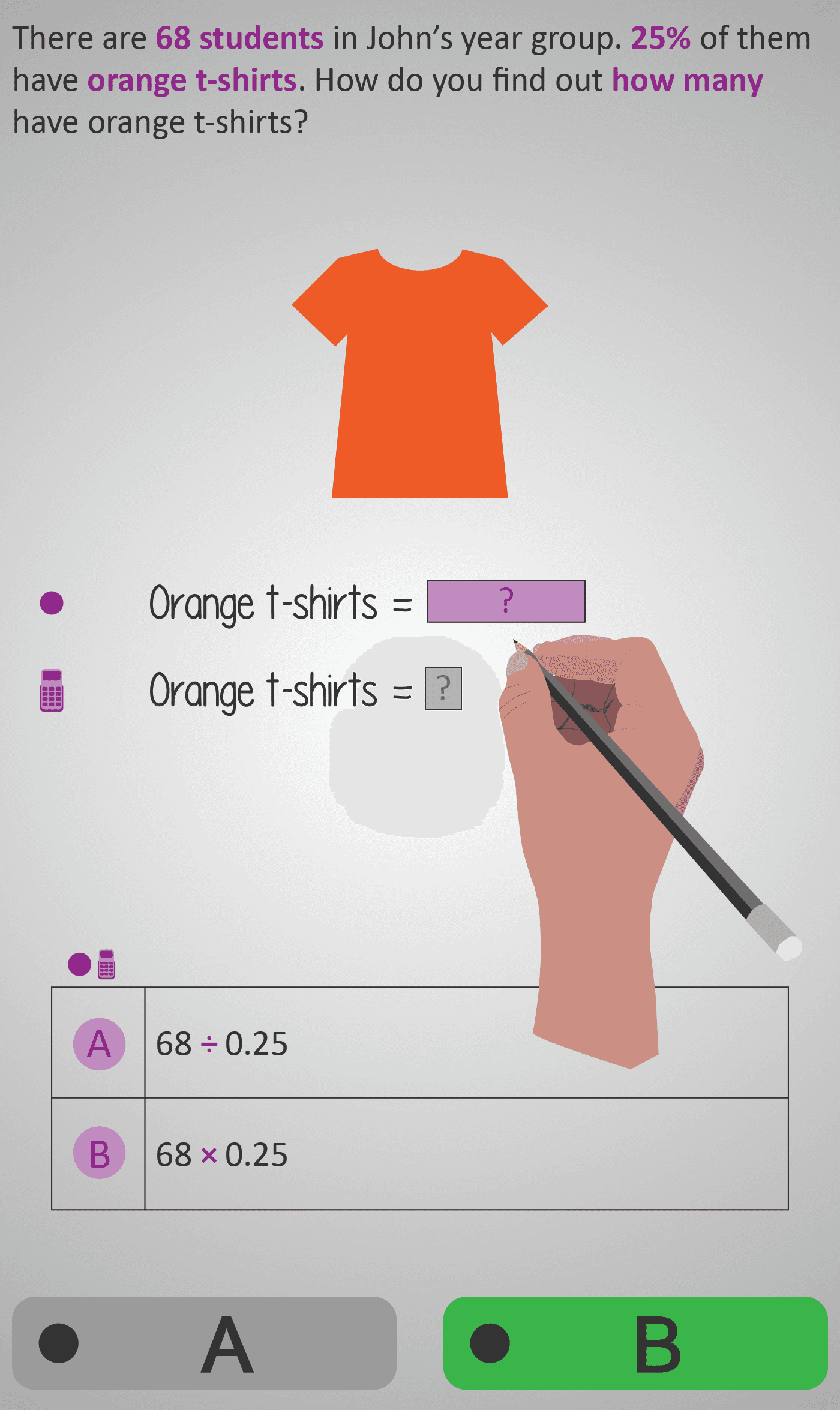
In this Phlow, learners develop fluency in finding a percentage of a total quantity, a key skill in practical numeracy. The Phlow introduces contextual examples like “45% of 60 students have bicycles” or “25% of 68 students wear orange t-shirts.”
Students work through a consistent four-step reasoning pattern:
- Identify the total amount (e.g., 60 students).
- Convert the given percentage into a decimal (e.g., 45% → 0.45).
- Multiply to find the part: 60 × 0.45 = 27.
- Interpret the answer in context (“27 students have bicycles”).
Real-world visuals (bicycles, t-shirts, students) make the learning concrete and familiar, while handwriting animations model clear procedural steps that connect symbolically and visually.
Worked Example
      There are 60 students in Jane’s year group.
      45% of them have bicycles.

      Step 1: Convert 45% → 0.45
      Step 2: Multiply → 60 × 0.45 = 27
      Step 3: Interpretation → 27 students have bicycles.
Sample Prompts
- What does “45% of 60” mean?
- Should we multiply or divide?
- What does 0.45 represent in this context?
- How many students is that in total?
Why This Matters
Finding percentages of quantities underpins everyday numeracy — from discounts and surveys to statistics and data interpretation. By grounding calculations in relatable examples, learners develop accuracy and confidence while reinforcing understanding of percentages as parts of a whole.
Prerequisite Knowledge Required
- Understand that percentages represent parts per hundred.
- Convert percentages to decimals (e.g., 45% = 0.45).
- Multiply decimals by whole numbers accurately.
- Recognise contextual units (“students,” “items,” etc.).
Linked Phlows:
Percentage 4A – Reductions and Sale Prices,
Percentage 4B – Converting Fractions to Percentages,
Decimals 3B – Multiplying by Decimals.
Main Category
Arithmetic → Percentages
Estimated Completion Time
Approx. 10–14 seconds per question.
40 questions total → Total time: 7–10 minutes.
Cognitive Load / Step Size
Very well sequenced. Step-by-step guidance ensures low intrinsic load. The learner first decides on the correct operation (multiply vs. divide), then executes the calculation, and finally interprets results. Consistent visual cues (purple highlights, clear layouts) support working memory and focus.
Language & Literacy Demand
Low to moderate. Sentences are concise, and everyday terms (“students,” “bicycles”) make abstract reasoning tangible. Bolded key phrases (“percentage,” “convert,” “multiply”) reinforce meaning. Suitable for learners with varied literacy levels, including ESL students.
Clarity & Design
- Minimal text per frame keeps attention on the calculation.
- Handwriting animation visually reinforces procedure.
- Purple highlights identify the active step or value.
- Context images (bicycle, t-shirt) create relevance and memory cues.
Curriculum Alignment (ROI Junior Cycle Mathematics)
- Strand: Number
- Learning Outcome: Calculate a percentage of a quantity and apply this to solve contextual problems.
Engagement & Motivation
The relatable, everyday examples maintain engagement and a sense of purpose. Learners feel immediate reward when the “part” matches the real-world item (e.g., 27 students, 17 t-shirts), reinforcing motivation through success.
Error Opportunities & Misconceptions
- Using division instead of multiplication (e.g., 60 ÷ 0.45).
- Forgetting to convert 45% → 0.45.
- Placing the decimal incorrectly in multiplication.
- Adding instead of multiplying (e.g., 60 + 45).
Transferability / Real-World Anchoring
High. Skills extend to discounts, test results, population data, and surveys. Learners understand that “X% of Y” is a universal pattern in everyday problem-solving.
Conceptual vs Procedural Balance
Procedural with conceptual grounding. While operations are mechanical, each step is contextualised to reinforce the meaning of percentages as parts of a whole. Learners see that multiplication finds “how many belong in that percentage group.”
Learning Objectives Addressed
- Convert percentages to decimals.
- Find a percentage of a quantity by multiplication.
- Interpret numerical results in context.
- Distinguish between finding parts and totals in word problems.
What Your Score Says About You
- Less than 20: Needs more confidence linking percentages, decimals, and operations.
- 21–29: Understands conversion but may misapply operation order or decimal placement.
- 31–39: Confident and accurate, showing clear understanding of context and reasoning.
- 40 / 40: Mastery — fluent and consistent in both calculation and conceptual interpretation.