
Perimeter 4A
Overview
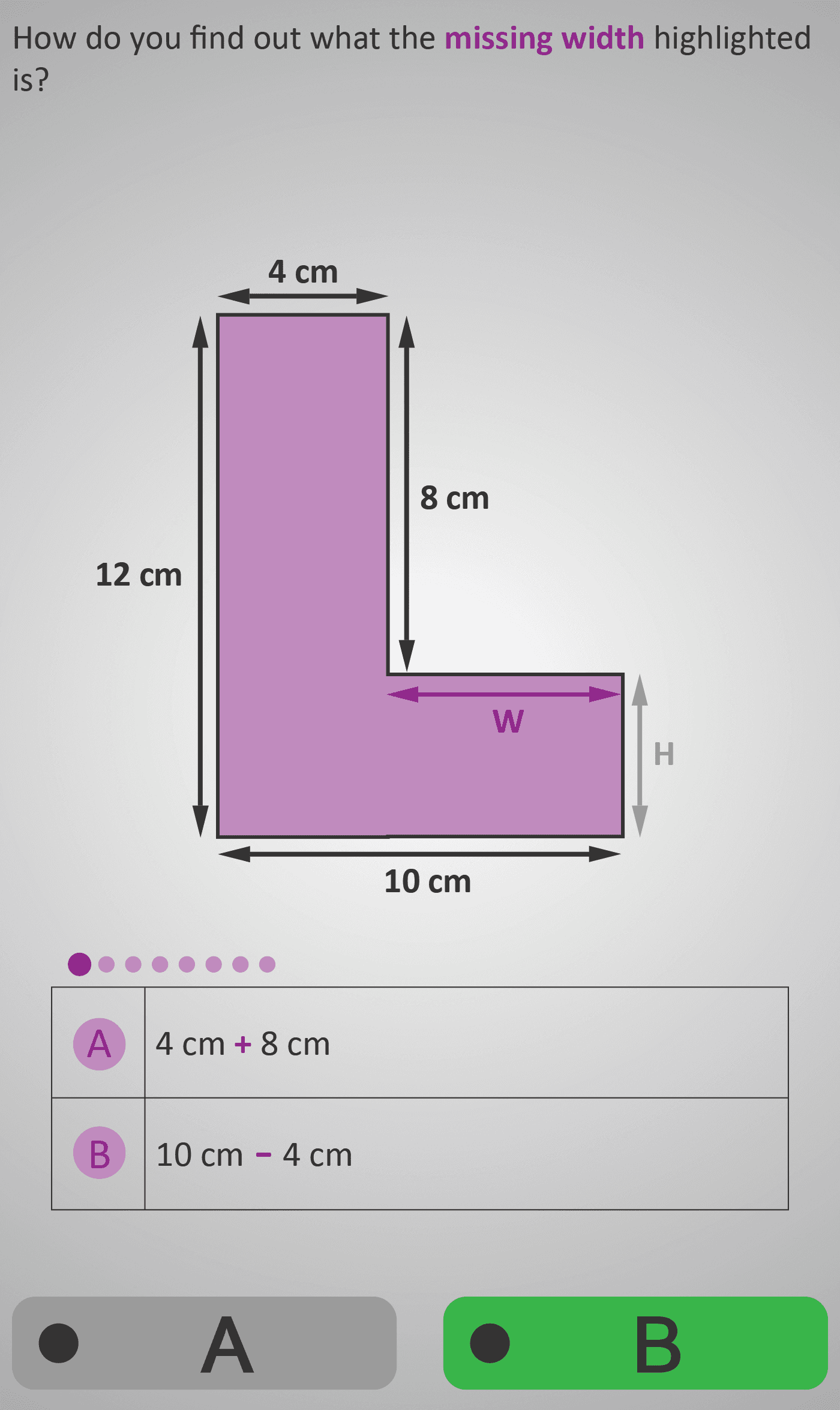
In this Phlow, learners apply their understanding of perimeter to composite shapes, specifically focusing on L-shaped figures. The task requires finding missing side lengths through subtraction, then summing all external sides to determine the total perimeter.
Each step of the sequence isolates a specific reasoning action:
- Identify known and unknown sides in the diagram.
- Use subtraction to find missing lengths (horizontal and vertical).
- Trace the outer boundary and add all sides to find the perimeter.
        W = 10 − 4 = 6 cm
        H = 12 − 8 = 4 cm
        Perimeter = 10 + 12 + 4 + 8 + 6 + 4 = 44 cm
The structure encourages logical deduction before computation,
ensuring conceptual understanding of how the sides connect in irregular shapes.
Visual cues like arrows, dotted lines, and consistent shading guide learners to focus on missing dimensions and the total boundary. This systematic approach bridges geometry and arithmetic reasoning.
Worked Example
      Given shape: L-shaped figure
      Total horizontal = 10 cm, inner horizontal = 4 cm
      Total vertical = 12 cm, inner vertical = 8 cm

      Step 1: Find missing width → 10 − 4 = 6 cm
      Step 2: Find missing height → 12 − 8 = 4 cm
      Step 3: Add all external sides → 10 + 12 + 4 + 8 + 6 + 4 = 44 cm
Sample Prompts
- Which sides are known and which are missing?
- Why do we subtract to find W or H?
- Which sides form the perimeter?
- What is the total distance around the shape?
Why This Matters
This Phlow strengthens spatial reasoning and prepares learners for real-world applications of perimeter in design, construction, and measurement. By linking diagram interpretation with calculation, it builds both visual logic and numerical fluency.
Prerequisite Knowledge Required
- Understand perimeter as the distance around a shape.
- Be able to add and subtract whole numbers accurately.
- Interpret simple diagrams and labelled lengths.
Linked Phlows:
Length 3A – Measuring in Centimetres and Metres,
Shape 3C – Recognising Rectangles and Squares,
Perimeter 3A – Perimeter of Simple Rectangles.
Main Category
Geometry → Measurement (Perimeter)
Estimated Completion Time
Approx. 10–14 seconds per question.
40 questions total → Total time: 7–10 minutes.
Cognitive Load / Step Size
Excellent progression. The cognitive demand increases gently: identifying → subtracting → summing. Reusing the same L-shape maintains focus on the underlying logic rather than new diagram types. Each action builds directly on the previous, ensuring understanding without overload.
Language & Literacy Demand
Low. Instructions are concise and reinforced through labelled diagrams. Mathematical keywords (“width,” “height,” “perimeter”) are colour-highlighted and directly linked to visual cues, making comprehension straightforward.
Clarity & Design
- Consistent L-shape diagram maintains visual familiarity.
- Purple shading provides clear shape recognition.
- Dotted lines and arrows effectively indicate missing sides.
- Step-by-step handwriting animation reinforces methodical reasoning.
Curriculum Alignment (ROI Junior Cycle Mathematics)
- Strand: Measures
- Learning Outcome: Calculate the perimeter of regular and irregular shapes by applying addition and subtraction of side lengths.
Engagement & Motivation
The L-shape puzzle format encourages exploration and curiosity. The progressive structure — reveal one side, find another — sustains motivation through incremental problem-solving success.
Error Opportunities & Misconceptions
- Forgetting to subtract to find missing lengths.
- Omitting sides when adding for total perimeter.
- Accidentally including internal (non-boundary) lines.
- Simple arithmetic errors during addition.
Transferability / Real-World Anchoring
High. Students learn how to calculate the perimeter of irregular boundaries — a direct analogue to real-life contexts such as fencing a garden, measuring flooring, or outlining a layout.
Conceptual vs Procedural Balance
Balanced. The Phlow integrates conceptual understanding (recognising which sides matter) with procedural accuracy (adding and subtracting correctly). Learners understand why subtraction is used, not just how.
Learning Objectives Addressed
- Identify and calculate missing side lengths in composite shapes.
- Apply addition and subtraction to determine perimeter.
- Distinguish between internal and external boundaries.
- Develop visual-spatial reasoning with multi-sided figures.
What Your Score Says About You
- Less than 20: Still developing understanding of shape layout and side relationships.
- 21–29: Understands concept but may omit or misidentify a side.
- 31–39: Solid reasoning and spatial understanding with minor arithmetic slips.
- 40 / 40: Full mastery — interprets composite shapes fluently and calculates perimeter with precision.