
Perimeter 4B
Overview
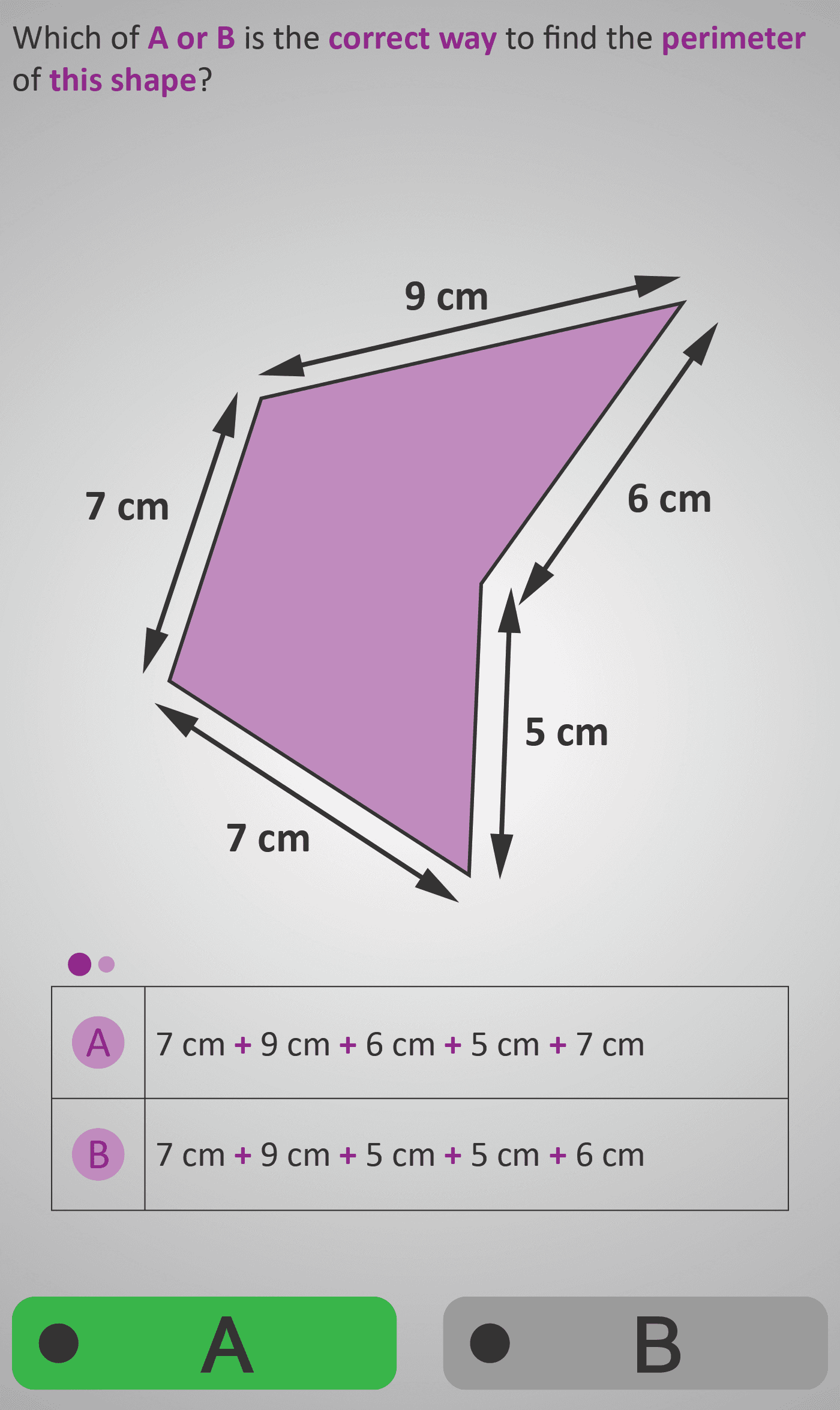
In this Phlow, learners extend their perimeter knowledge from simple rectangles to irregular and concave polygons. Each task reinforces the idea that perimeter means “the total distance around a shape”, regardless of its complexity.
Students practise identifying which sides form the boundary and then use addition to find the total length. They are guided step-by-step:
- Examine the shape and identify its outer edges.
- Note or calculate the length of each boundary side.
- Add all side lengths to find the perimeter.
- Check if any sides have been missed or counted twice.
Worked Example
      Example Shape:
         Irregular polygon with sides 5 cm, 7 cm, 4 cm, 8 cm, 6 cm.

      Step 1: Identify all outer edges.
      Step 2: Add → 5 + 7 + 4 + 8 + 6 = 30 cm.
      Step 3: Confirm all boundary sides are included.
      Answer → Perimeter = 30 cm.
Sample Prompts
- Which edges form the perimeter?
- Should this inner line be included?
- What is the total distance around the shape?
- Is option A or B the correct method?
Why This Matters
Understanding perimeter in irregular shapes develops spatial reasoning and prepares learners for real-world tasks like measuring boundaries, fences, and tiling. This Phlow ensures students can apply perimeter knowledge flexibly across a range of shapes.
Prerequisite Knowledge Required
- Understand what perimeter represents (distance around a shape).
- Be able to add multiple whole numbers accurately.
- Recognise and label sides of polygons correctly.
Linked Phlows:
Perimeter 3A – Rectangles,
Perimeter 3B – Squares and Triangles.
Main Category
Geometry → Measurement (Perimeter)
Estimated Completion Time
Approx. 10–14 seconds per question.
40 questions total → Total time: 7–10 minutes.
Cognitive Load / Step Size
Moderate and progressive. Learners advance from familiar regular shapes to more complex and concave ones, requiring increased spatial awareness while maintaining the same core process — adding outer sides. Each step focuses on identifying, not redrawing, keeping mental load low.
Language & Literacy Demand
Low. Instructions are brief, and arrows or highlights support comprehension visually. Consistent question phrasing (“Which sides make the perimeter?”) ensures accessibility for all literacy levels, including EAL learners.
Clarity & Design
- High-contrast purple outlines define shapes clearly.
- Arrows and highlights mark which sides to consider.
- Each question isolates a single decision (identify or add) to prevent overload.
- Diagrams remain functional and easy to interpret — no decorative distractions.
Curriculum Alignment (ROI Junior Cycle Mathematics)
- Strand: Geometry & Measures
- Learning Outcome: Estimate, measure, and calculate perimeters of plane figures in centimetres and metres.
Engagement & Motivation
The mix of regular, irregular, and concave shapes adds variety while maintaining challenge. Students enjoy the visual problem-solving aspect — spotting which sides count feels like a puzzle, keeping engagement high through rapid progression.
Error Opportunities & Misconceptions
- Omitting one or more sides when summing.
- Including internal or overlapping lines.
- Misreading slanted or diagonal measurements.
- Adding incorrectly when sides have mixed lengths.
Transferability / Real-World Anchoring
High. These skills apply directly to real-life tasks — measuring fences, borders, paths, or layout boundaries. The focus on irregular shapes mirrors authentic design and construction problems.
Conceptual vs Procedural Balance
Balanced. The Phlow reinforces why only external sides count (conceptual) while automating the how — accurate addition of side lengths (procedural). This dual emphasis deepens understanding and accuracy.
Learning Objectives Addressed
- Identify boundary sides in irregular polygons.
- Calculate total perimeter by adding all external lengths.
- Distinguish between internal and external sides.
- Apply perimeter reasoning to concave and real-world contexts.
What Your Score Says About You
- Less than 20: Needs to strengthen understanding of which sides make up a perimeter.
- 21–29: Understands perimeter but may struggle with irregular or concave shapes.
- 31–39: Consistent accuracy and solid spatial reasoning.
- 40 / 40: Excellent mastery — confident calculating perimeters of any 2D shape.