
Pie Chart 4E
Overview
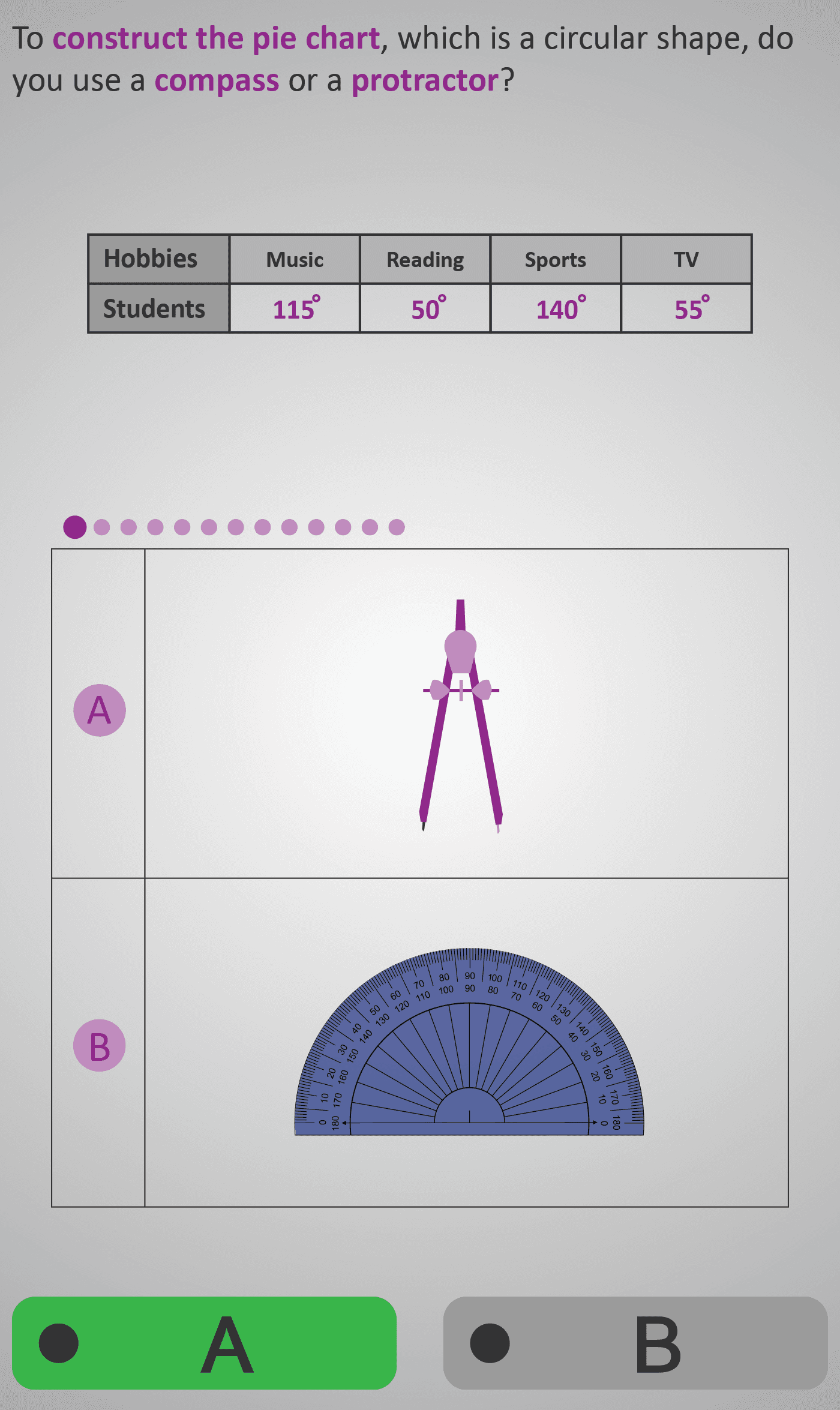
In this Phlow, learners move from analysing pie charts to constructing them physically. Using a dataset about students’ hobbies (Music, Reading, Sports, TV), they draw, measure, and complete a pie chart step by step.
Each stage introduces a single action — drawing a circle with a compass, using a ruler to mark guide lines, aligning the protractor correctly, and measuring each sector angle with precision.
The process reinforces spatial reasoning, geometric accuracy, and the relationship between data proportions and 360° angles. Learners see how numerical reasoning translates into a visual, real-world diagram they can create themselves.
Worked Example
      Dataset:
      Music = 115°
      Reading = 50°
      Sports = 140°
      TV = 55°

      Step 1: Draw circle with compass.
      Step 2: Use ruler to draw vertical guideline.
      Step 3: Align protractor at the centre, 0° on the baseline.
      Step 4: Measure and draw Music (115°), then Reading (50°), etc.
      Step 5: Verify total = 360° → chart complete.
Sample Prompts
- Where should the compass point be placed?
- How should the protractor be aligned before measuring?
- Which diagram correctly shows a 115° sector?
- Has the full circle been divided into 360°?
Why This Matters
Constructing a pie chart combines mathematical precision with spatial reasoning. Learners experience how proportions, geometry, and measurement unite in one meaningful task. This procedural fluency strengthens data interpretation skills and geometric confidence simultaneously.
Prerequisite Knowledge Required
- Understand that a full circle = 360°.
- Be confident using a protractor to measure and draw angles.
- Know how to calculate sector angles from data.
- Be familiar with basic compass use for drawing circles.
Linked Phlows:
Pie Chart 4C – Connecting Totals and Proportions,
Pie Chart 4D – Calculating Angles from Fractions,
Angle 3F – Constructing Angles with a Protractor.
Main Category
Data & Statistics
Estimated Completion Time
Approx. 10–14 seconds per question.
40 questions total → Total time: 7–10 minutes.
Cognitive Load / Step Size
Moderate and carefully staged. Each question isolates a single procedural action — drawing the circle, aligning instruments, or measuring one sector. This stepwise approach keeps intrinsic load focused and prevents overload.
Language & Literacy Demand
Low. Clear, action-oriented verbs (“Place,” “Measure,” “Draw”) guide understanding. Visual aids show each instrument in use, supporting learners regardless of reading level.
Clarity & Design
- Realistic visuals of compass, ruler, and protractor support spatial understanding.
- Purple highlights mark active steps or measurement points.
- A/B comparison format shows correct vs. incorrect positioning.
- Each diagram builds progressively toward the complete pie chart.
Curriculum Alignment (ROI Junior Cycle Mathematics)
- Strand: Data and Chance
- Learning Outcomes: Construct and interpret pie charts accurately; relate data to angular measures; develop procedural fluency in geometric drawing.
Engagement & Motivation
Learners find satisfaction in creating something tangible and precise. The relatable dataset (students’ hobbies) adds purpose and context, while immediate visual feedback reinforces motivation through visible progress.
Error Opportunities & Misconceptions
- Placing the compass off-centre.
- Aligning the protractor incorrectly.
- Reading the wrong protractor scale (inner vs outer).
- Forgetting to total 360° at the end.
Transferability / Real-World Anchoring
Strong. These construction skills apply directly to project work, design, data analysis, and geometry-based applications in science and technology. Students develop precision and confidence translating data into visual form.
Conceptual vs Procedural Balance
Primarily procedural with conceptual reinforcement. The act of measuring and drawing makes abstract proportional reasoning tangible. Each construction step physically demonstrates how 360° represents a complete dataset.
Learning Objectives Addressed
- Construct a pie chart using compass, ruler, and protractor.
- Measure and label accurate angles from given data.
- Verify that total angles add to 360°.
- Develop spatial precision and visual data reasoning.
What Your Score Says About You
- Less than 20: You understand data relationships but need more practice using drawing tools accurately.
- 21–29: You can measure and label angles but may misalign instruments or scales.
- 31–39: You construct pie charts confidently and understand how data links to geometry.
- 40 / 40: Mastery — you can calculate, measure, and construct pie charts independently with full accuracy.