
Possible Choices 4A
Overview
In this Phlow, learners explore how to calculate the total number of possible combinations when selecting one option from each of several groups. Using a relatable subject-choice scenario, students connect everyday decisions with the mathematical idea that independent choices multiply.
Each screen isolates a single idea: first count the options in each group, then recognise that choices from different groups combine, and finally apply multiplication to get the total number of possible outcomes.
Worked Example
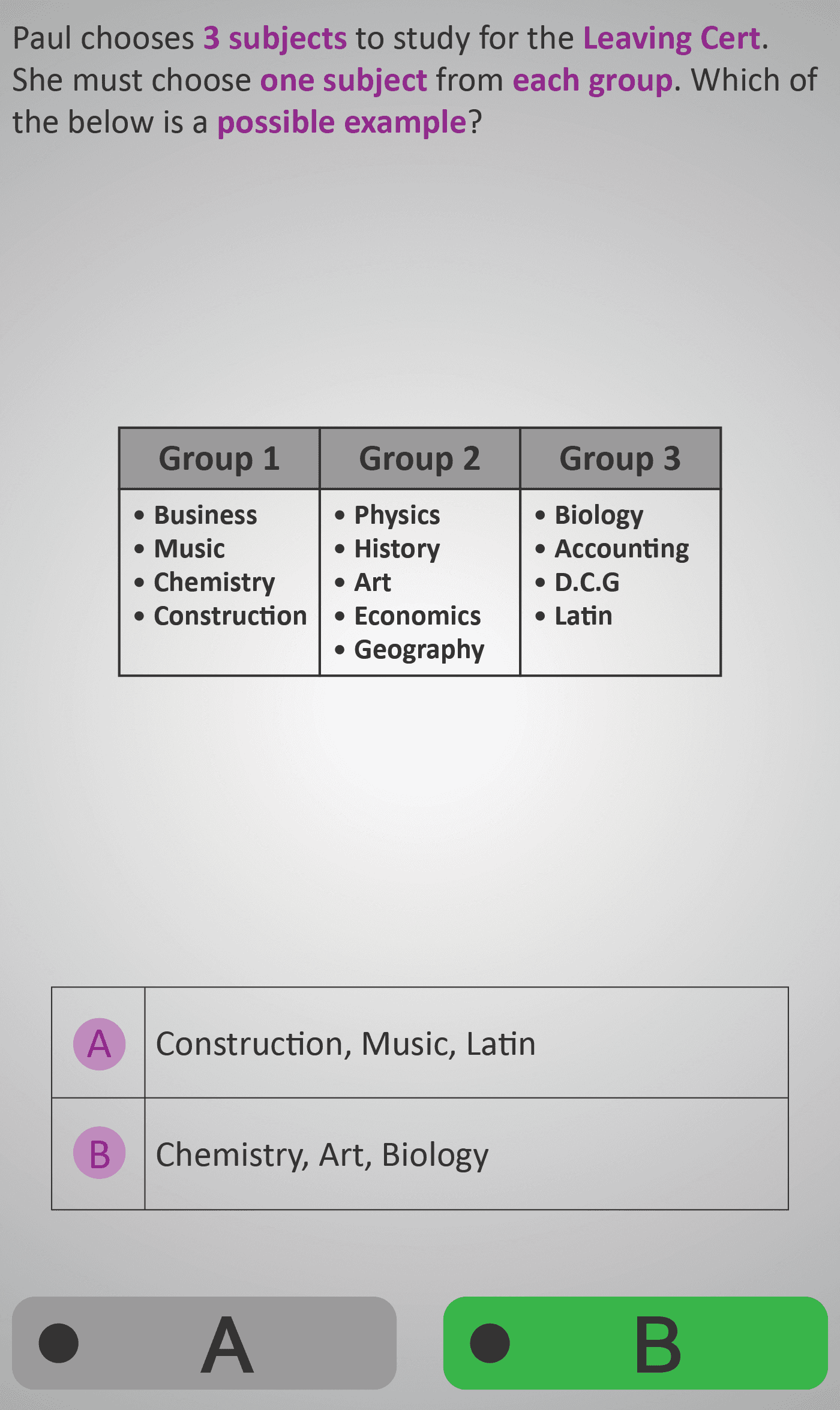
Group 1 options: 4
Group 2 options: 5
Group 3 options: 4

Total combinations = 4 × 5 × 4 = 80
Steps:
- Identify how many choices are in each group.
- Recognise that one choice is taken from each group.
- Multiply the group counts:
Group1 × Group2 × Group3. - Check with examples (e.g., Beth, Paul, Ayesha) to see different valid combinations.
Sample Prompts
- How many choices are in Group 1? Group 2? Group 3?
- Why do we multiply instead of add?
- If Group 2 increased to 6 options, what happens to the total?
- Give one possible 3-subject combination Beth could choose.
Why This Matters
The fundamental counting principle underpins probability, scheduling, menu planning, and product configurations. Mastering when and why to multiply gives learners a powerful tool for reasoning about combinations in real life and later probability courses.
Prerequisite Knowledge Required
- Understand multiplication as repeated addition / scaling.
- Recognise that one item is chosen from each group.
- Familiarity with simple outcome counting (e.g., Level 3).
Linked Phlows:
Outcomes 3C – Identifying Possible Results,
Lists & Tables 3E – Systematic Counting.
Main Category
Probability & Combinatorics
Estimated Completion Time
Approx. 10–14 seconds per question.
40 questions total → Total time: 7–10 minutes.
Cognitive Load / Step Size
Low to moderate. Each step isolates one variable (count → combine → multiply). Repetition across similar screens reinforces the structure while gradually making the calculation explicit.
Language & Literacy Demand
Moderate. Everyday terms (subjects, groups, choices) with consistent phrasing reduce reading strain. Visual grouping tables and highlighted key terms (e.g., “possible choices”, “multiply”) support comprehension.
Clarity & Design
- Balanced layout of text, tables, and handwriting-style cues.
- One idea per page for clear visual sequencing.
- Consistent colour and typography emphasise the logic: data → reasoning → solution.
Curriculum Alignment (ROI Junior Cycle Mathematics)
- Strand: Data and Chance
- Learning Outcomes: Determine the number of outcomes of combined events; represent information in lists/tables to identify combinations; apply multiplication to count outcomes when groups are combined.
Engagement & Motivation
Choosing school subjects is familiar and meaningful. Named examples (Beth, Ayesha, Paul) let learners see themselves in the task while practising logical reasoning.
Error Opportunities & Misconceptions
- Adding group sizes instead of multiplying.
- Miscounting options within a group.
- Assuming repeated subjects across groups are allowed.
- Forgetting one choice must come from each group.
Transferability / Real-World Anchoring
High. The same structure appears in menus, schedules, product variants, and probability problems.
Conceptual vs Procedural Balance
Balanced. Procedure: multiply the number of options in each group. Concept: understand why independent choices multiply total possibilities.
Learning Objectives Addressed
- Identify the number of options in each independent group.
- Use multiplication to find total combinations.
- Recognise real-life examples of combinatorial reasoning.
- Avoid the addition-instead-of-multiplication mistake.
What Your Score Says About You
- Less than 20: You can spot options but need to strengthen why we multiply, not add.
- 21–29: Structure is mostly clear; occasional miscounts or mixed operations.
- 31–39: Accurate application of the counting principle with sound reasoning.
- 40 / 40: Full mastery; you can generalise to larger sets and probability contexts.