
Possible Choices 4B
Overview
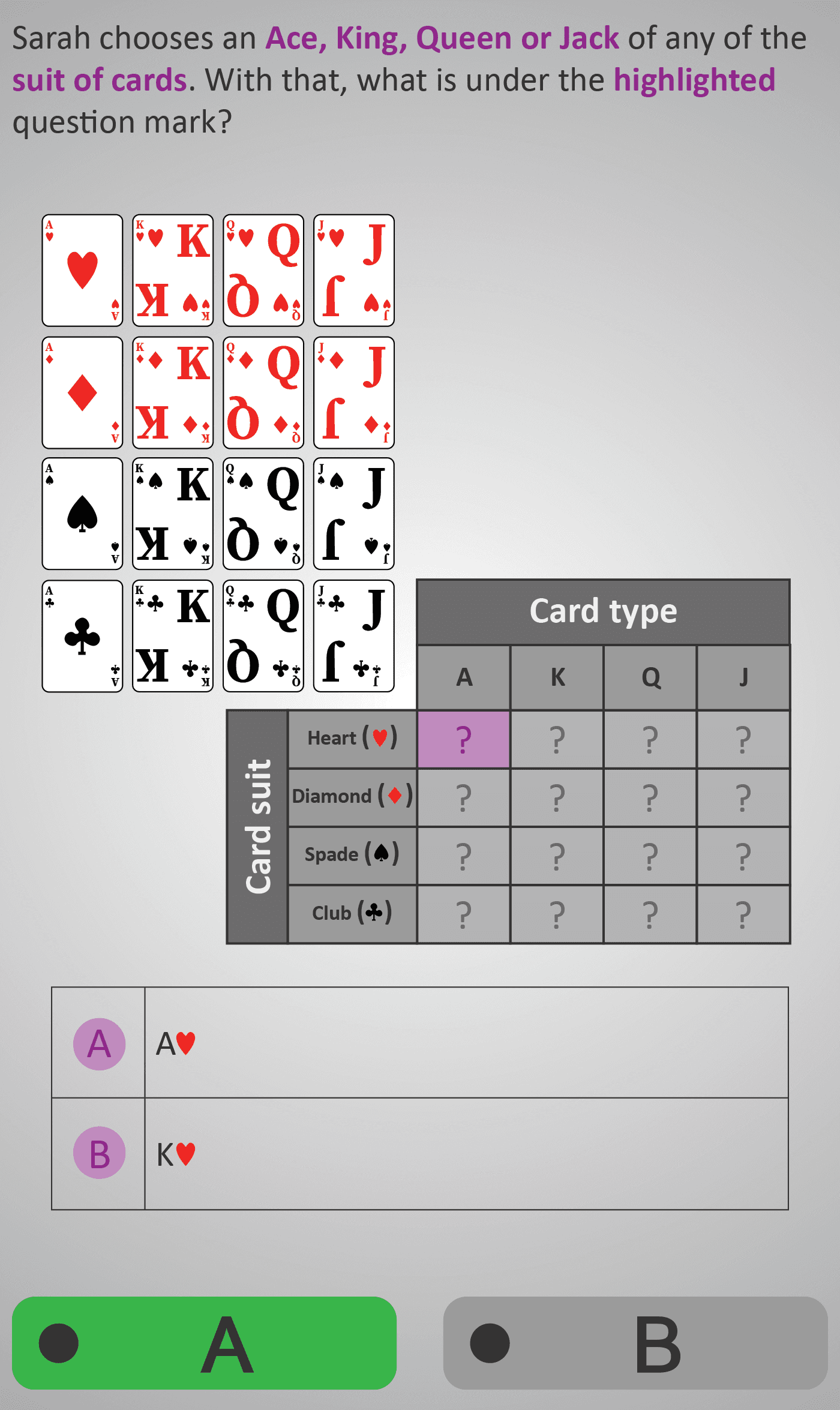
In this Phlow, learners use a 4×4 table of playing cards to identify which card is missing from the grid. Each screen highlights one position, requiring students to cross-reference row (rank) and column (suit) to deduce the correct card.
The familiar card symbols (♥ ♦ ♠ ♣) make the task intuitive while strengthening reasoning through structured pattern recognition. Learners move from simple observation to systematic deduction as they infer what fits under the highlighted question mark.
Worked Example
Suits →   ♥   ♦   ♠   ♣
Ranks ↓
A         A♥  A♦  A♠  A♣
K         K♥  K♦  K♠  K♣
Q         Q♥  Q♦  Q♠  ?
J         J♥  J♦  J♠  J♣

Missing card: Q♣ (Queen of Clubs)
Sample Prompts
- Which card is missing in the highlighted position?
- Which suit is shown in this column?
- Which rank belongs to this row?
- How do we know that card fits here?
Why This Matters
This activity develops logical organisation and cross-referencing skills — essential for understanding tables, charts, and databases. Learners practise matching information from two categories to find a single, correct result — a foundation skill for data handling and reasoning.
Prerequisite Knowledge Required
- Know the four suits and main ranks (A, K, Q, J) of a standard deck.
- Be familiar with table structures and how to locate entries using rows and columns.
- Have prior experience using clues to identify missing information.
Main Category
Data & Logic
Estimated Completion Time
Approx. 10–14 seconds per question.
40 questions total → Total time: 7–10 minutes.
Cognitive Load / Step Size
Small and consistent. Each screen introduces one missing card and one deduction. The repetitive structure supports focus on logical reasoning without overload.
Language & Literacy Demand
Moderate. Questions use concise, familiar vocabulary and rely heavily on visuals. Highlighted cues (question marks, suit symbols) minimise reading complexity while reinforcing key terms.
Clarity & Design
- Red (♥ ♦) and black (♠ ♣) suits clearly differentiated.
- Highlighted cell draws focus to the missing card.
- Consistent table layout promotes efficient scanning and pattern recognition.
- No decorative distractions — all visuals aid reasoning.
Curriculum Alignment (ROI Junior Cycle Mathematics)
- Strands: Data and Chance / Logical Reasoning
- Learning Outcomes: Organise information in tables; recognise and extend patterns; apply logical deduction to identify missing elements.
Engagement & Motivation
The card-game setting feels playful and immediate. Each solved clue delivers a small “aha” reward, motivating continued engagement without needing complex narrative framing.
Error Opportunities & Misconceptions
- Mixing up similar red suits (hearts vs diamonds).
- Misreading the row or column position.
- Assuming repetition instead of unique combinations.
Transferability / Real-World Anchoring
High. Cross-referencing rows and columns applies directly to reading timetables, spreadsheets, and coordinate maps — key skills for digital literacy and data reasoning.
Conceptual vs Procedural Balance
Balanced.
Conceptual: understanding how two categories intersect in structured data.
Procedural: systematically locating intersections and eliminating incorrect options.
Learning Objectives Addressed
- Locate and identify information using two intersecting categories.
- Recognise and apply logical patterns in structured data.
- Use elimination to deduce missing values.
- Strengthen visual reasoning through systematic scanning.
What Your Score Says About You
- Less than 20: You recognise suits but miss key logic links between rows and columns.
- 21–29: You spot patterns but make small visual or position errors.
- 31–39: You show strong logical deduction and visual matching accuracy.
- 40 / 40: Excellent – you’ve mastered structured reasoning across visual data.