
Possible Choices 4C
Overview
In this Phlow, learners explore how two independent results combine to form a single outcome.
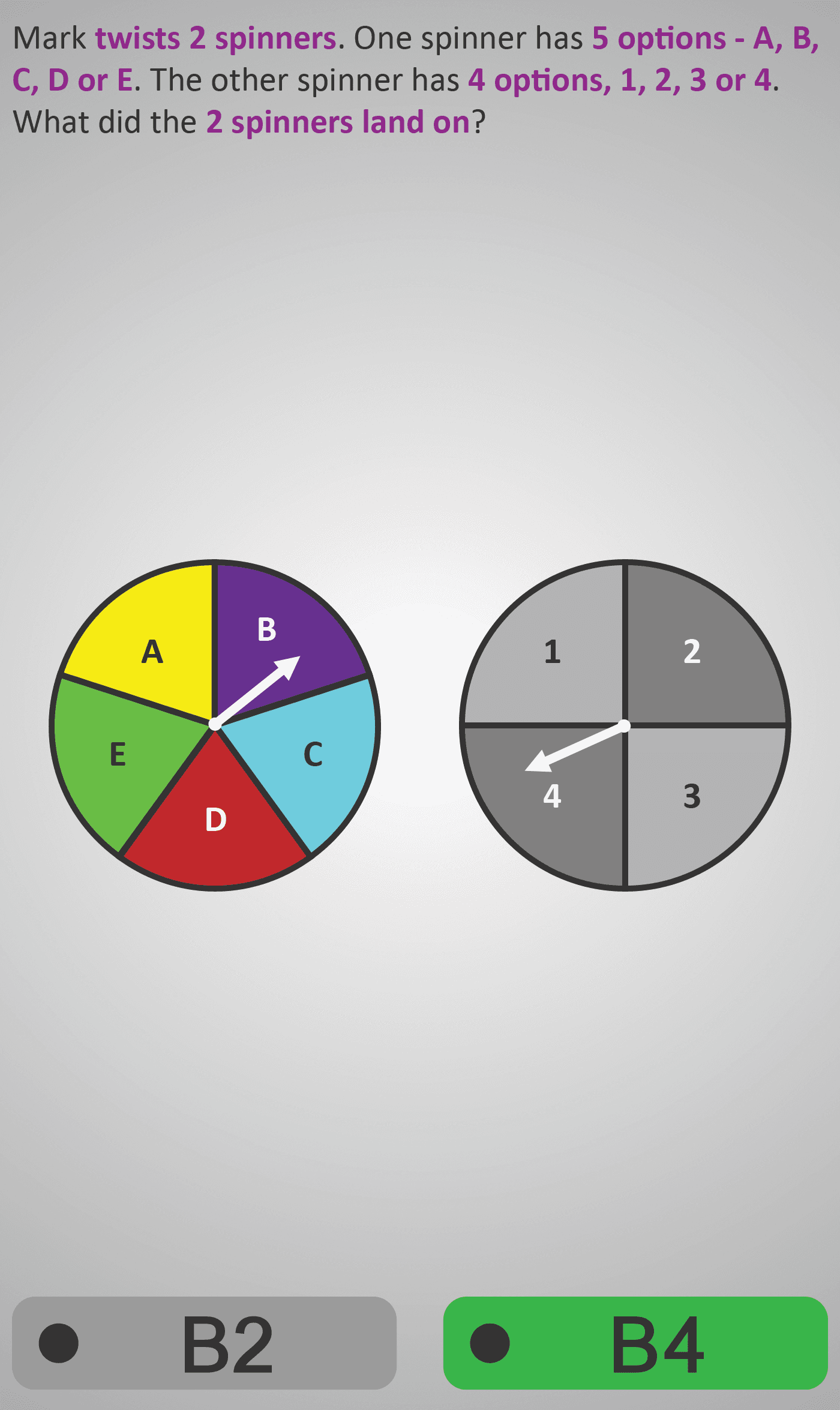
Two spinners — one labelled with letters and the other with numbers —
are shown side by side. Each question asks students to identify the correct pair that both arrows land on,
such as X0 or B4.
This activity introduces the principle of pairing outcomes, a foundation of probability and combinatorics. By reading each spinner separately and combining results, learners discover how total possibilities multiply across independent events.
Worked Example
Spinner 1 (Letters): A, B, C, D
Spinner 2 (Numbers): 0, 1, 2, 3, 4

If arrows land on: B and 4
Combined outcome → B4
Step sequence:
- Identify what each spinner lands on.
- Combine both results into a single ordered pair.
- Check that the letter comes first, then the number.
Sample Prompts
- Which letter and number did the spinners land on?
- What is the correct combined result?
- How many total outcomes are possible?
- Why does the order of letter and number matter?
Why This Matters
Understanding how independent events combine is essential for probability, data analysis, and logical reasoning. The dual spinner model visualises this concept clearly, showing how one event’s result pairs systematically with another.
Prerequisite Knowledge Required
- Recognise outcomes from a single spinner or dice roll.
- Understand that two independent events produce paired results.
- Be able to read and interpret visual representations like spinners and arrows.
Linked Phlows:
Outcomes 3C – Identifying Results from Single Spinners,
Lists & Tables 3E – Recording and Counting Combinations.
Main Category
Probability & Combinatorics
Estimated Completion Time
Approx. 10–14 seconds per question.
40 questions total → Total time: 7–10 minutes.
Cognitive Load / Step Size
Low. Each task involves two small, consistent steps — reading each spinner’s result, then combining them. The small step size maintains focus while consolidating independence and pairing.
Language & Literacy Demand
Minimal. Questions use simple, repetitive phrasing and clear keywords (“spinners”, “land on”, “combine”). Visual arrows and segment colours carry most of the meaning, reducing reading demand.
Clarity & Design
- Bright, contrasting colour schemes distinguish the two spinners.
- Arrows clearly show where each spinner lands.
- Answer options maintain consistent order — letter first, number second.
- Clean layout avoids clutter, focusing attention on pairing logic.
Curriculum Alignment (ROI Junior Cycle Mathematics)
- Strand: Data and Chance
- Learning Outcomes: Recognise outcomes of combined events; list or identify all possible results from paired random processes; apply reasoning to determine specific outcomes from independent events.
Engagement & Motivation
Colourful spinners and interactive visuals evoke play and curiosity. The task feels like a game while teaching the logic of compound events — an engaging gateway to probability thinking.
Error Opportunities & Misconceptions
- Reversing order (e.g., writing 0X instead of X0).
- Reading the wrong arrow position.
- Forgetting letter and number are from different spinners.
- Misjudging total possibilities (adding instead of multiplying).
Transferability / Real-World Anchoring
High. These reasoning skills apply directly to dice rolls, coordinate systems, and everyday combination problems — from outfit choices to probability grids.
Conceptual vs Procedural Balance
Balanced.
Procedural: reading each spinner and writing the combined result.
Conceptual: understanding how independent events create ordered pairs and total outcomes.
Learning Objectives Addressed
- Identify the results of two independent random events.
- Combine outcomes to form ordered pairs.
- Interpret pictorial data accurately.
- Strengthen probability reasoning for future combinatorics topics.
What Your Score Says About You
- Less than 20: You can identify single outcomes but need to practise combining two.
- 21–29: You interpret both spinners but may mix up order or direction.
- 31–39: You combine results accurately and understand event independence.
- 40 / 40: Excellent — you confidently read, combine, and reason through all two-event outcomes.