
Possible Choices 4D
Overview
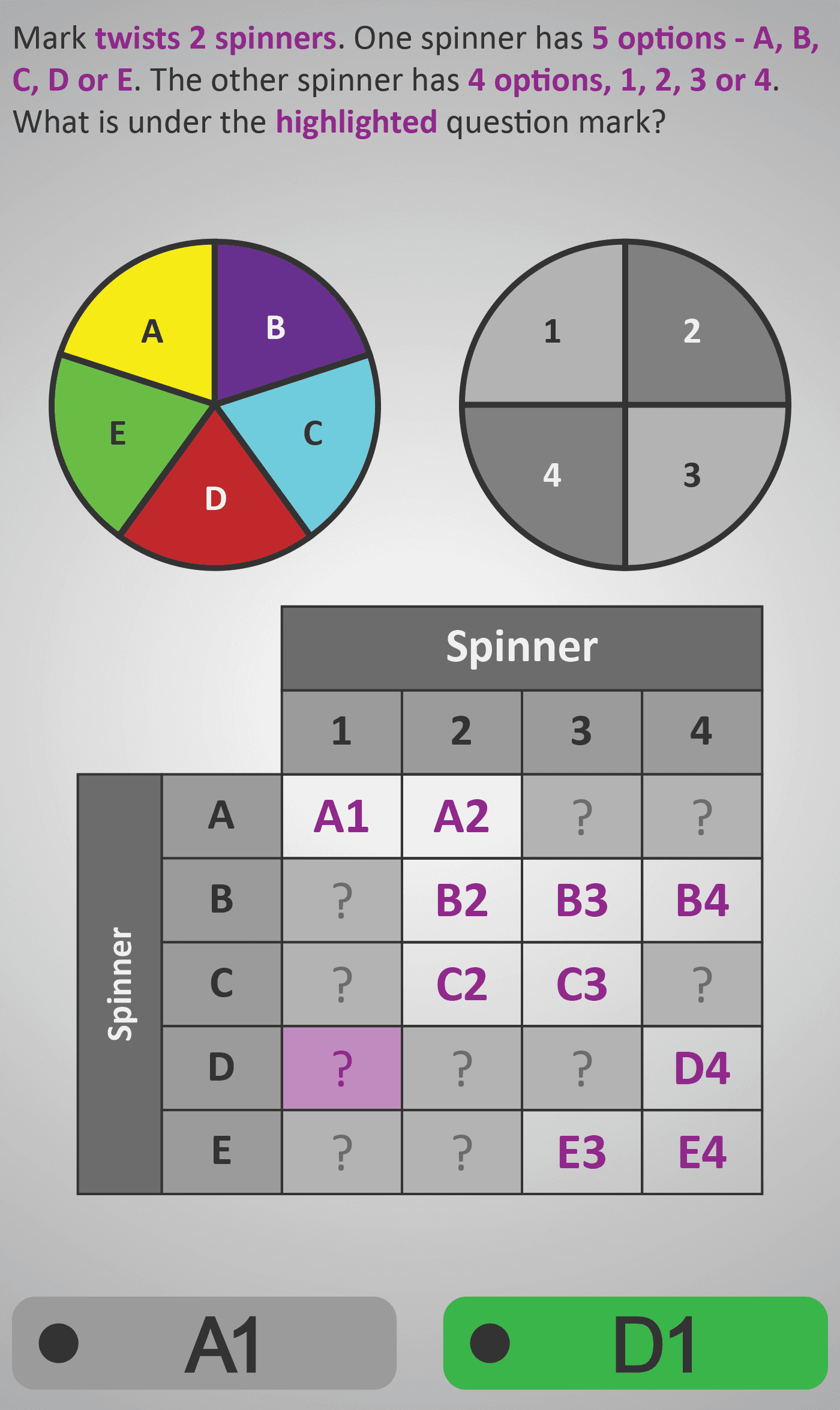
This Phlow extends Possible Choices 4C by moving from reading paired spinner results
to mapping all outcomes in an organised grid. One spinner shows letters
A–E, the other shows numbers 1–4. Each question highlights a single
missing cell; learners use the intersection of the letter row and number column to determine
the correct ordered pair (e.g., A1, C3, E4).
The grid models the Cartesian product visually: every letter combines with every number, creating a 5×4 table of 20 possible outcomes.
Worked Example
Spinner L (rows):  A  B  C  D  E
Spinner N (cols):  1  2  3  4

Grid (excerpt):
       1   2   3   4
A →   A1  A2  A3  A4
B →   B1  B2  B3  B4
C →   C1  C2  ??  C4
D →   D1  D2  D3  D4
E →   E1  E2  E3  E4

Highlighted cell at row C, column 3 → Missing outcome: C3
Total outcomes = 5 × 4 = 20
Steps:
- Identify the row from the letter spinner (A–E).
- Identify the column from the number spinner (1–4).
- Combine to form the ordered pair:
LetterNumber(letter first).
Sample Prompts
- Which row (letter) and column (number) are highlighted?
- What ordered pair belongs in the missing cell?
- How many outcomes does the full grid contain?
- Why is the order letter first, number second?
Why This Matters
Organising outcomes in a table builds fluency with systematic listing and prepares learners for coordinates, two-dice sample spaces, and probability grids. It makes abstract combination logic concrete.
Prerequisite Knowledge Required
- Understand single and double spinner outcomes (see 4C).
- Familiarity with row–column grids and intersections.
- Awareness that ordered pairs represent combined results of independent events.
Linked Phlows:
Possible Choices 4C – Combining Two Spinner Results,
Lists & Tables 3E – Reading Structured Grids.
Main Category
Probability & Data Organisation
Estimated Completion Time
Approx. 10–14 seconds per question.
40 questions total → Total time: 7–10 minutes.
Cognitive Load / Step Size
Moderate. Introducing the full 5×4 grid increases abstraction compared with 4C, but reasoning remains stable: cross-reference row and column to find the unique ordered pair.
Language & Literacy Demand
Low. Short, repetitive prompts with clear keywords; visuals carry the meaning so learners focus on structure rather than dense text.
Clarity & Design
- Two spinners positioned above the grid link outcomes to placement.
- Consistent fonts/colours separate letters (rows) and numbers (columns).
- Highlighted question mark directs attention to the target cell.
- Clean layout avoids decorative distractions.
Curriculum Alignment (ROI Junior Cycle Mathematics)
- Strand: Data and Chance
- Learning Outcomes: Explore and list all outcomes of combined events; represent outcomes in organised tables and grids; recognise patterns and systematic recording of probability data.
Engagement & Motivation
Bright, game-like spinners keep the activity playful; the grid offers satisfying “missing piece” logic for pattern-minded learners.
Error Opportunities & Misconceptions
- Confusing which spinner maps to rows vs columns.
- Reversing order (e.g., writing 1A instead of A1).
- Misaligning by scanning the wrong row/column.
- Overgeneralising patterns without checking the intersection.
Transferability / Real-World Anchoring
High. Skills transfer to timetables, spreadsheets, coordinate maps, and to later probability models (two-dice outcomes, Punnett squares).
Conceptual vs Procedural Balance
Strong conceptual grounding (why there are 5×4 = 20 outcomes) paired with procedural fluency (how to locate a specific ordered pair via intersection).
Learning Objectives Addressed
- Cross-reference data accurately using rows and columns.
- Identify all possible outcomes from two independent events.
- Link spinner results to grid structure (Cartesian product).
- Build systematic reasoning for probability and combinations.
What Your Score Says About You
- Less than 20: Beginning to grasp the grid but mixing up rows/columns.
- 21–29: Can find outcomes but sometimes reverse order or pairing.
- 31–39: Consistently locates correct pairs using structured logic.
- 40 / 40: Mastery of systematic reasoning on two-variable data tables.