
Probability 4B
Overview
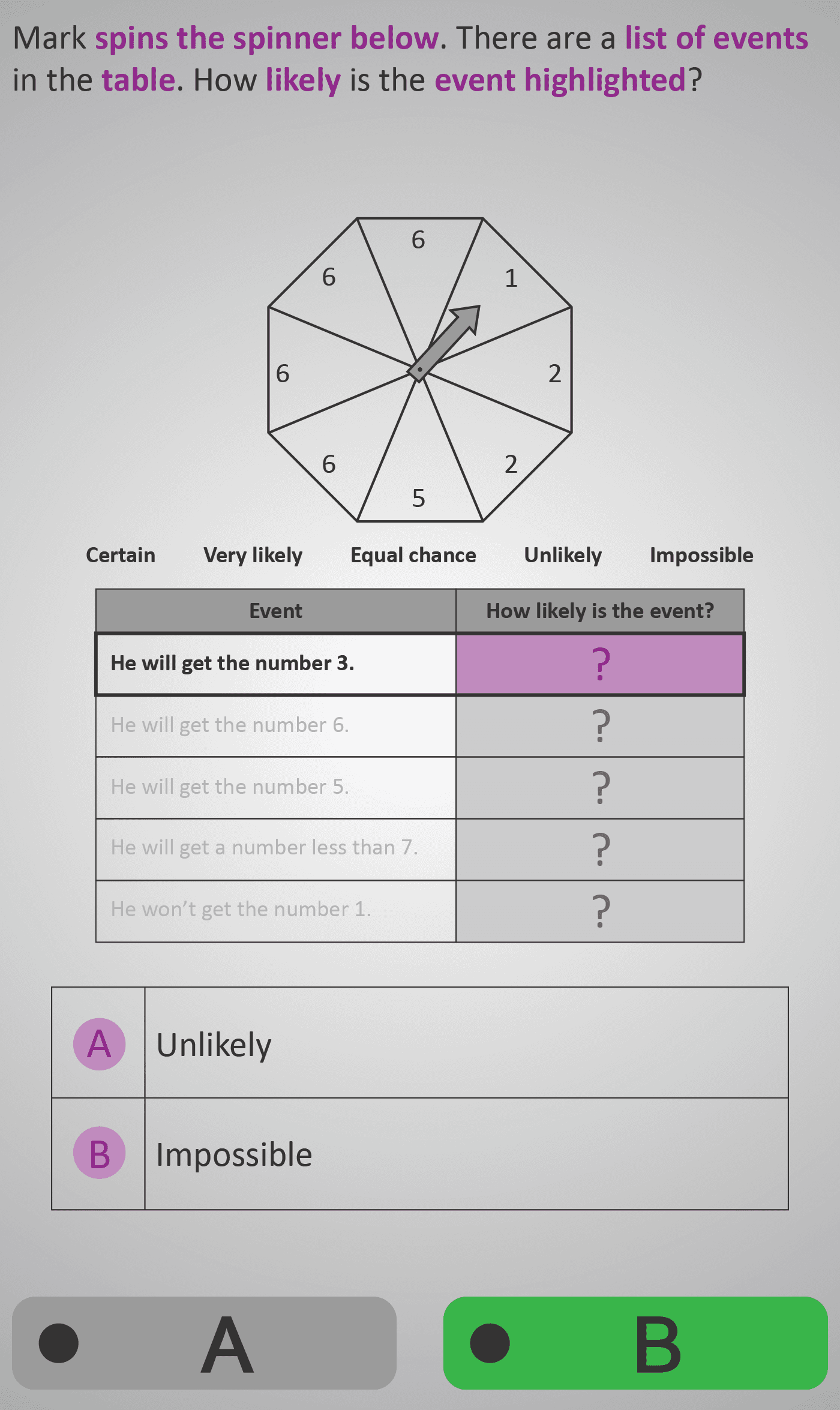
In this Phlow, learners explore how likely different events are when spinning a numbered spinner with unequal outcomes. Each question highlights one event (e.g., “He will get the number 3” or “He will get the number 6”) and asks students to choose the best descriptor: certain, very likely, equal chance, unlikely, or impossible.
The spinner shows eight segments (numbers 1, 2, 5, and several 6s). By comparing how many times each number appears, learners reason about relative likelihood without needing to calculate fractions. This introduces the language of probability in a meaningful, visual way.
Worked Example
Spinner outcomes: 1, 2, 5, 6, 6, 6, 6, 6

Event: “He will get the number 3.”
→ Impossible (3 does not appear)

Event: “He will get the number 6.”
→ Very likely (6 appears on most sections)
Step sequence:
- Observe which numbers appear on the spinner.
- Read the event statement.
- Judge how likely it is to occur.
- Select the best descriptive term.
Sample Prompts
- Which number appears most often?
- Could this event ever happen?
- Would it be fair to expect each number equally?
- Which description fits this event best?
Why This Matters
Understanding likelihood in words prepares learners for formal probability. They connect mathematical structure to everyday language — the bridge between intuition (“it’s very likely to rain”) and calculation (“5 out of 8 chance”). This strengthens both mathematical and communication skills.
Prerequisite Knowledge Required
- Know that probability measures how likely an event is to occur.
- Be familiar with the five likelihood terms: certain, very likely, equal chance, unlikely, impossible.
- Understand spinner outcomes and basic random events from earlier Phlows.
Linked Phlows:
Possible Choices 4C & 4D – Systematic Listing of Outcomes,
Probability 4A – Fraction-Based Probability Reasoning.
Main Category
Probability & Data Interpretation
Estimated Completion Time
Approx. 10–14 seconds per question.
40 questions total → Total time: 7–10 minutes.
Cognitive Load / Step Size
Low to moderate. Each question isolates one event, keeping attention focused. Students visually interpret the spinner and link it to probability language, promoting gradual pattern recognition between visuals and descriptive terms.
Language & Literacy Demand
Moderate. Learners engage with everyday probability words in short, structured sentences. Visual cues and highlighted terms (e.g., “very likely”) support comprehension for all reading levels.
Clarity & Design
- Large spinner graphic clearly shows number distribution.
- Event table below keeps questions consistent and easy to scan.
- Highlighted purple text directs focus to target event.
- A/B format limits choice overload and maintains flow.
Curriculum Alignment (ROI Junior Cycle Mathematics)
- Strand: Data and Chance
- Learning Outcomes: Recognise unequal likelihood between outcomes; classify events using qualitative probability terms; describe chance in everyday contexts with appropriate vocabulary.
Engagement & Motivation
The spinner context feels like a game — accessible, colourful, and intuitive. Visual animation and predictable structure sustain curiosity and confidence.
Error Opportunities & Misconceptions
- Claiming impossible outcomes (e.g., number 3).
- Confusing “very likely” with “certain.”
- Assuming the spinner is fair when it is biased.
- Guessing from memorised terms instead of reasoning from visuals.
Transferability / Real-World Anchoring
High. Learners connect to games, sports predictions, and forecasts — real situations where probability is expressed in words. Builds vocabulary for reasoning in maths, science, and daily decisions.
Conceptual vs Procedural Balance
Primarily conceptual. Learners reason qualitatively rather than calculate. The repetitive structure supports procedural confidence while deepening conceptual understanding of likelihood.
Learning Objectives Addressed
- Describe and compare the likelihood of everyday events.
- Distinguish between impossible, unlikely, equal chance, likely, and certain.
- Interpret probability using visual models like spinners.
- Use precise language when expressing probability.
What Your Score Says About You
- Less than 20: You’re learning to link spinner results with probability words.
- 21–29: You understand the terms but sometimes mix up “very likely” and “equal chance.”
- 31–39: You accurately classify events based on visual and linguistic clues.
- 40 / 40: Excellent — you confidently interpret and describe all likelihood categories.