
Probability 4F
Overview
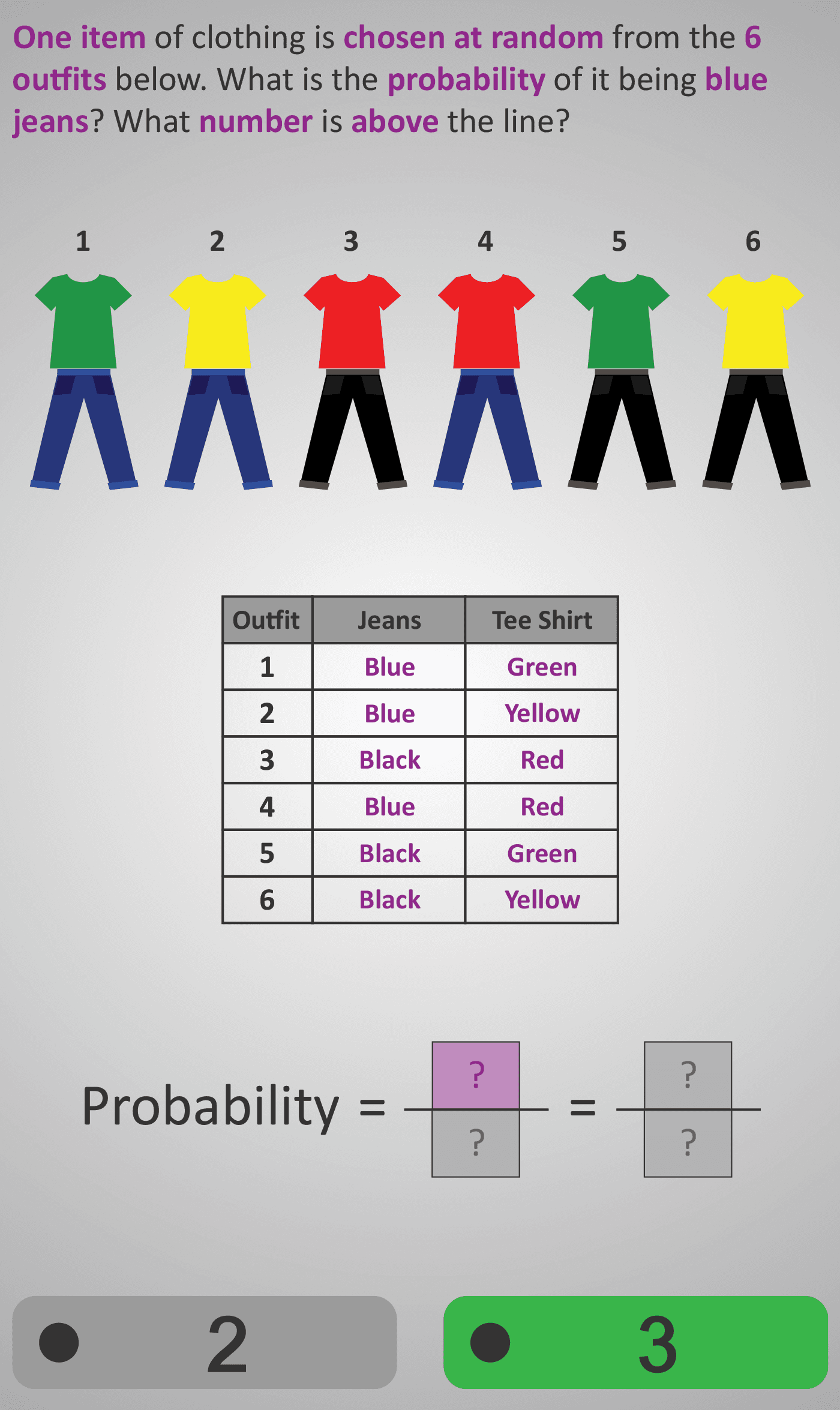
This Phlow combines probability and fraction simplification through a playful, real-world context. Learners view six illustrated outfits, each pairing jeans (blue or black) with T-shirts (green, yellow, or red). They calculate the probability of choosing certain items (e.g., “blue jeans”) and then simplify the resulting fractions to their lowest form.
The task explicitly separates numerator and denominator reasoning: learners first count favourable outcomes, then total outcomes, before simplifying the fraction using a shared factor. This strengthens understanding that simplification does not change the probability’s meaning — only how efficiently it’s represented.
Worked Example
Outfits (6 total):
Blue–Green, Blue–Red, Blue–Yellow,
Black–Green, Black–Red, Black–Yellow

Q: Probability of choosing Blue Jeans.
→ Favourable = 3
→ Total = 6
→ Fraction = 3 / 6
→ Simplified = 1 / 2
Step sequence:
- Count favourable outcomes (what you want).
- Count total outcomes (all possibilities).
- Write the fraction
favourable ÷ total. - Simplify to simplest form by dividing numerator and denominator.
Sample Prompts
- How many outfits include blue jeans?
- How many total outfits are shown?
- What goes above and below the line?
- Can this fraction be simplified further?
Why This Matters
Linking probability and fraction simplification
builds deep proportional reasoning.
Students see that 3/12 and 1/4 represent the same likelihood,
reinforcing equivalence across contexts.
It’s a vital bridge toward understanding probabilities as decimals and percentages.
Prerequisite Knowledge Required
- Know that probability = favourable ÷ total outcomes.
- Recognise equivalent fractions (e.g., 3/6 = 1/2).
- Be able to divide numerator and denominator by a common factor.
Linked Phlows:
Probability 4E – Probability from Frequency Data,
Fractions 3C & 3D – Simplifying Fractions.
Main Category
Probability & Fractions
Estimated Completion Time
Approx. 10–14 seconds per question.
40 questions total → Total time: 7–10 minutes.
Cognitive Load / Step Size
Moderate. Two operations — finding probability and simplifying fractions — are handled sequentially. Clear visuals and repetition ensure learners master both without overload.
Language & Literacy Demand
Low to moderate. Simple, repetitive phrasing and key highlights (“simplest form”, “above”, “below”) reduce reading load. Mathematical vocabulary is embedded contextually, supporting cross-topic understanding.
Clarity & Design
- Bright outfit visuals make the task concrete and engaging.
- Colours are consistent between text and images (e.g., jeans vs. T-shirts).
- Two-column layout: visuals above, table below for quick reference.
- Fraction at bottom anchors reasoning and simplification step.
Curriculum Alignment (ROI Junior Cycle Mathematics)
- Strand: Data and Chance
- Learning Outcomes: Express probabilities as fractions and simplify them; recognise equivalent probabilities; use visual and tabular data to reason about likelihood; connect simplification with proportional reasoning.
Engagement & Motivation
The clothing context feels fresh and relatable. Students experience an “aha” moment when simplifying correctly — turning an abstract operation into a clear, visual result.
Error Opportunities & Misconceptions
- Forgetting to simplify the fraction.
- Dividing only one number by the factor.
- Miscounting favourable outcomes (colour confusion).
- Reversing numerator and denominator.
Transferability / Real-World Anchoring
Strong. The reasoning applies to any context involving fractions, ratios, or scaling — from data representation to percentages and fair comparisons.
Conceptual vs Procedural Balance
Balanced with conceptual depth. The procedure (simplify) is anchored in the concept that equivalent fractions represent the same probability, connecting visual, numerical, and contextual reasoning.
Learning Objectives Addressed
- Form and simplify probability fractions.
- Identify numerator and denominator meaningfully in context.
- Recognise equivalent probabilities through simplification.
- Strengthen proportional reasoning across probability and fractions.
What Your Score Says About You
- Less than 20: You can identify fractions but need more work on simplification and structure.
- 21–29: You form correct probabilities but sometimes simplify inconsistently.
- 31–39: You find and simplify fractions accurately with clear reasoning.
- 40 / 40: Excellent — you fully grasp equivalent fractions and simplified probabilities, ready for decimals and percentages.