
QMARK by 100 4
Overview
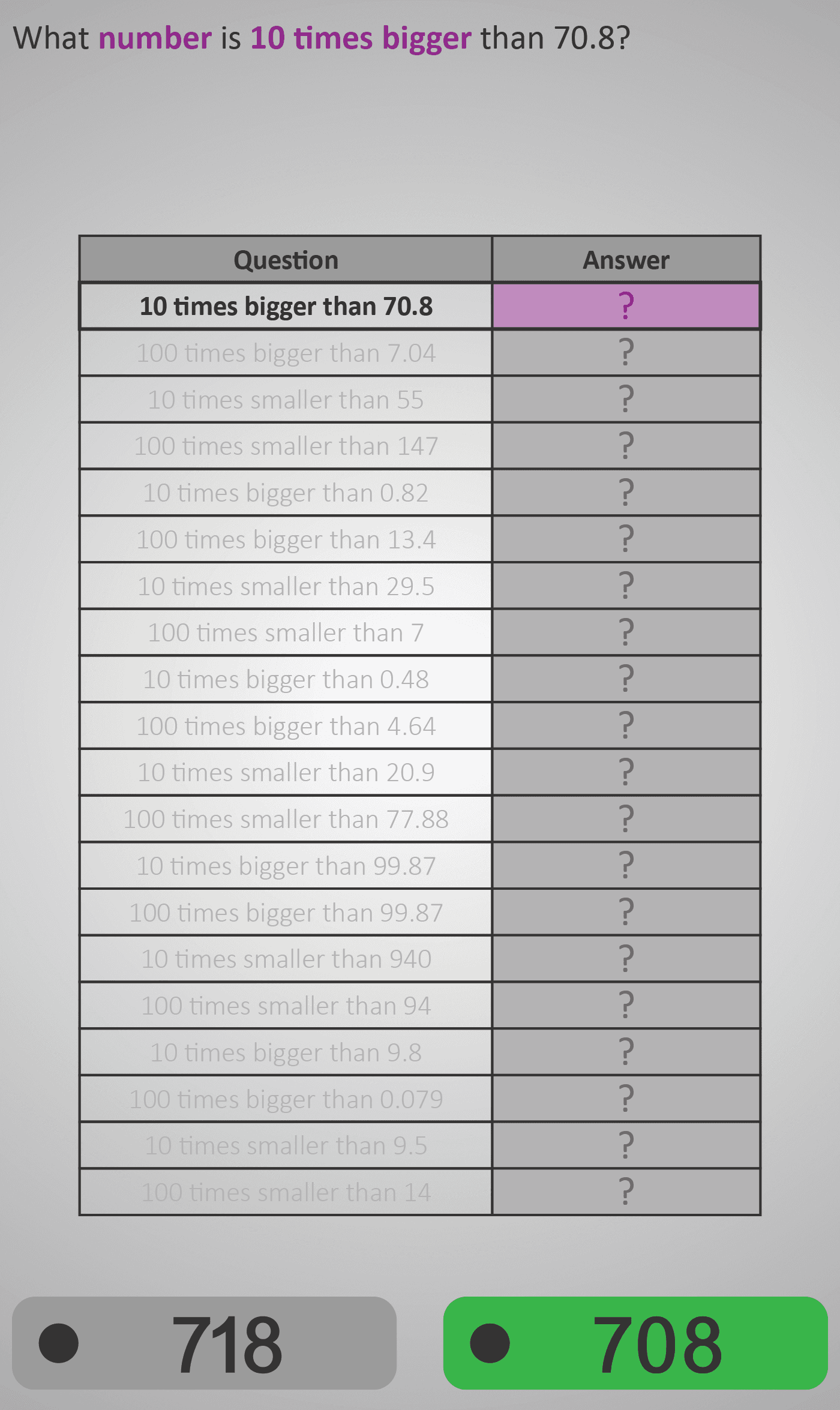
In this Phlow, learners strengthen their understanding of multiplicative scaling — how numbers increase or decrease by factors of ten and a hundred. Through a two-column table format, students complete missing entries such as:
- 10 times bigger than 70.8 → 708
- 100 times smaller than 147 → 1.47
- 10 times smaller than 55 → 5.5
The alternating structure between “times bigger” and “times smaller” challenges learners to flexibly switch between multiplication and division by 10 or 100. Visual cues and consistent rhythm build confidence in understanding place-value shifts rather than memorised “add or remove zeros” rules.
Worked Example
10 times bigger than 3.4 → 34
100 times smaller than 250 → 2.5
10 times smaller than 7.2 → 0.72
Step sequence:
- Read whether the question says bigger or smaller.
- Identify the correct operation: ×10, ÷10, ×100, or ÷100.
- Move digits left or right accordingly.
- Write the new number carefully, maintaining decimal placement.
Sample Prompts
- What number is 100 times bigger than 0.34?
- What number is 10 times smaller than 90?
- How do the digits move when multiplying by 10?
- Why does dividing by 100 make the number smaller?
Why This Matters
Fluency with powers of ten is a foundation for all later numeracy — from metric conversions to percentages and scientific notation. By mastering these patterns visually, students internalise the structure of the base-ten system and develop intuitive control over decimals and scaling.
Prerequisite Knowledge Required
- Understand place value (ones, tenths, hundredths).
- Know how to multiply and divide by 10 and 100.
- Be comfortable reading and writing decimal numbers.
Linked Phlows:
Multiply by 10 – QMARK by 10 (3A),
Divide by 10 – QMARK by 10 (3B),
Understanding Decimal Place Value – 2C.
Main Category
Arithmetic – Number Operations & Place Value
Estimated Completion Time
Approx. 10–14 seconds per question.
40 questions total → Total time: 7–10 minutes.
Cognitive Load / Step Size
Small and predictable. Each new question changes only one factor — operation type or number form — keeping challenge steady and reinforcing automaticity. Alternating between × and ÷ prevents overreliance on repetition.
Language & Literacy Demand
Low. Questions follow a consistent pattern: “What number is … times bigger/smaller than …?” Repetition and visual highlighting reduce reading demand, keeping focus on number movement rather than text decoding.
Clarity & Design
- Clean two-column table with minimal text and strong visual order.
- Purple-highlighted active cell focuses attention.
- Green feedback signals success and reinforces confidence.
- Simple typography and neutral background prevent distraction.
Curriculum Alignment (ROI Junior Cycle Mathematics)
- Strand: Number
- Learning Outcomes: Recognise and apply multiplication and division by 10 and 100; understand how digits move within place value when scaling by powers of ten; convert between whole-number and decimal representations.
Engagement & Motivation
Learners experience quick wins with each correct answer. The repetitive rhythm builds a sense of mastery and pattern recognition that encourages sustained focus without overcomplication.
Error Opportunities & Misconceptions
- Confusing “times bigger” with adding a zero.
- Moving the decimal in the wrong direction.
- Using subtraction instead of division when making a number smaller.
- Ignoring zeros in decimal shifts (e.g., 0.82 × 10 = 8.2).
Transferability / Real-World Anchoring
Moderate. Skills directly support metric conversions, money calculations, data scaling, and interpreting calculator results — key for science and everyday numeracy.
Conceptual vs Procedural Balance
Mainly procedural with light conceptual reinforcement. Learners practise repeated place-value shifts, contrasting × and ÷ to strengthen understanding of proportional scaling and directionality.
Learning Objectives Addressed
- Multiply and divide numbers by 10 and 100 accurately.
- Predict and explain digit movement within the place-value system.
- Distinguish between increasing and decreasing scale factors.
- Apply rules to both whole numbers and decimals confidently.
What Your Score Says About You
- Less than 20: You may still confuse direction or decimal movement.
- 21–29: You recognise the pattern but need more consistency under time pressure.
- 31–39: You show strong fluency and accuracy with both × and ÷ scaling.
- 40 / 40: Excellent — you’ve fully mastered place-value shifts by 10 and 100.