
Sets 4
Overview
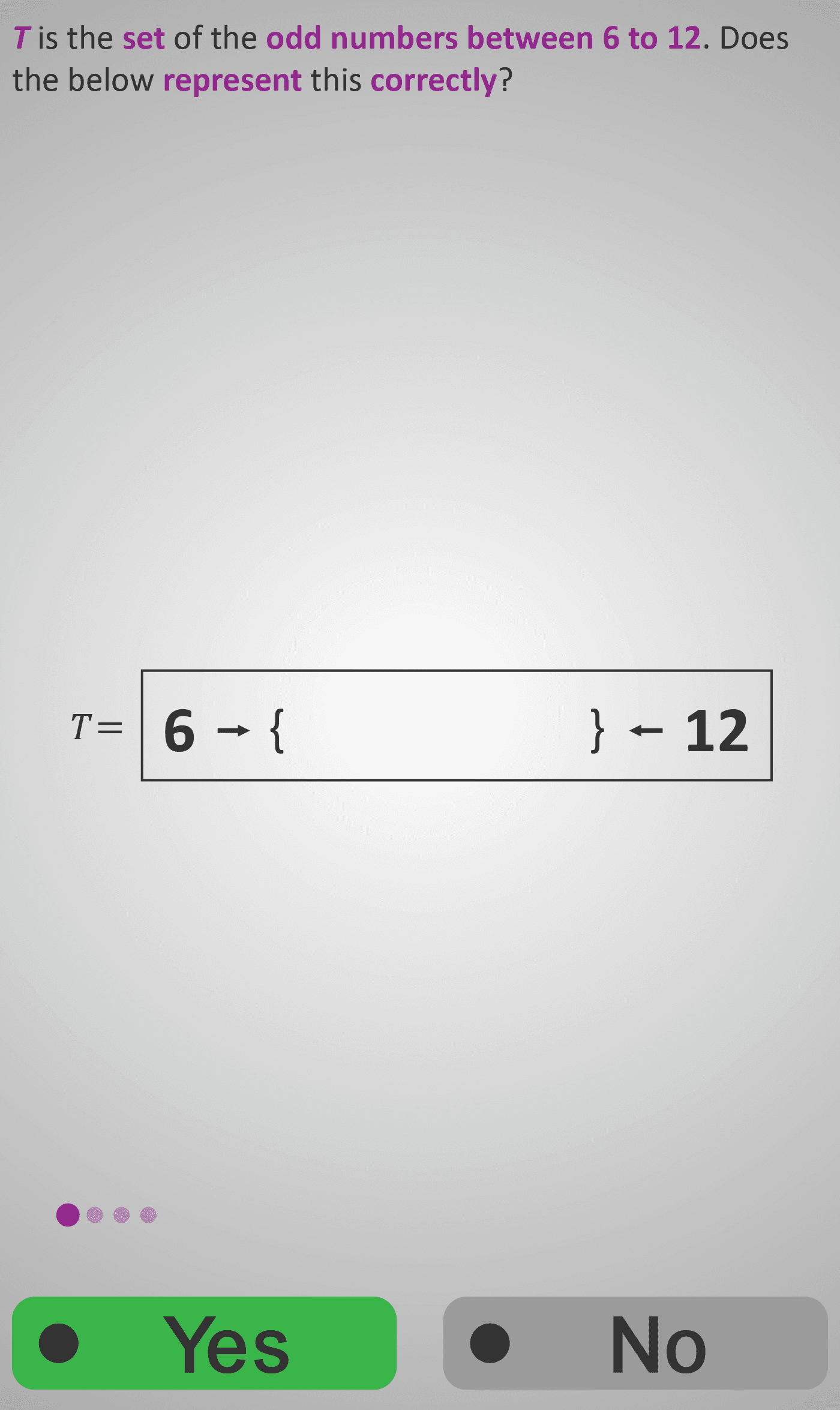
This Phlow introduces students to constructing sets from a rule rather than from a given list. Learners identify the odd numbers between 6 and 12, revealing each element one at a time:
- First odd number greater than 6 → 7
- Next odd number → 9
- Last odd number before 12 → 11
- Final set: T = {7, 9, 11}
The visual layout of curly braces and placeholders helps students focus on set structure, while step-by-step reasoning builds logical fluency. The concept of “between” is emphasised visually and verbally, reinforcing that endpoints are excluded.
Worked Example
Rule: T = { odd numbers between 6 and 12 }

Numbers between 6 and 12: 7, 8, 9, 10, 11
Odd numbers only: 7, 9, 11
Therefore, T = {7, 9, 11}
Step sequence:
- Read the rule carefully (“odd numbers between 6 and 12”).
- List all numbers between 6 and 12.
- Filter out the even ones.
- Write the result as a set in curly braces { }.
Sample Prompts
- What is the first odd number after 6?
- Which odd numbers come next?
- How do we write the complete set?
- Does “between” include 6 or 12?
Why This Matters
This Phlow lays the foundation for later algebraic and data reasoning. Understanding how sets are defined by rules supports learning in probability, number patterns, and logic. Students gain precision in using mathematical language and symbols — a crucial transition to abstract reasoning.
Prerequisite Knowledge Required
- Recognise odd and even numbers.
- Understand number order and how to list values between limits.
- Be familiar with curly-brace set notation { }.
Linked Phlows:
Odd & Even 3A – Identify Odd Numbers,
Number Sequences 3B – Numbers Between Two Values,
Set Notation 3A – Introduction to Sets.
Main Category
Algebraic Foundations – Sets and Number Properties
Estimated Completion Time
Approx. 10–14 seconds per question.
40 questions total → Total time: 7–10 minutes.
Cognitive Load / Step Size
Small and structured. Each screen reveals only one element or rule at a time, keeping focus and reducing overload. Predictable progression supports schema formation and retention.
Language & Literacy Demand
Moderate. Short, repeated phrasing with visual reinforcement of key academic terms — set, element, smallest, between. Visual cues support understanding even for weaker readers.
Clarity & Design
- Number line or boxed range visually anchors “between”.
- Curly braces in purple emphasise set structure.
- Stepwise animation reveals each element in order.
- Clean layout ensures focus on reasoning, not decoration.
Curriculum Alignment (ROI Junior Cycle Mathematics)
- Strand: Algebra / Data – Sets
- Learning Outcomes: Identify and describe sets using rules; recognise members of a set; use correct notation for finite sets; apply logical reasoning in defining membership.
Engagement & Motivation
The step-by-step reveal feels like solving a small puzzle — learners experience satisfaction as each missing number is discovered and the complete set takes shape.
Error Opportunities & Misconceptions
- Including endpoints (6 or 12) by misreading “between”.
- Choosing even numbers instead of odd.
- Incorrect ordering of numbers.
- Omitting or misusing curly braces.
Transferability / Real-World Anchoring
Moderate. While sets are abstract, filtering by conditions mirrors real-world logic — such as sorting data, classifying categories, or defining rules in code or probability.
Conceptual vs Procedural Balance
Conceptually focused. Students understand what defines membership and practise expressing that understanding symbolically. Procedural fluency with notation develops naturally through repetition.
Learning Objectives Addressed
- Define sets by a written rule and identify their elements.
- Distinguish odd and even numbers within a range.
- Use set notation accurately with curly braces.
- Apply logical reasoning to inclusion/exclusion conditions.
What Your Score Says About You
- Less than 20: You may confuse “between” with “including” or mix up odd/even numbers.
- 21–29: You identify most odd numbers but sometimes miss order or notation accuracy.
- 31–39: You consistently apply rules and structure sets correctly.
- 40 / 40: Excellent — you can construct and interpret sets fluently from written rules.