
Shade in Shape 4
Overview
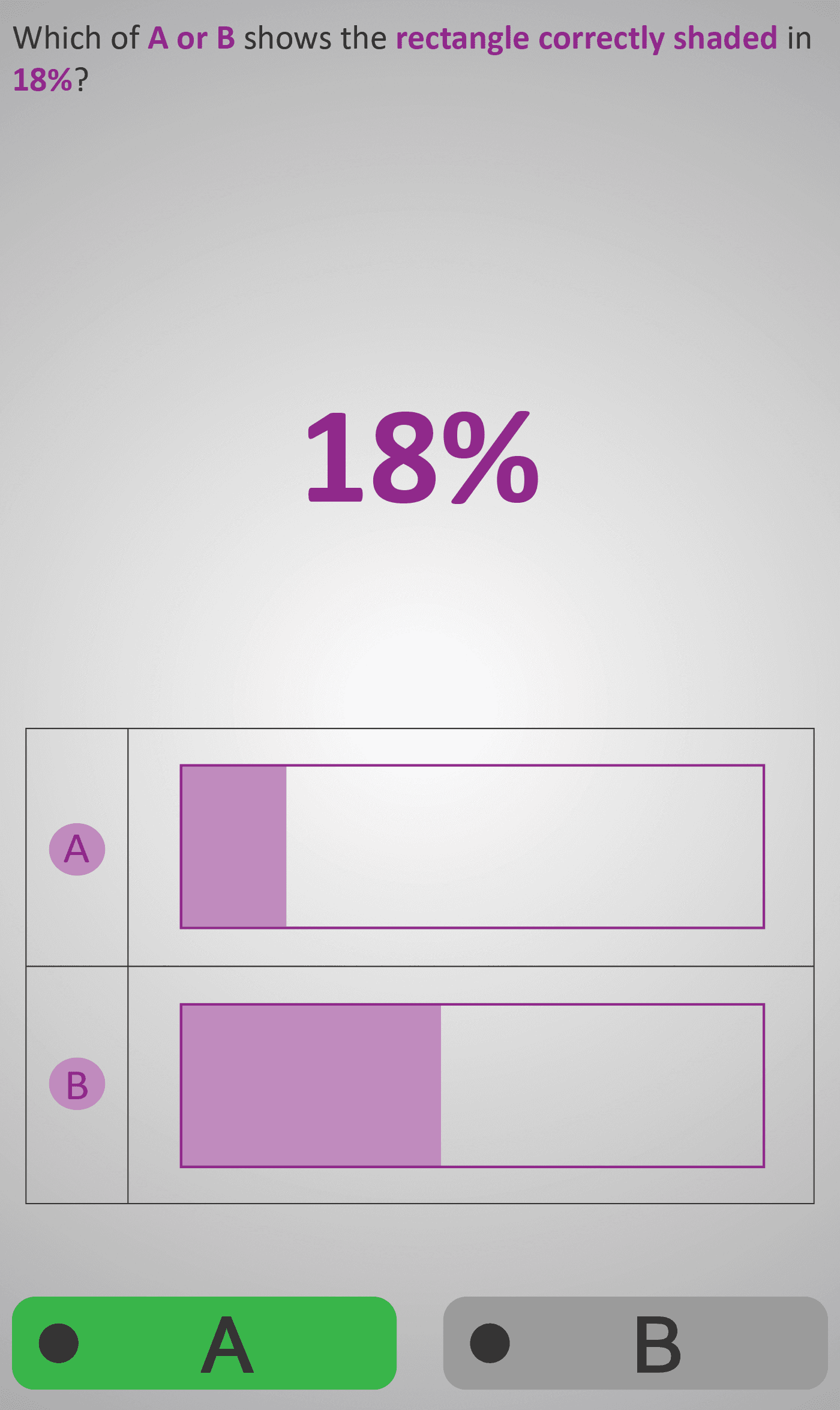
This Phlow helps students connect fractions, decimals, and percentages through visual reasoning. Each screen shows two bar models (A and B) and a numerical value such as 0.75, 1/3, or 55%. Students choose which shaded rectangle correctly represents that amount.
By alternating between number formats, learners discover that these are different ways of describing the same concept — a part–whole relationship. The sequence develops flexible understanding without requiring symbolic conversion.
Worked Example
0.75 = 3/4 = 75%

0.4 = 2/5 = 40%

If the rectangle is divided into four equal parts and three are shaded,
it represents both 0.75 and 75%.
Step sequence:
- Read the given number (fraction, decimal, or percentage).
- Estimate how much of the bar should be shaded.
- Compare the two diagrams and choose the correct one.
- Recognise equivalent values across formats through repetition.
Sample Prompts
- Which rectangle shows 0.4 shaded?
- Which represents 3/5 correctly?
- Which is 55% shaded?
- Are these the same amount written differently?
Why This Matters
Understanding how fractions, decimals, and percentages link together is foundational for data interpretation, probability, and proportional reasoning. This Phlow helps learners visualise equivalence before formal conversion methods are introduced, strengthening conceptual number sense.
Prerequisite Knowledge Required
- Understand that fractions, decimals, and percentages represent parts of a whole.
- Recognise simple equivalents (½ = 0.5 = 50%).
- Read and interpret shaded shapes or bar models.
Linked Phlows:
Fractions 3B – Shade a Fraction of a Shape,
Decimals 3A – Tenths and Hundredths on a Bar,
Percentages 3A – Shade a Percentage.
Main Category
Number – Fractions, Decimals, and Percentages
Estimated Completion Time
Approx. 10–14 seconds per question.
40 questions total → Total time: 7–10 minutes.
Cognitive Load / Step Size
Small to moderate. Each screen isolates one proportional comparison. Alternating between formats (decimal, fraction, percentage) adds variety while reinforcing the shared concept of part–whole reasoning.
Language & Literacy Demand
Low. Questions use simple phrasing and minimal text. The visual models carry the main meaning, making the task accessible to all learners regardless of reading level.
Clarity & Design
- Two aligned rectangles (A/B) for immediate visual comparison.
- Purple shading against a neutral background enhances focus.
- Large, central numeric target ensures single-point attention.
- Minimalist layout keeps working memory on concept, not visuals.
Curriculum Alignment (ROI Junior Cycle Mathematics)
- Strand: Number – Fractions, Decimals & Percentages
- Learning Outcomes: Recognise and represent fractions, decimals, and percentages visually; identify equivalent values across these forms; interpret parts of a whole using proportional models.
Engagement & Motivation
Highly engaging and intuitive. Each question is a short visual puzzle that rewards logical and proportional reasoning. Alternating between forms keeps curiosity and focus high.
Error Opportunities & Misconceptions
- Confusing ⅓ with 0.3 instead of 0.33.
- Misjudging shaded proportions visually.
- Believing decimals and percentages measure different types of quantity.
- Choosing answers by symbol familiarity instead of proportional reasoning.
Transferability / Real-World Anchoring
Strong. Students apply this reasoning when interpreting data charts, progress bars, and everyday percentages in digital or real contexts (e.g., downloads, battery life, sales, experiments).
Conceptual vs Procedural Balance
Conceptually focused. No calculation is needed — the challenge is understanding proportional equivalence and recognising shared meaning across formats.
Learning Objectives Addressed
- Recognise fractions, decimals, and percentages as equivalent representations.
- Estimate proportions visually with accuracy.
- Understand number magnitude between 0 and 1.
- Relate numeric forms to visual part–whole models.
What Your Score Says About You
- Less than 20: You may still rely on symbols rather than true part–whole understanding.
- 21–29: You recognise some equivalences but may confuse certain formats visually.
- 31–39: You confidently interpret visual proportions and most equivalences.
- 40 / 40: Excellent — you have full conceptual fluency across fractions, decimals, and percentages.