
Sin Cos Tan 4B
Overview
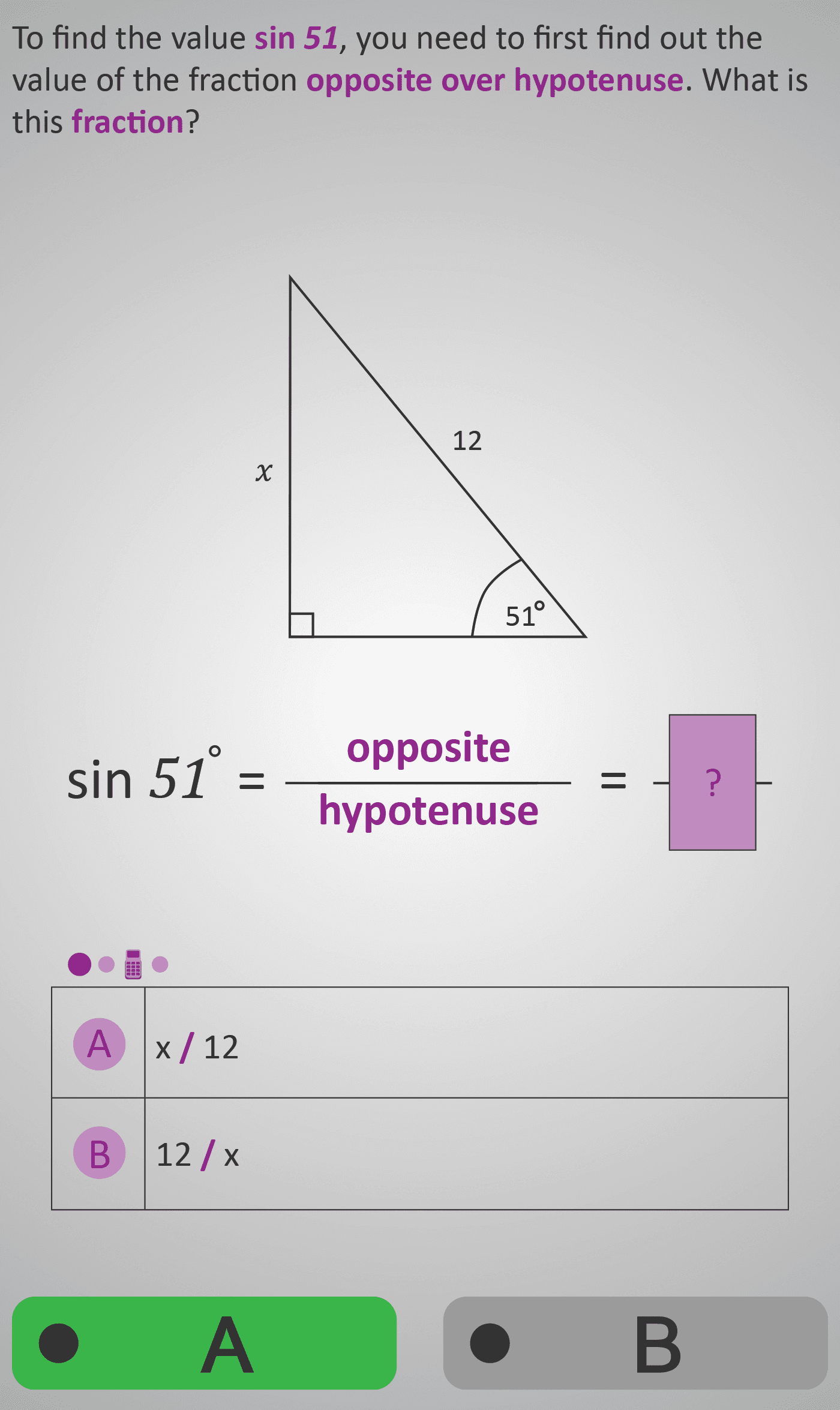
This Phlow teaches students how to calculate the sine ratio for a given angle in a right-angled triangle. Using a triangle with a hypotenuse of 12 m and an opposite side labelled x, learners recall that sin θ = opposite ÷ hypotenuse and apply it to find sin(51°) with a calculator.
Each question builds in clear micro-steps: identifying the correct sides, forming the fraction, calculating sin(51°), and rounding the result to two decimal places. The process reveals both what sine means and how to find it accurately using digital tools.
Worked Example
Given:
θ = 51°
Opposite = x
Hypotenuse = 12 m

sin θ = opposite ÷ hypotenuse
sin(51°) = x ÷ 12

Calculator:
sin(51°) = 0.77714596…
≈ 0.78
Step Sequence
- Identify the opposite and hypotenuse sides relative to θ.
- Substitute into sin θ = opposite ÷ hypotenuse.
- Use the calculator to find sin(51°).
- Round the result to two decimal places.
Sample Prompts
- Which side is the hypotenuse?
- Which is the opposite side?
- What fraction represents sin θ?
- What is sin(51°) rounded to two decimal places?
Why This Matters
The sine ratio links angles directly to side lengths — a core idea in trigonometry. Learning how to calculate sin(θ) builds fluency for later problem-solving in geometry, physics, and real-world measurements.
Prerequisite Knowledge Required
- Recognise opposite and hypotenuse sides in right-angled triangles.
- Understand that sin, cos, and tan relate angles to side ratios.
- Use a calculator for trigonometric functions and rounding.
- Know that angles are measured in degrees.
Linked Phlows:
Sin Cos Tan 4A – Finding an Angle Using Tangent,
Triangles 3 – Recognising Sides,
Ratios 3B–3C – Understanding Proportion.
Main Category
Geometry & Trigonometry
Estimated Completion Time
Approx. 10–14 seconds per question.
40 questions total → Total time: 7–10 minutes.
Cognitive Load / Step Size
Moderate and consistent. Each step introduces one focused action — identify, substitute, calculate, or round — maintaining clarity and supporting steady skill development.
Language & Literacy Demand
Low–medium. Mathematical terms (sine, opposite, hypotenuse, degree) are colour-coded and paired with visuals. The text is short, direct, and supported by clear numerical examples.
Clarity & Design
- Large, labelled triangle highlights key sides and angles.
- Purple ratio fraction mirrors the sin formula.
- Calculator graphic models correct input syntax for sin(θ).
- Sequential highlighting reinforces reasoning at each step.
Curriculum Alignment (ROI Junior Cycle Mathematics)
- Strand: Geometry & Trigonometry
- Learning Outcomes: Apply trigonometric ratios to find unknown sides and angles; use calculators for trigonometric evaluations; round results accurately to specified decimal places.
Engagement & Motivation
Seeing trigonometric ratios appear on-screen through calculator interaction provides a strong sense of discovery and understanding. The realistic visual cues (triangles, measurements) make it tangible and motivating.
Error Opportunities & Misconceptions
- Reversing the ratio (12/x instead of x/12).
- Entering sin(51) incorrectly or omitting degree mode.
- Rounding errors (0.77 vs 0.78).
- Confusing sine with division (thinking sin(51) = 51 ÷ 12).
Transferability / Real-World Anchoring
Highly transferable. This understanding supports applications in navigation, architecture, design, and surveying — wherever measuring angles or slopes is needed.
Conceptual vs Procedural Balance
Strong balance. Learners understand that sine represents a ratio (conceptual) and practise calculating it accurately (procedural). Recognising why sin(θ) is less than 1 deepens comprehension.
Learning Objectives Addressed
- Identify opposite and hypotenuse sides in right-angled triangles.
- Form the sine ratio correctly as sin θ = opposite ÷ hypotenuse.
- Use a calculator to evaluate sin(θ).
- Round to appropriate decimal places accurately.
What Your Score Says About You
- Less than 20: You may confuse sides or calculator input.
- 21–29: You understand the concept but need more rounding and accuracy practice.
- 31–39: You apply sine confidently and calculate precisely.
- 40 / 40: Excellent — you’ve mastered evaluating sine values and interpreting them correctly.