
Small–Large 4
Overview
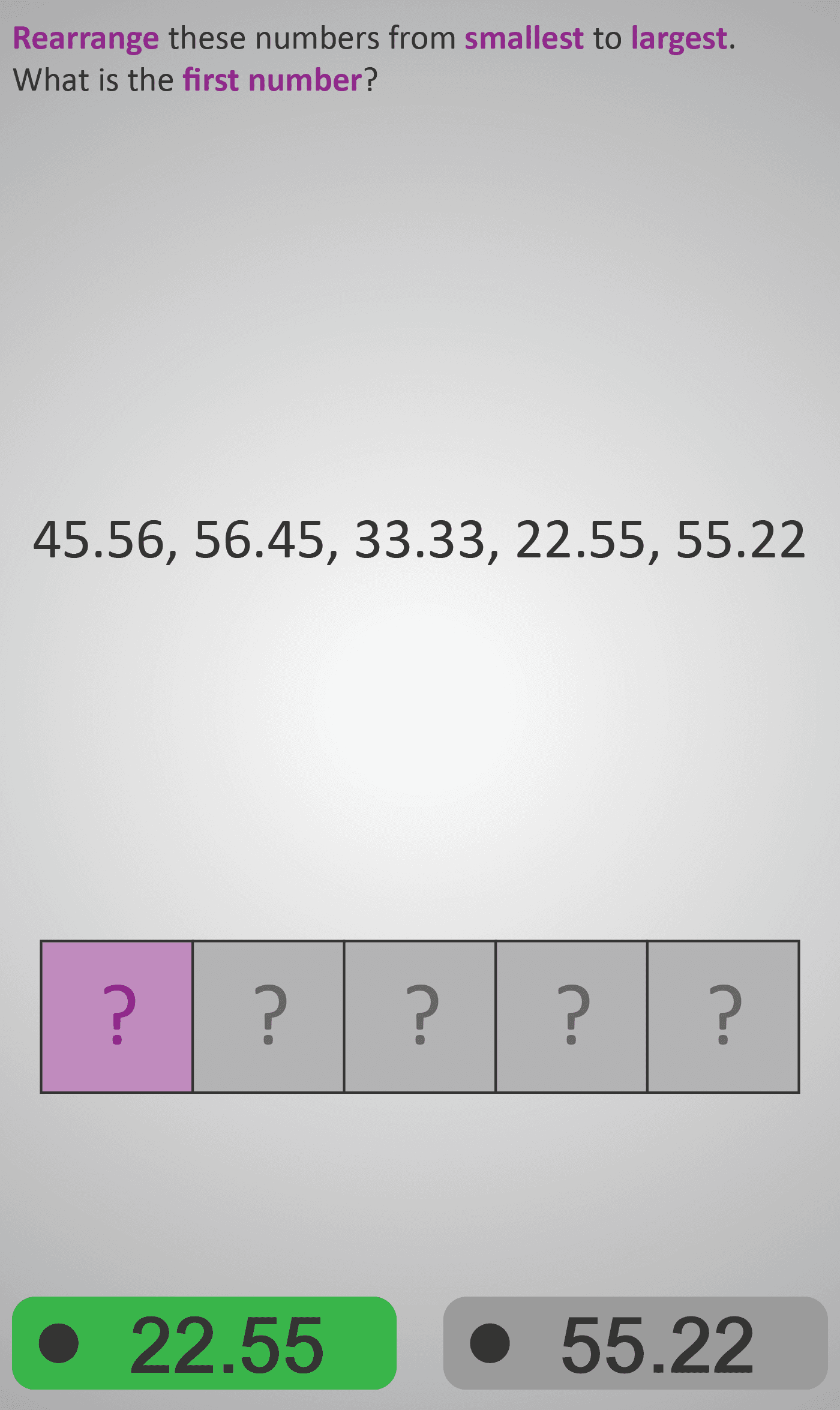
This Phlow develops learners’ ability to compare and arrange decimal numbers accurately. Students are presented with a list of decimals — for example: 45.56, 56.45, 33.33, 22.55, 55.22 — and must order them from smallest to largest. Each question focuses on identifying the next value in the sequence, encouraging reasoning about decimal place value at each stage.
The progressive reveal structure (one number at a time) guides learners through comparison thinking step-by-step. Visual boxes fill as the order is completed, reinforcing understanding of how tens, ones, tenths, and hundredths determine size.
Worked Example
Given numbers:
45.56, 56.45, 33.33, 22.55, 55.22

Ordered from smallest to largest:
22.55 → 33.33 → 45.56 → 55.22 → 56.45
Step Sequence
- Compare numbers by their whole-number parts first (tens, ones).
- If equal, compare the tenths digits, then the hundredths.
- Place the smallest value first and continue comparing the remaining numbers.
- Confirm the full ordered sequence visually.
Sample Prompts
- Which number is the smallest?
- What comes next in order?
- Which number is the largest?
- How do the tenths and hundredths compare?
Why This Matters
Understanding decimal order is fundamental to interpreting real-world quantities — from prices and measurements to statistics. This skill supports confidence in reading and comparing numerical information accurately.
Prerequisite Knowledge Required
- Understand place value including tenths and hundredths.
- Compare decimals using digits and their numeric value.
- Read decimals aloud accurately (e.g., “fifty-five point two-two”).
Linked Phlows:
Decimals 3A – Reading and Writing Decimals,
Number Line 3 – Positioning Values,
Place Value 3B – Comparing Digits.
Main Category
Number & Arithmetic
Estimated Completion Time
Approx. 10–14 seconds per question.
40 questions total → Total time: 7–10 minutes.
Cognitive Load / Step Size
Low to moderate. The sequential structure focuses attention on one comparison at a time, reducing working-memory demand. Repetition across similar sets builds fluency without monotony.
Language & Literacy Demand
Low. Instructions are short (“What is the next number?”) and consistent. Key terms such as smallest, largest, and rearrange are colour-coded to guide understanding and minimise reading strain.
Clarity & Design
- Five-box layout visually represents the ordered sequence.
- Purple highlights indicate the current comparison focus.
- Numbers use consistent two-decimal formatting for easy alignment.
- Minimalist design keeps all attention on numerical reasoning.
Curriculum Alignment (ROI Junior Cycle Mathematics)
- Strand: Number
- Learning Outcome: Order and compare positive numbers, including decimals, and position them on the number line.
Engagement & Motivation
The incremental reveal format creates momentum — each correct answer builds visible progress. The simplicity and instant feedback keep the learner engaged without distraction.
Error Opportunities & Misconceptions
- Comparing digits rather than place value (e.g., thinking 56.45 < 55.22).
- Ignoring tenths/hundredths when numbers are close.
- Misinterpreting 33.33 as greater than 45.56 due to repeating digits.
Transferability / Real-World Anchoring
Strong. Decimal ordering applies directly to money, distances, measurements, and data ranking — foundational skills in both numeracy and daily decision-making.
Conceptual vs Procedural Balance
Balanced. The activity reinforces conceptual understanding of decimal place value while providing repeated procedural practice in ordering and comparison.
Learning Objectives Addressed
- Compare and order decimal numbers with up to two decimal places.
- Recognise how place value determines numerical order.
- Sequence mixed decimals accurately from smallest to largest.
- Develop fluency in reading and comparing decimals.
What Your Score Says About You
- Less than 20: You may confuse decimal places — review tenths and hundredths.
- 21–29: You understand ordering but may misread close values.
- 31–39: Strong accuracy with occasional slips under time pressure.
- 40 / 40: Excellent — you can confidently order any set of decimal values.