
Stem Leaf 4
Overview
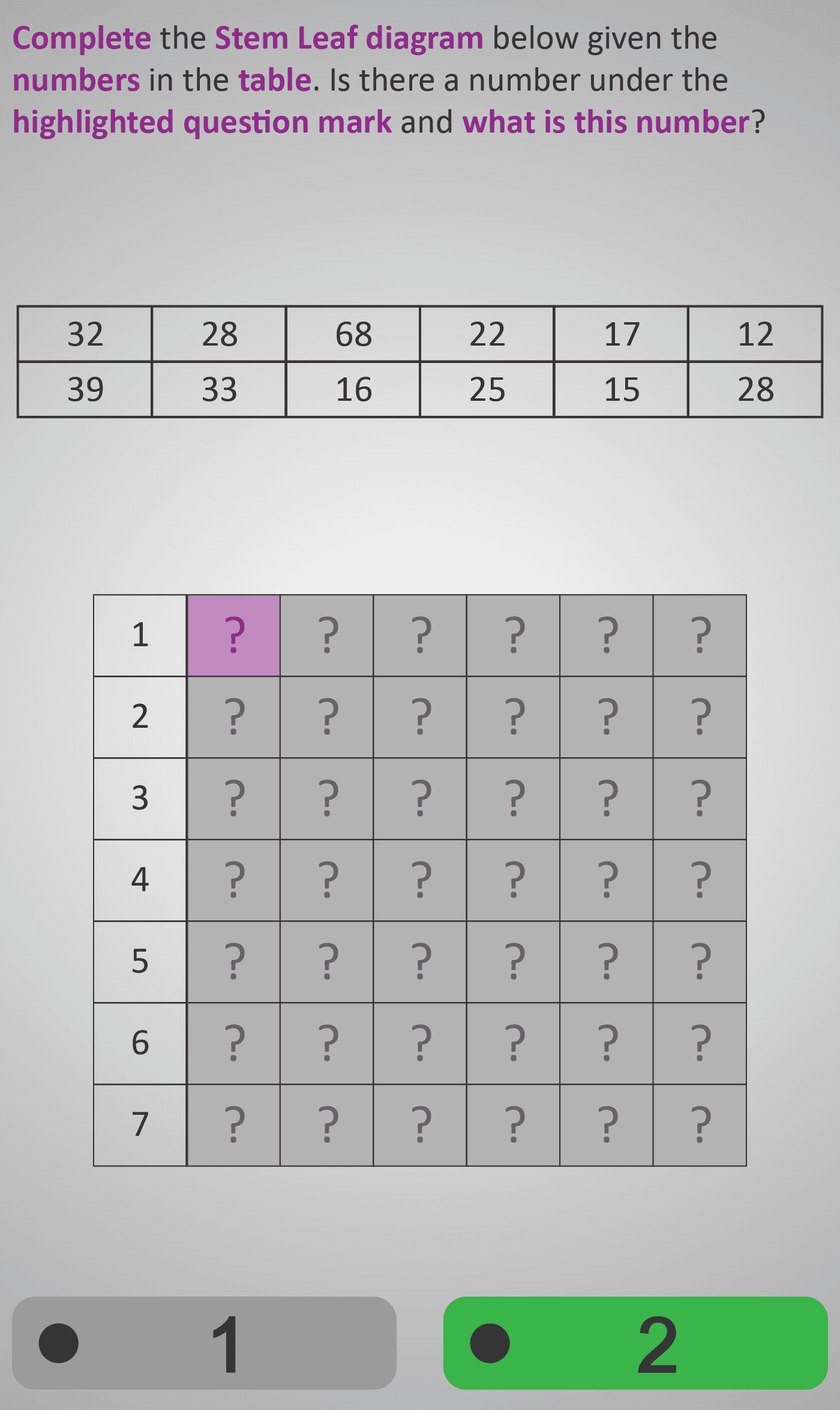
This Phlow guides students through constructing a stem-and-leaf diagram step-by-step from raw two-digit data. Learners determine where each number fits — first identifying its stem (tens digit) and then its leaf (units digit).
Each question introduces one decision at a time: whether a new number belongs under a given stem and, if so, which digit should be placed as its leaf. As the activity progresses, the full diagram forms, revealing the data’s structure and spread.
Worked Example
Dataset: 14, 16, 21, 25, 25, 28, 32

Step 1: Stem 1 → leaves 4, 6
Step 2: Stem 2 → leaves 1, 5, 5, 8
Step 3: Stem 3 → leaf 2

Final Diagram:
Stem | Leaf
  1  | 4 6
  2  | 1 5 5 8
  3  | 2
Step Sequence
- Recognise the tens digit as the stem.
- Identify the units digit as the leaf.
- Place each number under the correct stem.
- Ensure leaves are ordered correctly along each row.
- Interpret the final diagram to see patterns or clusters.
Sample Prompts
- Which stem does 25 belong under?
- What is the leaf for 34?
- Are there any empty stems?
- Which stem has the most leaves?
Why This Matters
Building a stem-and-leaf diagram helps learners visualise how data is distributed while retaining each individual value. It strengthens understanding of place value and prepares students for future work with frequency tables and histograms.
Prerequisite Knowledge Required
- Understanding of tens and units place value.
- Ability to order two-digit numbers in ascending order.
- Familiarity with interpreting a completed stem-and-leaf plot.
Linked Phlows:
Stem Leaf 3A – Reading a Completed Diagram,
Place Value 3B – Tens and Units,
Ordering Numbers 3C – Arranging Numbers.
Main Category
Data & Statistics
Estimated Completion Time
Approx. 10–14 seconds per question.
40 questions total → Total time: 7–10 minutes.
Cognitive Load / Step Size
Low to moderate. Each step isolates one decision (selecting stem or leaf) to prevent overload. Learners internalise the structure of the diagram gradually through micro-progression.
Language & Literacy Demand
Low. Instructions are concise and visual. Coloured highlights and table positioning communicate meaning clearly without heavy text reading.
Clarity & Design
- Clean grid layout with clear stems and leaves.
- Purple highlights indicate the current decision focus.
- Visual hierarchy ensures attention aligns with the relevant data point.
- All visuals serve instructional purpose — no decoration.
Curriculum Alignment (ROI Junior Cycle Mathematics)
- Strand: Data
- Learning Outcome: Represent, interpret, and analyse data using graphical methods, including stem-and-leaf plots, recognising patterns and distributions.
Engagement & Motivation
The progressive reveal of the diagram feels puzzle-like, offering immediate visual reward as each stem fills. This interactivity keeps students engaged while reinforcing systematic thinking.
Error Opportunities & Misconceptions
- Mixing up tens and units (e.g., placing 25 under stem 5).
- Duplicating or skipping numbers with shared stems.
- Assuming empty stems indicate no data rather than pending placement.
Transferability / Real-World Anchoring
High. Skills transfer directly to summarising test results, scores, and surveys. It builds a conceptual bridge to frequency tables and data visualisation used in practical contexts.
Conceptual vs Procedural Balance
Conceptual focus. Learners actively understand why data is grouped by tens and how stems and leaves reveal patterns, not just how to fill the diagram.
Learning Objectives Addressed
- Construct a stem-and-leaf diagram from raw data.
- Identify stems (tens) and leaves (units) accurately.
- Recognise when no data fits under a given stem.
- Interpret distributions and frequencies visually.
What Your Score Says About You
- Less than 20: You may be confusing stems and leaves — revisit tens and units place value.
- 21–29: You understand stems but sometimes misplace leaves — practise careful observation.
- 31–39: You’re confident and accurate with minor placement slips.
- 40 / 40: Excellent — you can construct and interpret stem-and-leaf diagrams independently.