
Survey 4A
Overview
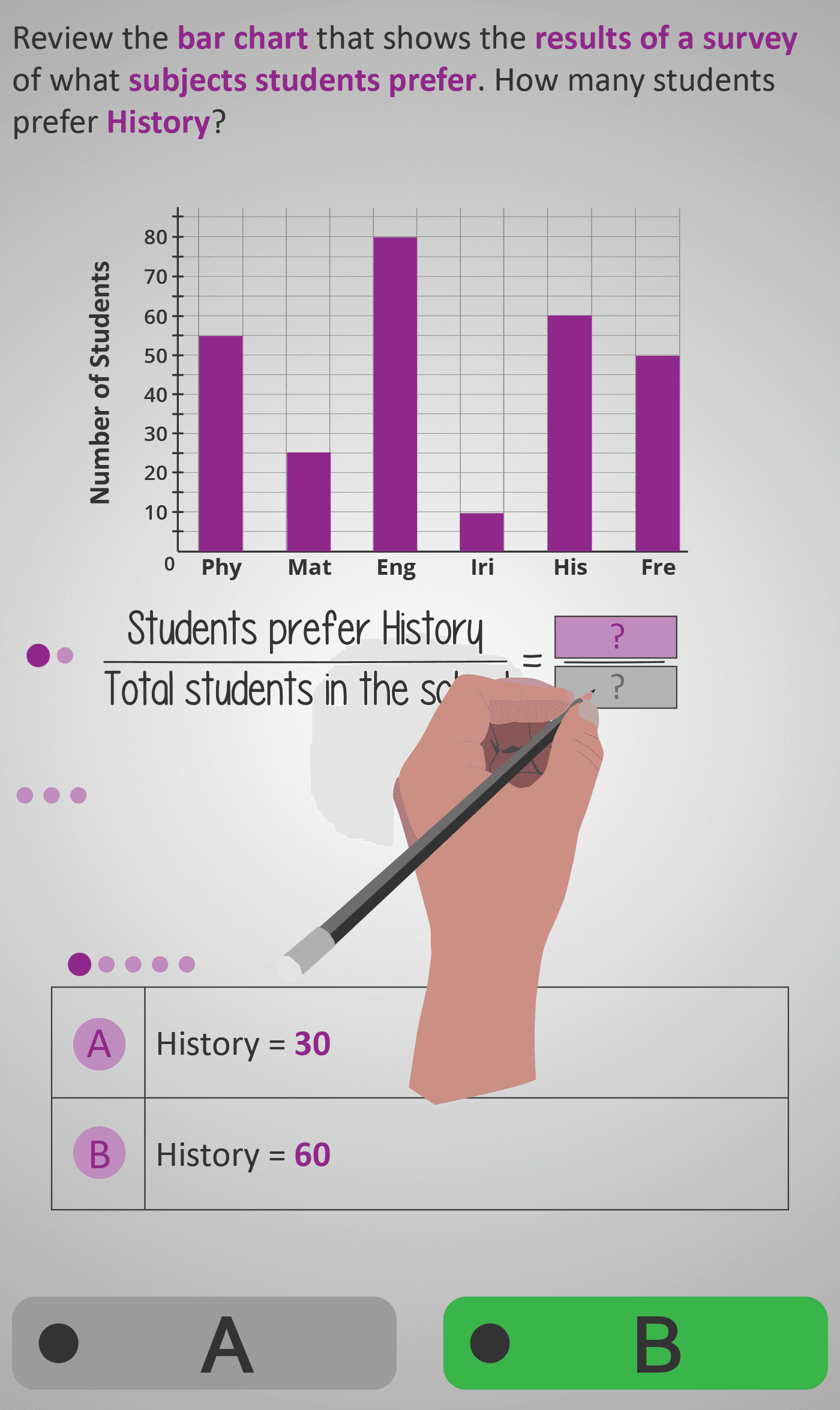
In this Phlow, students learn to move from visual data to mathematical representation. Using a bar chart showing student subject preferences, learners extract frequencies, calculate totals, and represent findings as fractions, ratios, and percentages.
For example, if 60 students out of 280 prefer History, the Phlow guides learners through:
• Forming a fraction: 60/280
• Simplifying it: 60/280 → 6/28 → 3/14
• Converting it to a percentage: (3 ÷ 14) × 100 ≈ 21%
The step-by-step design strengthens data interpretation, fractional reasoning, and percentage fluency. Visual scaffolds — such as the bar chart, fraction model, and calculator sequence — ensure learners connect each step conceptually and procedurally.
Worked Example
Subject Preferences (Bar Chart)
History = 60
Total Students = 280

Step 1: Write as a fraction → 60/280
Step 2: Simplify → 3/14
Step 3: Convert → (3 ÷ 14) × 100 = 21%
Step Sequence
- Read the bar chart to find the frequency for each subject.
- Calculate the total number surveyed.
- Write the fraction representing one category over the total.
- Simplify step-by-step, dividing top and bottom by common factors.
- Use a calculator to convert to a percentage and round the result.
Sample Prompts
- What is the frequency for History?
- What is the total number of students surveyed?
- How can we simplify 60/280?
- What percentage prefer History?
Why This Matters
This Phlow helps students understand how to transform real data into meaningful mathematical comparisons. It connects multiple representations — charts, fractions, ratios, and percentages — providing a foundation for statistics and proportional reasoning in everyday contexts.
Prerequisite Knowledge Required
- Understanding numerator and denominator relationships.
- Basic fraction simplification using common factors.
- Reading and interpreting bar charts.
- Using a calculator for percentage conversions.
Linked Phlows:
Survey 3A – Reading Simple Bar Charts,
Fractions 3B – Understanding Numerator/Denominator,
Simplifying Fractions 3C – Reducing Step-by-Step,
Percentages 3A – Fraction-to-Percentage Conversion.
Main Category
Data & Statistics
Estimated Completion Time
Approx. 10–14 seconds per question.
40 questions total → Total time: 7–10 minutes.
Cognitive Load / Step Size
Moderate but well-sequenced. Each step builds naturally from the previous one — reading, fraction formation, simplification, and conversion — creating cumulative understanding without overload. Visual consistency keeps attention focused on one transformation at a time.
Language & Literacy Demand
Low to moderate. Instructions use short sentences with key terms (simplify, total, percentage) highlighted. Charts and fraction visuals reduce dependence on text, making it accessible to a wide range of learners.
Clarity & Design
- Bar chart provides intuitive, real-world context.
- Step-by-step handwriting animations reinforce understanding.
- Purple highlighting directs focus to current operation (simplify, divide, convert).
- Every design element supports comprehension — no decorative clutter.
Curriculum Alignment (ROI Junior Cycle Mathematics)
- Strands: Data & Number
- Learning Outcomes: Represent and interpret data using charts and graphs, and compare fractions, ratios, and percentages to solve proportional problems.
Engagement & Motivation
The familiar school-subject context keeps students engaged. The satisfaction of reducing fractions and converting them accurately gives visible progress and a sense of mastery.
Error Opportunities & Misconceptions
- Reading bar chart scales incorrectly (e.g., 60 vs. 50).
- Dividing only one part of the fraction during simplification.
- Swapping numerator and denominator.
- Inputting incorrect calculator steps when finding percentages.
Transferability / Real-World Anchoring
Strong. The reasoning applies directly to interpreting surveys, polls, sports stats, and performance comparisons — essential real-world data literacy skills.
Conceptual vs Procedural Balance
Balanced. The Phlow integrates conceptual understanding of proportions with procedural fluency in simplifying and converting numbers. Learners understand both why and how these representations connect.
Learning Objectives Addressed
- Interpret data from bar charts accurately.
- Represent results as fractions and simplify step-by-step.
- Convert fractions to percentages using a calculator.
- Link visual data to mathematical reasoning.
What Your Score Says About You
- Less than 20: You may be misreading bar heights or mixing up fraction parts — review carefully.
- 21–29: You can read charts and form fractions but need more practice simplifying evenly.
- 31–39: You’re fluent in simplifying and converting — only small rounding slips remain.
- 40 / 40: Excellent applied understanding — you can interpret data across charts, fractions, and percentages confidently.