
Survey 4D
Overview
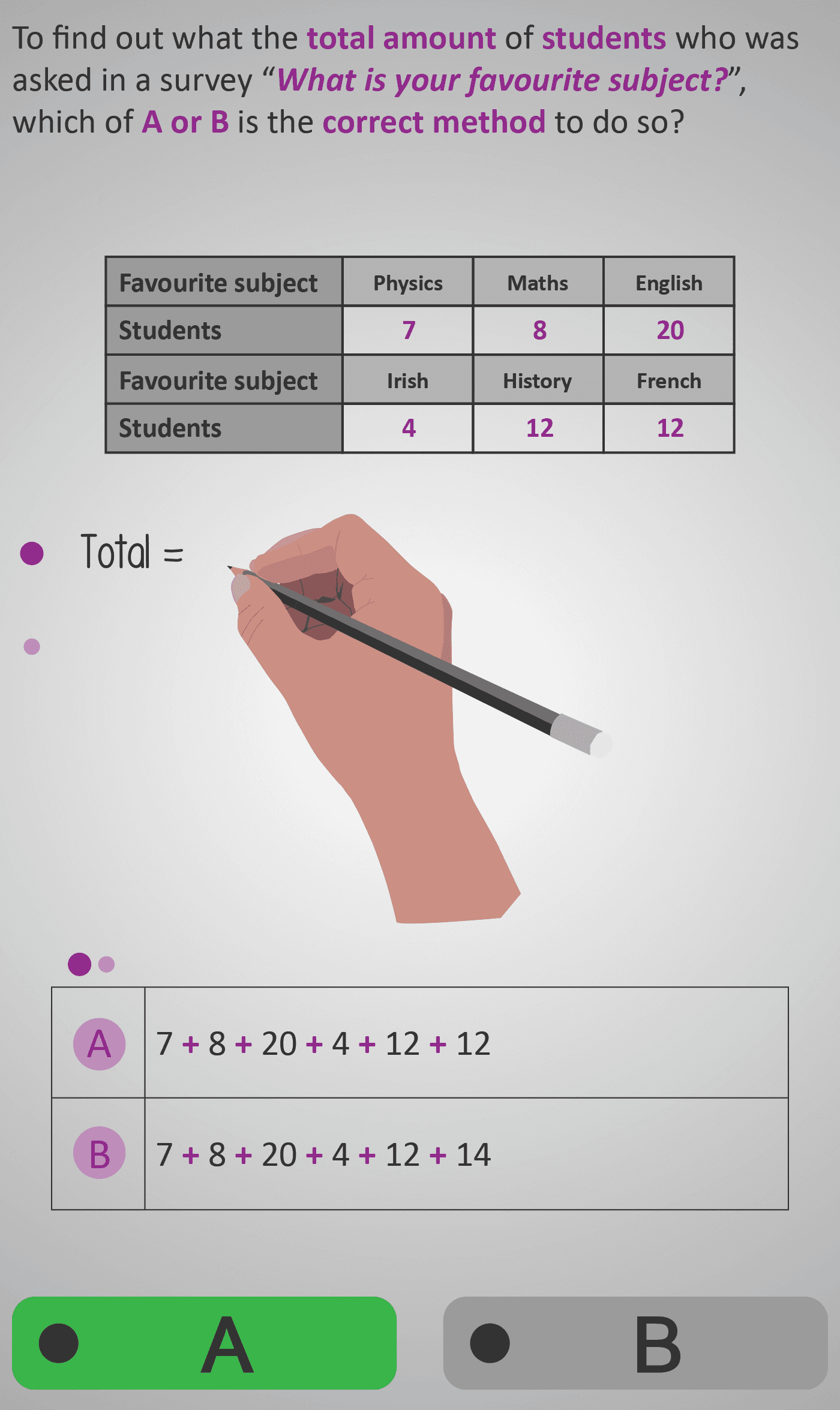
In this Phlow, students practise calculating totals from data tables using real-world examples such as ice cream sales, marbles owned, shapes drawn, and favourite subjects. Each scenario requires learners to identify which numbers to combine and then compute their total correctly.
The exercise reinforces two key skills:
• Conceptual understanding — knowing that totals represent the sum of all categories.
• Procedural fluency — performing accurate addition using mental strategies or a calculator.
Through step-by-step visuals, students move from recognising relevant data to executing the correct calculation. The gradual scaffolding ensures mastery of part–whole reasoning — a core foundation for later statistics and arithmetic problem-solving.
Worked Example
Table: Ice Cream Sales
Chocolate: 45
Vanilla: 60
Strawberry: 35
Mint: 40

Step 1: Identify all categories → 45 + 60 + 35 + 40
Step 2: Add together → 45 + 60 = 105; 105 + 35 = 140; 140 + 40 = 180
Step 3: Total = 180 ice creams sold
Step Sequence
- Read all category values in the table.
- Recognise which numbers belong in the total.
- Select the correct addition expression (A or B).
- Perform the addition mentally or on a calculator.
- Verify that every category is included in the total.
Sample Prompts
- What is the total number of marbles owned?
- Which addition statement is correct?
- How many shapes were drawn in total?
- Estimate first — does your total seem reasonable?
Why This Matters
Understanding how to calculate totals is fundamental to both mathematics and data handling. Whether counting sales, survey responses, or class scores, the concept of “sum of all parts” underpins all quantitative reasoning. This Phlow prepares learners to analyse, interpret, and check real-world data with confidence.
Prerequisite Knowledge Required
- Adding two or more numbers accurately.
- Reading data presented in simple tables.
- Recognising the meaning of “total” as the combined sum.
- Basic calculator skills for verification.
Linked Phlows:
Survey 3C – Summing Data from Tables,
Addition 3B – Adding Multiple Values,
Survey 4C – Interpreting Tables and Bar Charts,
Calculator Skills 3A – Confirming Answers Digitally.
Main Category
Data & Arithmetic
Estimated Completion Time
Approx. 10–14 seconds per question.
40 questions total → Total time: 7–10 minutes.
Cognitive Load / Step Size
Moderate. The sequence from identifying relevant numbers to calculating totals involves two connected reasoning steps. Context variation (marbles, ice creams, etc.) sustains engagement while maintaining consistent cognitive structure.
Language & Literacy Demand
Low to moderate. Sentences are concise and concrete. Real-world vocabulary (e.g., “shapes,” “marbles,” “ice creams”) aids comprehension and engagement. Key mathematical terms like “total” and “amount” are highlighted in purple to strengthen conceptual links.
Clarity & Design
- Tables are consistently formatted with aligned numbers and clear labels.
- Purple highlighting connects table entries to the total calculation.
- Handwriting-style overlays simulate the addition process visually.
- Clean, vertical layouts reduce distraction and support focus.
Curriculum Alignment (ROI Junior Cycle Mathematics)
- Strands: Data & Number
- Learning Outcomes: Represent and interpret data in tables, calculate totals and combined values across categories, and apply addition in real-world contexts.
Engagement & Motivation
Students enjoy relatable contexts and the tangible satisfaction of summing to find meaningful totals. The step-by-step handwriting visuals make arithmetic feel like active participation rather than static observation.
Error Opportunities & Misconceptions
- Forgetting to include one category in the total.
- Copying a number incorrectly from the table.
- Adding only one row or partial set of values.
- Choosing the wrong method before calculating.
Transferability / Real-World Anchoring
Excellent. The skill of summing categories is essential for understanding reports, surveys, and totals in everyday life — from budgeting to analysing sports or classroom data.
Conceptual vs Procedural Balance
Balanced. Students build conceptual understanding of part–whole relationships while practising the procedural accuracy of multi-number addition. This dual focus ensures deeper, transferable numeracy skills.
Learning Objectives Addressed
- Recognise totals as the sum of all data parts.
- Select and apply the correct addition expression.
- Perform multi-number addition accurately.
- Interpret totals meaningfully within real-world contexts.
What Your Score Says About You
- Less than 20: You may be missing one or more categories — double-check that every number is included.
- 21–29: You identify correct methods but sometimes make arithmetic slips — try grouping numbers for easier addition.
- 31–39: You show consistent accuracy and clear understanding — great progress.
- 40 / 40: You demonstrate full accuracy and comprehension — confident and ready for grouped data analysis.