
Survey 4E
Overview
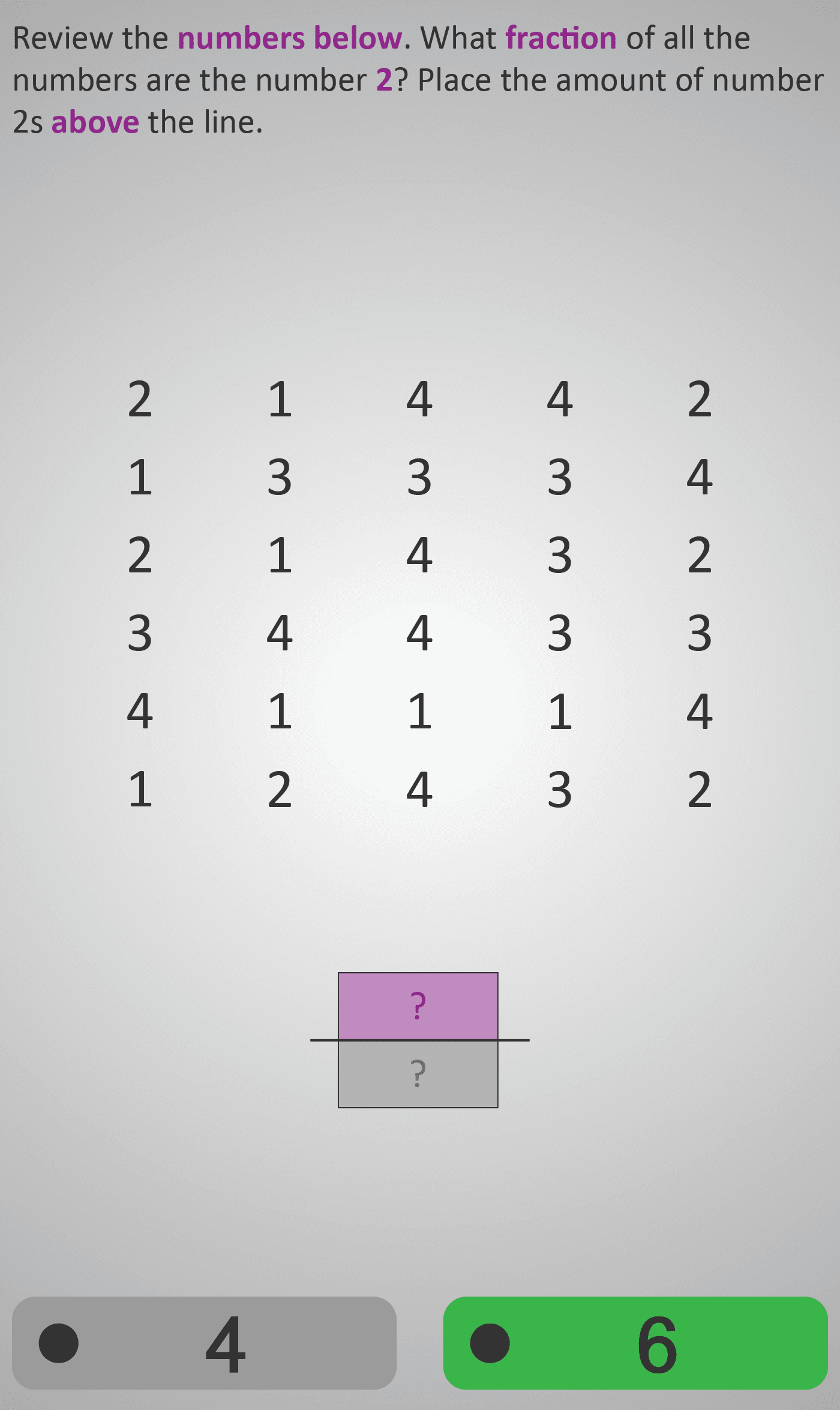
This Phlow introduces students to fractions as part–whole relationships through simple, visual counting tasks. Learners examine grids filled with numbers or letters, identify how many fit a given condition (e.g., “How many 2s?”), and express that count as a fraction of the total number of items.
Each screen focuses on one clear reasoning step — first counting the target items, then identifying the total in the grid, and finally forming the fraction part / whole. This structured repetition reinforces the conceptual meaning of fractions beyond memorising symbols.
Worked Example
Grid (Total 20 symbols):
2 5 2 7 2
3 2 1 2 4
4 2 3 2 5
2 6 2 8 2

Targets: "How many 2s?"
Count = 8 (part)
Total = 20 (whole)
Fraction = 8 / 20 = 2 / 5
Step Sequence
- Identify the target item (number or letter).
- Count how many times it appears in the grid.
- Find the total number of items in the grid.
- Write the fraction: part (numerator) over whole (denominator).
- Simplify if possible and interpret its meaning.
Sample Prompts
- How many 2s are in the grid?
- What fraction of the grid shows the letter Y?
- Which number appears most frequently?
- What fraction of the total is shaded/selected?
Why This Matters
Understanding fractions as “how many out of how many” provides the foundation for ratio, percentage, and probability. By connecting counting with symbolic representation, learners gain intuitive and transferable fraction sense that supports later reasoning across measurement, data, and algebra contexts.
Prerequisite Knowledge Required
- Counting and grouping objects accurately.
- Understanding numerator and denominator roles.
- Recognising the concept of total or whole in a dataset.
Linked Phlows:
Survey 4D – Totals and Part–Whole Relationships,
Fractions 3B – Understanding Numerators and Denominators,
Counting & Grouping 3A – Identifying Quantities.
Main Category
Data & Fractions
Estimated Completion Time
Approx. 10–14 seconds per question.
40 questions total → Total time: 7–10 minutes.
Cognitive Load / Step Size
Moderate. Each task isolates one clear cognitive action — counting, identifying total, forming a fraction. The consistent visual grid format keeps working memory load stable and supports confidence through predictability.
Language & Literacy Demand
Low. Instructions are short and repetitive, using familiar words like “count,” “total,” “above,” and “below.” Colour-coded highlights reinforce key terms and structures, supporting students with lower literacy or EAL backgrounds.
Clarity & Design
- Evenly spaced grid with clean typography for quick counting.
- Purple highlights focus attention on target symbols.
- Fraction boxes below the grid visually represent numerator and denominator positions.
- White background and ample spacing minimise distractions.
Curriculum Alignment (ROI Junior Cycle Mathematics)
- Strands: Number & Data
- Learning Outcome: Recognise and represent part–whole relationships as fractions; identify frequency and total to describe data in fractional form.
Engagement & Motivation
The counting-based design feels playful, like a visual puzzle. Alternating between letters and numbers maintains curiosity while reinforcing a single consistent mathematical idea.
Error Opportunities & Misconceptions
- Swapping numerator and denominator.
- Miscounting the total or missing items near grid edges.
- Forgetting that the horizontal line separates part from whole.
- Double-counting or skipping repeated items.
Transferability / Real-World Anchoring
High. Understanding “part of a total” underpins skills in surveys, probability, and data analysis — such as expressing “6 out of 30 students prefer blue.” This builds the bridge between raw data and fractional reasoning.
Conceptual vs Procedural Balance
Conceptually strong. Students go beyond counting to interpret meaning — why a fraction represents part–whole relationships. The procedure (count → write → check) reinforces this understanding visually and symbolically.
Learning Objectives Addressed
- Identify the part and whole in a set of items.
- Express subsets as fractions of the total.
- Distinguish numerator (part) and denominator (whole).
- Connect visual quantity with symbolic fraction notation.
What Your Score Says About You
- Less than 20: You may be miscounting or mixing up part and whole — take time to recount carefully.
- 21–29: You count correctly but occasionally reverse the fraction order — review numerator vs denominator.
- 31–39: You show strong accuracy and understanding of part–whole reasoning.
- 40 / 40: Excellent mastery — you can represent and interpret fractions confidently and precisely.