
Survey 4G
Overview
In this Phlow, students explore how distance–time graphs represent motion and rest in real-world situations. They are presented with various journeys — such as a car trip, sports competition, cliff walk, or race — and must match each graph to its correct written story.
Through this, learners build understanding of what slopes, flat lines, and downward gradients represent. They begin to see graphs as visual stories of movement over time, not just abstract lines.
Worked Example
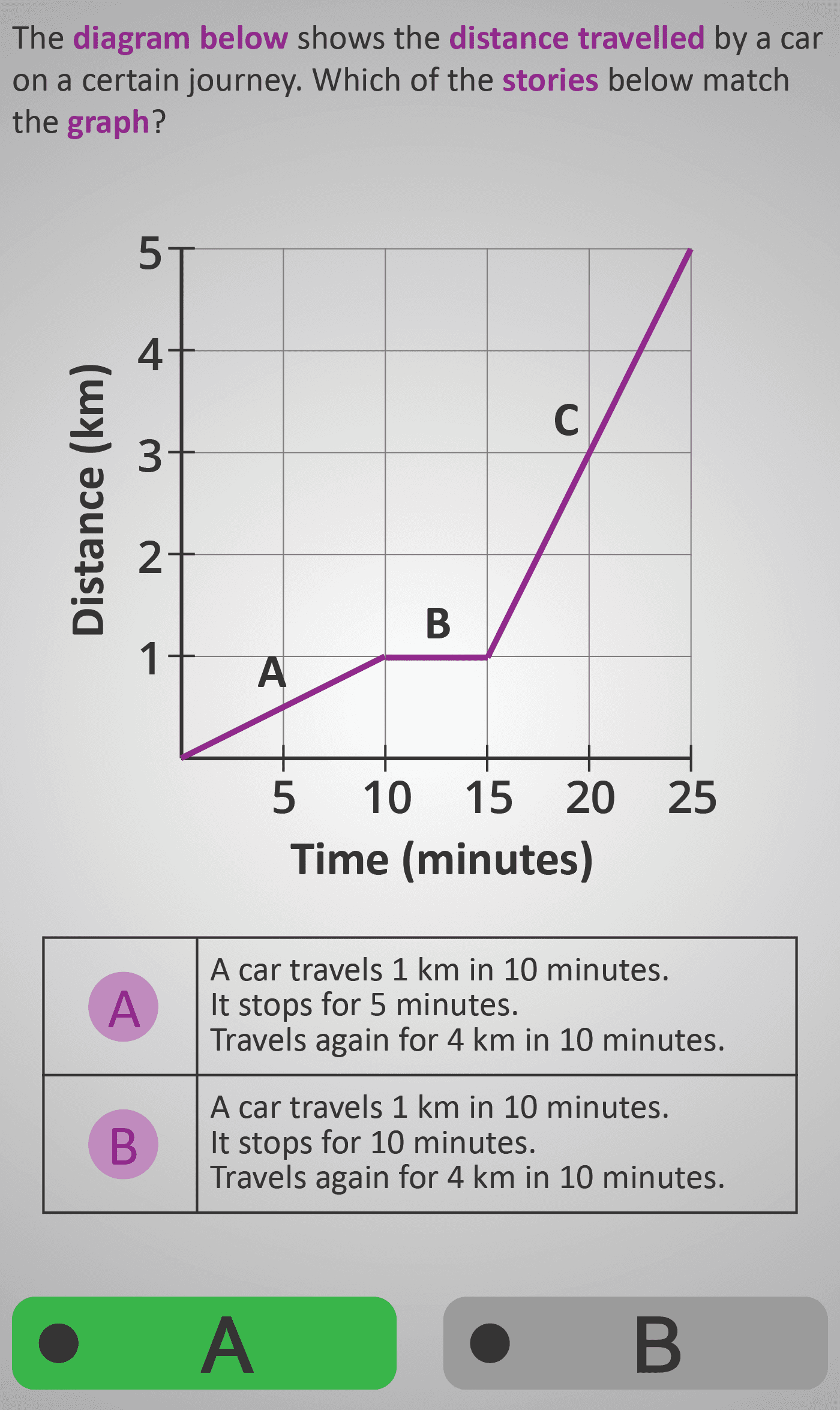
Scenario: Car Journey
The graph rises steeply (driving fast), flattens (stopped),
then rises again more steeply (accelerating).

Matching story:
"The car starts slowly, stops for a short break, and then drives faster."

Interpretation:
• Steep line → fast motion
• Flat line → rest or no movement
• Change in slope → change in speed
Step Sequence
- Read the graph axes and labels (time, distance).
- Observe slope patterns — flat, steady, or steep.
- Identify key events (start, stop, change in speed).
- Match the corresponding written story to the graph.
- Explain how the slope shows the type of motion.
Sample Prompts
- Which story best fits this graph?
- What does the flat section represent?
- During which part was the object moving fastest?
- What does the downward slope mean in this context?
Why This Matters
Interpreting distance–time graphs helps students visualise relationships between motion and time. This builds conceptual readiness for later topics in algebra, physics, and data interpretation. Understanding how slope links to rate of change deepens comprehension beyond procedural graph reading.
Prerequisite Knowledge Required
- Reading basic line and bar graphs.
- Understanding that time increases horizontally and distance vertically.
- Recognising that slope steepness represents speed.
- Basic awareness of axes, labels, and units.
Linked Phlows:
Survey 4E – Fractions and Totals,
Survey 4F – Calculating the Mean from Data.
Main Category
Data & Graphs / Interpreting Line Graphs
Estimated Completion Time
Approx. 10–14 seconds per question.
40 questions total → Total time: 7–10 minutes.
Cognitive Load / Step Size
Moderate. Each question focuses on a single interpretation concept — rest, motion, faster/slower movement, or descent. Students integrate narrative and graphical data, developing higher-order reasoning about change and sequence.
Language & Literacy Demand
Low to moderate. Text uses familiar verbs such as “travels,” “rests,” “runs,” or “climbs.” Sentences are short and supported by visual cues. Some comparative phrasing (“faster than,” “after resting”) may require teacher clarification.
Clarity & Design
- Coordinate grids are clean and labelled with clear scales.
- Coloured lines highlight changes in slope or direction.
- Flat segments (rest) and steep segments (fast motion) are visually distinct.
- Two-choice A/B layout below each graph keeps focus on interpretation.
Curriculum Alignment (ROI Junior Cycle Mathematics)
- Strands: Data & Algebra (Functions)
- Learning Outcomes: Interpret and relate line graphs to real contexts, recognise constant and variable rates of change, and describe trends represented graphically.
Engagement & Motivation
Students connect mathematical graphs to real-life experiences — driving, sports, or climbing — making abstract data meaningful. The story-matching approach feels interactive, encouraging reasoning and discussion rather than memorisation.
Error Opportunities & Misconceptions
- Confusing flat sections (no movement) with zero distance.
- Thinking steeper lines always mean longer distance instead of higher speed.
- Interpreting downward slopes as “going backwards” instead of descending.
- Overlooking time duration when comparing motion periods.
Transferability / Real-World Anchoring
High. These skills apply directly in science, geography, and PE — wherever graphs represent change over time, such as speed, temperature, or elevation data.
Conceptual vs Procedural Balance
Conceptual emphasis. Students interpret and reason from graph shapes rather than perform calculations, deepening understanding of rate, rest, and motion.
Learning Objectives Addressed
- Interpret and describe distance–time graphs.
- Connect narrative descriptions to visual data.
- Identify rest and motion using slope and flat segments.
- Explain how gradient changes represent changing speed.
What Your Score Says About You
- Less than 20: You can read axes but struggle to match stories to motion correctly.
- 21–29: You understand shape meanings but sometimes mismatch timing details.
- 31–39: You show strong interpretation of graph events and motion patterns.
- 40 / 40: Excellent understanding — you interpret slope changes confidently and explain motion clearly.