
Survey 4H
Overview
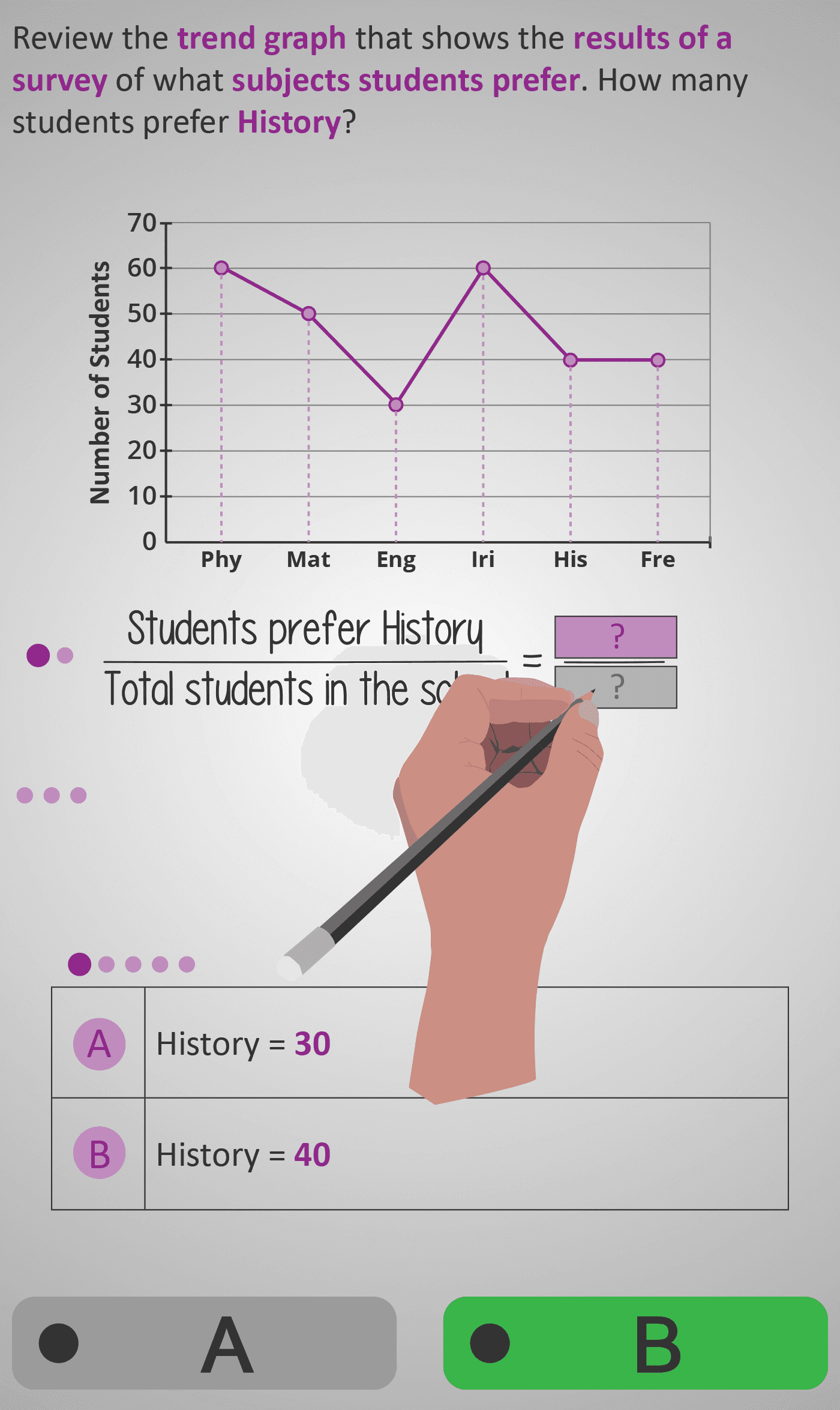
This Phlow combines graph interpretation with fraction and percentage conversion. Students read values from a line graph that shows how many students prefer each subject (Physics, Maths, English, Irish, History, French), then transform this data into mathematical representations step by step.
Each screen focuses on a single operation — reading the graph, finding totals, forming a fraction, simplifying it, and finally converting to a percentage. The visual progression helps learners connect real-world data to proportional reasoning.
Worked Example
Subjects: Physics 60, Maths 50, English 30, Irish 60, History 40, French 40
Total = 280 students

Step 1: History = 40 students
Step 2: Fraction = 40 / 280
Step 3: Simplify → 4 / 28 → 1 / 7
Step 4: Convert to % → 1 ÷ 7 ≈ 14%

Interpretation:
≈ 14% of students prefer History.
Step Sequence
- Read the data value for the target subject from the line graph.
- Find the total number of students surveyed.
- Form a fraction: part (subject) ÷ whole (total).
- Simplify the fraction step-by-step.
- Convert the simplified fraction into a percentage.
Sample Prompts
- How many students preferred History?
- What fraction of the total is this?
- Can the fraction be simplified further?
- What is this value as a percentage?
Why This Matters
This Phlow connects data representation to proportional thinking — showing how visual information becomes numerical insight. It prepares students for interpreting surveys, charts, and reports in real-life settings by developing fluency in reading, simplifying, and converting between representations.
Prerequisite Knowledge Required
- Understanding of numerators, denominators, and equivalent fractions.
- Reading data from simple bar or line graphs.
- Basic awareness of how to convert fractions to percentages.
Linked Phlows:
Survey 4F – Calculating Totals and Fractions,
Survey 4G – Interpreting Line Graphs,
Fraction 4B – Simplifying Fractions,
Percent 4A – Fraction to Percentage Conversion.
Main Category
Data & Fractions / Percentages
Estimated Completion Time
Approx. 10–14 seconds per question.
40 questions total → Total time: 7–10 minutes.
Cognitive Load / Step Size
Moderate. Each new question introduces one additional operation — from visual recognition to numerical manipulation — maintaining a steady cognitive rhythm. The clear sequence supports understanding across multiple representations (graph → fraction → percent).
Language & Literacy Demand
Low to moderate. Key mathematical terms (“total,” “simplified,” “percentage”) are colour-coded and paired with numerical examples. Sentences are short and instructional, keeping focus on data reasoning rather than heavy text.
Clarity & Design
- Line graph uses consistent colour schemes across screens.
- Step-by-step highlights show where to look (data point, total, fraction, simplified form).
- Handwriting-style annotations show how to simplify and convert visually.
- Fraction alignment maintains vertical clarity between part and whole.
Curriculum Alignment (ROI Junior Cycle Mathematics)
- Strands: Data, Number, and Proportional Reasoning
- Learning Outcomes: Interpret and analyse graphical data; represent proportions as fractions and percentages; simplify and convert between equivalent forms.
Engagement & Motivation
The subject preference context feels familiar and personally relevant. Students experience satisfaction when simplifying to neat fractions and clean percentages, reinforcing intrinsic motivation through pattern discovery.
Error Opportunities & Misconceptions
- Misreading graph values (e.g., confusing 30 with 40).
- Incorrectly adding totals or omitting a category.
- Simplifying only once instead of fully reducing.
- Converting 1/7 to the wrong percentage (e.g., 17% instead of 14%).
Transferability / Real-World Anchoring
High. Students apply these skills to everyday contexts — surveys, statistics, sports, or polls. The task connects mathematical analysis with how data is presented in reports and media.
Conceptual vs Procedural Balance
Balanced. Students practise step-by-step fraction simplification and conversion while maintaining a strong conceptual link to the meaning of proportions and totals.
Learning Objectives Addressed
- Read and interpret data from line graphs.
- Form fractions to represent parts of a total.
- Simplify fractions through common factors.
- Convert simplified fractions to percentages accurately.
What Your Score Says About You
- Less than 20: You can read graphs but struggle to connect data to fractions or totals.
- 21–29: You can form fractions but may simplify or convert inaccurately — review your steps carefully.
- 31–39: You show strong understanding of how fractions and percentages relate — excellent progress.
- 40 / 40: Full mastery — you think like a data analyst, accurately linking graphical and numerical reasoning.